Kirjojen hintavertailu. Mukana 11 717 486 kirjaa ja 12 kauppaa.

Kirjahaku

Etsi kirjoja tekijän nimen, kirjan nimen tai ISBN:n perusteella.

2 kirjaa tekijältä C. A. Brebbia

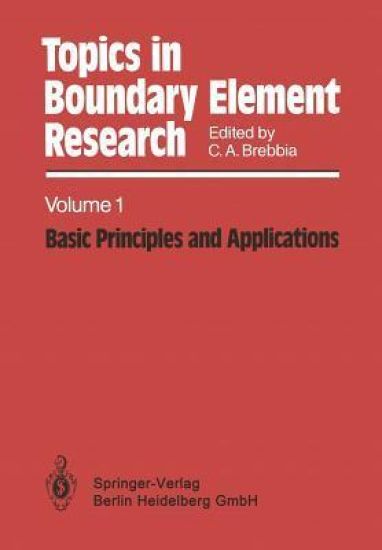
Topics in Boundary Element Research

Topics in Boundary Element Research

C. A. Brebbia

Springer-Verlag New York Inc.
1984
nidottu
As the Boundary Element Method develops into a tool of engineering analysis more effort is dedicated to studying new applications and solving different problems. This book contains chapters on the basic principles of the technique, time dependent problems, fluid mechanics, hydraulics, geomechanics and plate bending. The number of non-linear and time dependent problems which have become amenable to solution using boundary elements have induced many researchers to investigate in depth the basis of the method. Chapter 0 of this book presents an ap­ proach based on weighted residual and error approximations, which permits easy construction of the governing boundary integral equations. Chapter I reviews the theoretical aspects of integral equation formulations with emphasis in their mathematical aspects. The analysis of time dependent problems is presented in Chap. 2 which describes the time and space dependent integral formulation of heat conduction problems and then proposes a numerical procedure and time marching algorithm. Chapter 3 reviews the application of boundary elements for fracture mechanics analysis in the presence of thermal stresses. The chapter presents numerical results and the considerations on numerical accuracy are of interest to analysts as well as practising engineers.
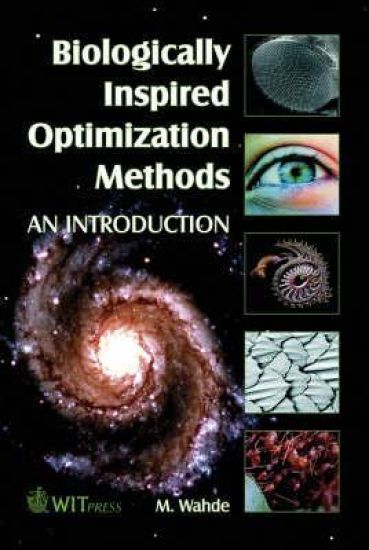
Biologically Inspired Optimization Methods
The advent of rapid, reliable and cheap computing power over the last decades has transformed many, if not most, fields of science and engineering. The multidisciplinary field of optimization is no exception. First of all, with fast computers, researchers and engineers can apply classical optimization methods to problems of larger and larger size. In addition, however, researchers have developed a host of new optimization algorithms that operate in a rather different way than the classical ones, and that allow practitioners to attack optimization problems where the classical methods are either not applicable or simply too costly (in terms of time and other resources) to apply. This book is intended as a course book for introductory courses in stochastic optimization algorithms (in this book, the terms optimization method and optimization algorithm will be used interchangeably), and it has grown from a set of lectures notes used in courses, taught by the author, at the international master programme Complex Adaptive Systems at Chalmers University of Technology in Goteborg, Sweden.Thus, a suitable audience for this book are third and fourth-year engineering students, with a background in engineering mathematics (analysis, algebra, and probability theory) as well as some knowledge of computer programming.