Kirjojen hintavertailu. Mukana 11 244 527 kirjaa ja 12 kauppaa.

Kirjahaku

Etsi kirjoja tekijän nimen, kirjan nimen tai ISBN:n perusteella.

3 kirjaa tekijältä Caleb Simmons

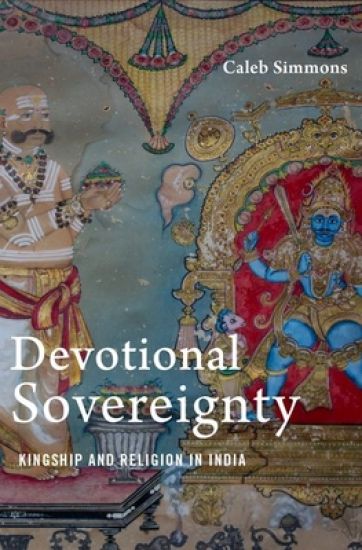
Devotional Sovereignty

Devotional Sovereignty

Caleb Simmons

Oxford University Press Inc
2020
sidottu
Devotional Sovereignty: Kingship and Religion in India investigates the shifting conceptualization of sovereignty in the South Indian kingdom of Mysore during the reigns of Tipu Sultan (r. 1782-1799) and Krishnaraja Wodeyar III (r. 1799-1868). Tipu Sultan was a Muslim king famous for resisting British dominance until his death; Krishnaraja III was a Hindu king who succumbed to British political and administrative control. Despite their differences, the courts of both kings dealt with the changing political landscape by turning to the religious and mythical past to construct a royal identity for their kings. Caleb Simmons explores the ways in which these two kings and their courts modified and adapted pre-modern Indian notions of sovereignty and kingship in reaction to British intervention. The religious past provided an idiom through which the Mysore courts could articulate their rulers' claims to kingship in the region, attributing their rule to divine election and employing religious vocabulary in a variety of courtly genres and media. Through critical inquiry into the transitional early colonial period, this study sheds new light on pre-modern and modern India, with implications for our understanding of contemporary politics. It offers a revisionist history of the accepted narrative in which Tipu Sultan is viewed as a radical Muslim reformer and Krishnaraja III as a powerless British puppet. Simmons paints a picture of both rulers in which they work within and from the same understanding of kingship, utilizing devotion to Hindu gods, goddesses, and gurus to perform the duties of the king.
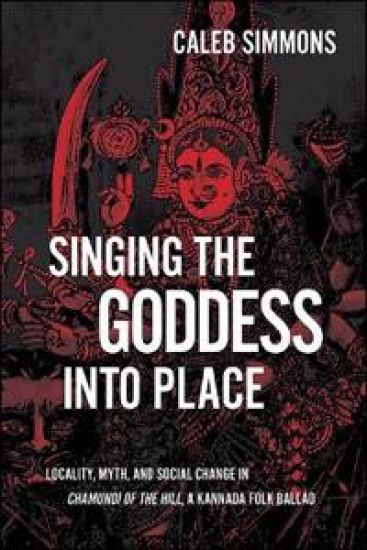
Singing the Goddess into Place

Singing the Goddess into Place

Caleb Simmons

STATE UNIVERSITY OF NEW YORK PRESS
2022
sidottu
Explores how a folk ballad in southern India transforms the landscape and embeds the deities that are its subject within the social worlds of their devotees.Singing the Goddess into Place examines Chamundi of the Hill, a collection of songs that tells the stories of the gods and goddesses of the region around the city of Mysore in southern Karnataka. The ballad actively transforms the region into a land where gods and goddesses live, embedding these deities within the social worlds of their devotees and remapping southern Karnataka into sacred geography connected through networks of devotion and pilgrimage. In this in-depth study of the songs and their context, Caleb Simmons not only provides the first English-language translation of these songs but brings to light the unstudied folk perspectives on the foundational myth of Mysore and its urban history. Singing the Goddess into Place demonstrates how folk narratives reflect local context while also actively working to upend social inequities based on caste and ritual/devotional practices. By delving into this world, the book helps us understand how a landscape is transformed through people's relationship with it and how this relationship helps build meaning for the communities that call it home.
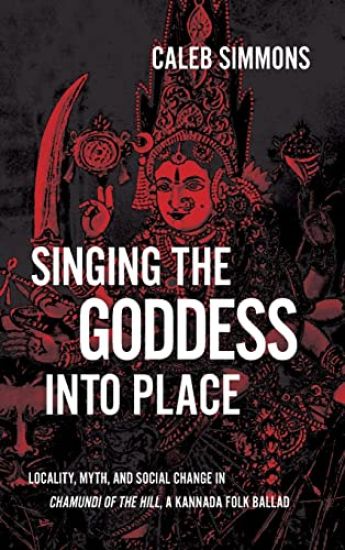
Singing the Goddess into Place

Singing the Goddess into Place

Caleb Simmons

STATE UNIVERSITY OF NEW YORK PRESS
2023
pokkari
Explores how a folk ballad in southern India transforms the landscape and embeds the deities that are its subject within the social worlds of their devotees.Singing the Goddess into Place examines Chamundi of the Hill, a collection of songs that tells the stories of the gods and goddesses of the region around the city of Mysore in southern Karnataka. The ballad actively transforms the region into a land where gods and goddesses live, embedding these deities within the social worlds of their devotees and remapping southern Karnataka into sacred geography connected through networks of devotion and pilgrimage. In this in-depth study of the songs and their context, Caleb Simmons not only provides the first English-language translation of these songs but brings to light the unstudied folk perspectives on the foundational myth of Mysore and its urban history. Singing the Goddess into Place demonstrates how folk narratives reflect local context while also actively working to upend social inequities based on caste and ritual/devotional practices. By delving into this world, the book helps us understand how a landscape is transformed through people's relationship with it and how this relationship helps build meaning for the communities that call it home.