Kirjojen hintavertailu. Mukana 11 244 527 kirjaa ja 12 kauppaa.

Kirjahaku

Etsi kirjoja tekijän nimen, kirjan nimen tai ISBN:n perusteella.

5 kirjaa tekijältä Caren Irr

Toward the Geopolitical Novel

Toward the Geopolitical Novel

Caren Irr

Columbia University Press
2013
sidottu
Caren Irr's survey of more than 125 novels outlines the dramatic resurgence of the American political novel in the twenty-first century. She explores the writings of Chris Abani, Susan Choi, Edwidge Danticat, Junot Diaz, Dave Eggers, Jeffrey Eugenides, Aleksandar Hemon, Hari Kunzru, Dinaw Mengestu, Norman Rush, Gary Shteyngart, and others as they rethink stories of migration, the Peace Corps, nationalism and neoliberalism, revolution, and the expatriate experience. Taken together, these innovations define a new literary form: the geopolitical novel. More cosmopolitan and socially critical than domestic realism, the geopolitical novel provides new ways of understanding crucial political concepts to meet the needs of a new century.
Toward the Geopolitical Novel

Toward the Geopolitical Novel

Caren Irr

Columbia University Press
2013
pokkari
Caren Irr's survey of more than 125 novels outlines the dramatic resurgence of the American political novel in the twenty-first century. She explores the writings of Chris Abani, Susan Choi, Edwidge Danticat, Junot Diaz, Dave Eggers, Jeffrey Eugenides, Aleksandar Hemon, Hari Kunzru, Dinaw Mengestu, Norman Rush, Gary Shteyngart, and others as they rethink stories of migration, the Peace Corps, nationalism and neoliberalism, revolution, and the expatriate experience. Taken together, these innovations define a new literary form: the geopolitical novel. More cosmopolitan and socially critical than domestic realism, the geopolitical novel provides new ways of understanding crucial political concepts to meet the needs of a new century.
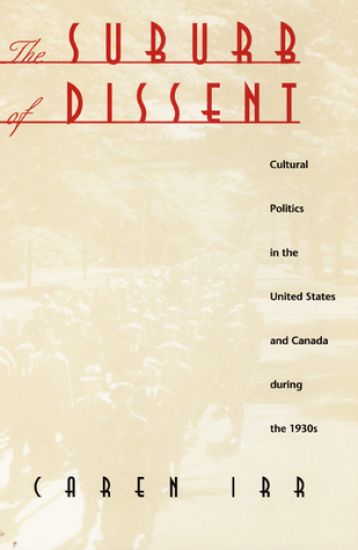
The Suburb of Dissent

The Suburb of Dissent

Caren Irr

Duke University Press
1998
sidottu
In The Suburb of Dissent Caren Irr explores the leftist literary subculture of the United States and Canada during the 1930s to reconstruct the ideas of mass culture, class, and nationality that emerged as a result of the Great Depression. Unearthing plots and characters that still surface in contemporary narratives, Irr juxtaposes classic and neglected works of criticism, fiction, poetry, and journalism and demonstrates how leftist writers resisted totalitarianism much more thoroughly than Cold War accounts would suggest. Irr highlights works by Richard Wright, John Dos Passos, Nathanael West, and others to uncover the complex relationship between American anti-communism and communist anti-Americanism. In an unprecedented move, she extends her inquiry to the work of Canadian intellectuals such as Dorothy Livesay and Hugh MacLennan to reveal the important yet overlooked fact that the territory at the border of the United States and Canada provided a vital contact zone and transnational “home” for leftist thinkers. Attending to intersections of race, ethnicity, and gender, Irr illustrates the ways dissenting writers made culture actively respond to the political crises of the Great Depression and questioned the nature of what it means to be “American.” Drawing on insights from postcolonial and American studies and taking into account the intellectual and cultural dimensions of leftist politics, The Suburb of Dissent is the first study of the 1930s to bring together U.S. and Canadian writings. In doing so, it reveals how the unique culture of the left contributed to North American history at this critical juncture and beyond.
The Suburb of Dissent

The Suburb of Dissent

Caren Irr

Duke University Press
1998
pokkari
In The Suburb of Dissent Caren Irr explores the leftist literary subculture of the United States and Canada during the 1930s to reconstruct the ideas of mass culture, class, and nationality that emerged as a result of the Great Depression. Unearthing plots and characters that still surface in contemporary narratives, Irr juxtaposes classic and neglected works of criticism, fiction, poetry, and journalism and demonstrates how leftist writers resisted totalitarianism much more thoroughly than Cold War accounts would suggest. Irr highlights works by Richard Wright, John Dos Passos, Nathanael West, and others to uncover the complex relationship between American anti-communism and communist anti-Americanism. In an unprecedented move, she extends her inquiry to the work of Canadian intellectuals such as Dorothy Livesay and Hugh MacLennan to reveal the important yet overlooked fact that the territory at the border of the United States and Canada provided a vital contact zone and transnational “home” for leftist thinkers. Attending to intersections of race, ethnicity, and gender, Irr illustrates the ways dissenting writers made culture actively respond to the political crises of the Great Depression and questioned the nature of what it means to be “American.” Drawing on insights from postcolonial and American studies and taking into account the intellectual and cultural dimensions of leftist politics, The Suburb of Dissent is the first study of the 1930s to bring together U.S. and Canadian writings. In doing so, it reveals how the unique culture of the left contributed to North American history at this critical juncture and beyond.
Pink Pirates

Pink Pirates

Caren Irr

University of Iowa Press
2010
nidottu
Today, copyright is everywhere, surrounded by a thicket of no-trespassing signs that mark creative work as private property. Caren Irr’s `Pink Pirates’ asks how contemporary novelists—represented by Ursula Le Guin, Andrea Barrett, Kathy Acker, and Leslie Marmon Silko—have read those signs, arguing that for feminist writers in particular copyright often conjures up the persistent exclusion of women from ownership. Bringing together voices from law schools, courtrooms, and the writer's desk, Irr shows how some of the most inventive contemporary feminist novelists have reacted to this history. Explaining the complex, three-century lineage of Anglo-American copyright law in clear, accessible terms and wrestling with some of its most deeply rooted assumptions, Irr sets the stage for a feminist reappraisal of the figure of the literary pirate in the late twentieth century—a figure outside the restrictive bounds of U.S. copyright statutes. Whether illuminating the gendered problem of intellectual property or providing smart, meticulous, well-versed discussions of contemporary literary work, Irr presents a comprehensive and convincing argument for the salience of pink piracy. Going beyond her readings of contemporary women authors, Irr’s exhaustive history of how women have fared under intellectual property regimes speaks to broader political, social, and economic implications and engages digital-era excitement about the commons with the most utopian and materialist strains in feminist criticism.