Kirjojen hintavertailu. Mukana 12 390 323 kirjaa ja 12 kauppaa.

Kirjahaku

Etsi kirjoja tekijän nimen, kirjan nimen tai ISBN:n perusteella.

5 kirjaa tekijältä Carlos A. Smith

A First Course in Differential Equations, Modeling, and Simulation

A First Course in Differential Equations, Modeling, and Simulation

Carlos A. Smith; Scott W. Campbell; Ryan G. Toomey

TAYLOR FRANCIS LTD
2025
sidottu
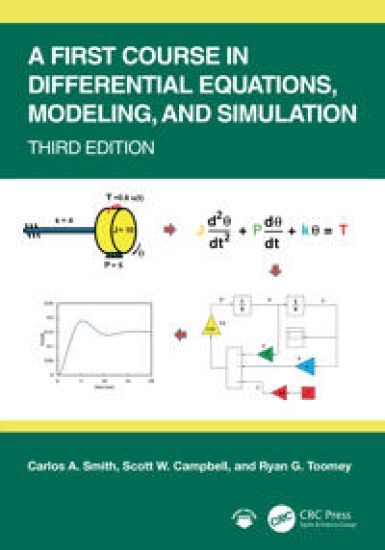
A First Course in Differential Equations, Modeling, and Simulation shows how differential equations arise from applying basic physical principles and experimental observations to engineering systems. Avoiding overly theoretical explanations, the textbook also discusses classical and Laplace transform methods for obtaining the analytical solution of differential equations. In addition, the authors explain how to solve sets of differential equations where analytical solutions cannot easily be obtained. Incorporating valuable suggestions from mathematicians and mathematics professors, the Third Edition:Reworks the chapter “Response of First and Second Order Systems” to include the system response to step changes, impulses, rectangular pulses, and sinusoid forcing functions as well as the response of coupled first and second order ODEs; it also introduces Bode plots to analyze the frequency response of second order ODE and the principle of oscillation modes in coupled second order ODE.Adds a new section on springs and dampers in series or parallel.Includes new content on Simulink and modelling.Contains new exercises that can be used as projects and answers to many of the end-of-chapter problems.Features new end-of-chapter problems and updates throughout.This textbook provides students with a practical understanding of how to apply differential equations in modern engineering and science.A solutions manual and files of all figures in the text are available to adopting professors.
A First Course in Differential Equations, Modeling, and Simulation

A First Course in Differential Equations, Modeling, and Simulation

Carlos A. Smith; Scott W. Campbell

Apple Academic Press Inc.
2016
sidottu
A First Course in Differential Equations, Modeling, and Simulation shows how differential equations arise from applying basic physical principles and experimental observations to engineering systems. Avoiding overly theoretical explanations, the textbook also discusses classical and Laplace transform methods for obtaining the analytical solution of differential equations. In addition, the authors explain how to solve sets of differential equations where analytical solutions cannot easily be obtained.Incorporating valuable suggestions from mathematicians and mathematics professors, the Second Edition: Expands the chapter on classical solutions of ordinary linear differential equations to include additional methodsIncreases coverage of response of first- and second-order systems to a full, stand-alone chapter to emphasize its importanceIncludes new examples of applications related to chemical reactions, environmental engineering, biomedical engineering, and biotechnologyContains new exercises that can be used as projects and answers to many of the end-of-chapter problemsFeatures new end-of-chapter problems and updates throughoutThus, A First Course in Differential Equations, Modeling, and Simulation, Second Edition provides students with a practical understanding of how to apply differential equations in modern engineering and science.
Automated Continuous Process Control

Automated Continuous Process Control

Carlos A. Smith

John Wiley Sons Inc
2002
sidottu
An expert guide for understanding and applying process control Automated Continuous Process Control pulls together–in one compact and practical volume–the essentials for understanding, designing, and operating process control systems. This comprehensive guide covers the major elements of process control in a well-defined and ordered framework. Concepts are clearly presented, with minimal reliance on mathematical equations and strong emphasis on practical, real-life examples. Beginning with the very basics of process control, Automated Continuous Process Control builds upon each chapter to help the reader understand and efficiently practice industrial process control. This complete presentation includes: *A discussion of processes from a physical point of view *Feedback controllers and the workhorse in the industry–the PID controller *The concept and implementation of cascade control *Ratio, override (or constraint), and selective control *Block diagrams and stability *Feedforward control *Techniques to control processes with long dead times *Multivariable process control Applicable for electrical, industrial, chemical, or mechanical engineers, Automated Continuous Process Control offers proven process control guidance that can actually be used in day-to-day operations. The reader will also benefit from the companion CD-ROM, which contains processes that have been successfully used for many years to practice tuning feedback and cascade controllers, as well as designing feedforward controllers.
Principles and Practices of Automatic Process Control

Principles and Practices of Automatic Process Control

Carlos A. Smith; Armando B. Corripio

John Wiley Sons Inc
2005
sidottu
Highly practical and applied, this Third Edition of Smith and Corripio’s Principles and Practice of Automatic Process Control continues to present all the necessary theory for the successful practice of automatic process control. The authors discuss both introductory and advanced control strategies, and show how to apply those strategies in industrial examples drawn from their own professional practice. The strengths of the book are its simplicity, excellent examples, practical approach, real case studies, and focus on Chemical Engineering processes. More than any other textbook in the field, Smith & Corripio prepares a student for use of process control in a manufacturing setting. Course Hierarchy: Course is called Process Control Senior level course Same course as Seborg but Smith is considered more accessible