Kirjojen hintavertailu. Mukana 11 699 587 kirjaa ja 12 kauppaa.

Kirjahaku

Etsi kirjoja tekijän nimen, kirjan nimen tai ISBN:n perusteella.

7 kirjaa tekijältä Carol A. Hess

Manuel de Falla's El amor brujo

Manuel de Falla's El amor brujo

Carol A. Hess

OXFORD UNIVERSITY PRESS INC
2025
nidottu
El amor brujo (trans. "Love, the Magician") is a theater work by the Spanish classical composer Manuel de Falla. It showcases flamenco, the music of the Gitanos who traditionally form Spain's underclass. When it premiered in Spain in 1915, it proved controversial: some Spanish critics applauded Falla for celebrating the music of a marginalized culture while others attacked his mixing of classical and popular idioms. Since then, El amor brujo has intrigued arrangers and artists. It has been repeatedly reshaped, rearranged, and repackaged, either by Falla himself or by artists ranging from the concert pianist Artur Rubinstein to the super-showman Liberace or to various jazz and pop arrangers. El amor brujo has also figured in soundtracks, whether frothy movie musicals from the 1940s, somber accounts of recent Spanish history, or films on anti-Black racism, including one by Spike Lee. In Manuel de Falla's El amor brujo, author Carol A. Hess explores the ways in which music, class, and race are intertwined in this composition's unusually rich history.
Manuel de Falla and Modernism in Spain, 1898-1936

Manuel de Falla and Modernism in Spain, 1898-1936

Carol A. Hess

University of Chicago Press
2002
sidottu
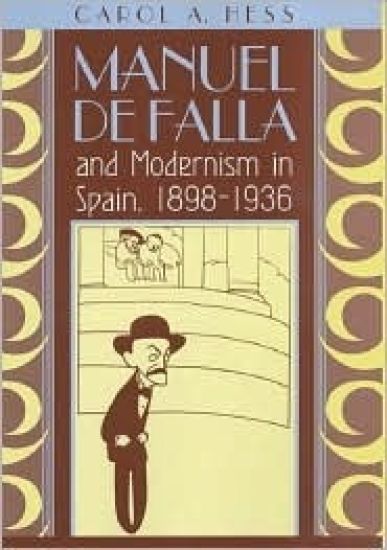
Although studies of modernism have focused largely on European nations, Spain has been conspicuously neglected. As Carol A. Hess argues in this book, such neglect is undeserved. Through the composer Manuel de Falla (1876-1946), Hess explores the advent of modernism in Spain in relation to political and cultural tensions prior to the Spanish Civil War. The result is a view of the the musical life of Spain in an evolving aesthetic climate.
Aaron Copland in Latin America

Aaron Copland in Latin America

Carol A. Hess

UNIVERSITY OF ILLINOIS PRESS
2023
sidottu
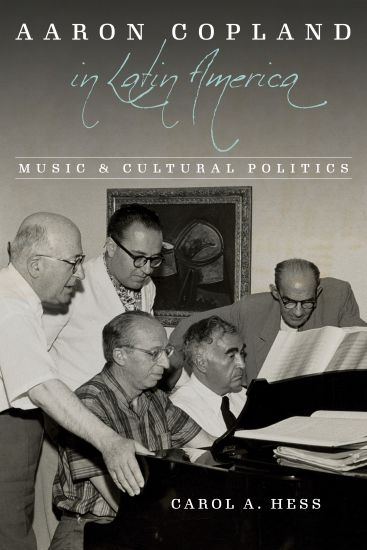
Between 1941 and 1963, Aaron Copland made four government-sponsored tours of Latin America that drew extensive attention at home and abroad. Interviews with eyewitnesses, previously untapped Latin American press accounts, and Copland’s diaries inform Carol A. Hess’s in-depth examination of the composer’s approach to cultural diplomacy. As Hess shows, Copland’s tours facilitated an exchange of music and ideas with Latin American composers while capturing the tenor of United States diplomatic efforts at various points in history. In Latin America, Copland’s introduced works by U.S. composers (including himself) through lectures, radio broadcasts, live performance, and conversations. Back at home, he used his celebrity to draw attention to regional composers he admired. Hess’s focus on Latin America’s reception of Copland provides a variety of outside perspectives on the composer and his mission. She also teases out the broader meanings behind reviews of Copland and examines his critics in the context of their backgrounds, training, aesthetics, and politics.
Aaron Copland in Latin America

Aaron Copland in Latin America

Carol A. Hess

UNIVERSITY OF ILLINOIS PRESS
2023
nidottu
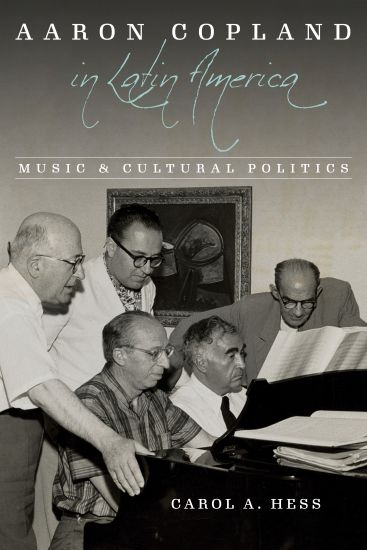
Between 1941 and 1963, Aaron Copland made four government-sponsored tours of Latin America that drew extensive attention at home and abroad. Interviews with eyewitnesses, previously untapped Latin American press accounts, and Copland’s diaries inform Carol A. Hess’s in-depth examination of the composer’s approach to cultural diplomacy. As Hess shows, Copland’s tours facilitated an exchange of music and ideas with Latin American composers while capturing the tenor of United States diplomatic efforts at various points in history. In Latin America, Copland’s introduced works by U.S. composers (including himself) through lectures, radio broadcasts, live performance, and conversations. Back at home, he used his celebrity to draw attention to regional composers he admired. Hess’s focus on Latin America’s reception of Copland provides a variety of outside perspectives on the composer and his mission. She also teases out the broader meanings behind reviews of Copland and examines his critics in the context of their backgrounds, training, aesthetics, and politics.
Enrique Granados

Enrique Granados

Carol A. Hess

Greenwood Press
1991
sidottu
Enrique Granados (1867-1916) was one of the first modern Spanish composers to achieve international recognition. During a 1916 visit to the United States his opera Goyescas was premiered by the Metropolitan Opera and his symphonic poem, Dante, by the Chicago Symphony. Granados was also especially admired in Paris, where he knew Saint-Saens, d'Indy, and Faure. He had composed a remarkable body of work and was also at the height of his career as a concert pianist at his untimely death while a passenger on a torpedoed British ship.The biographical study, the first in English, draws on primary sources in English, Spanish, French, Catalan, and other languages. This material is carefully documented in the extensive annotated bibliography along with contemporaneous and recent analytical studies and other sources. Granados's oeuvre presents cataloging problems due to his habit of reworking pieces, long-delayed publication, and arbitrary opus numbers. In the Works and Performances section, however, every effort has been made to offer publication dates, manuscript locations, and information on premieres. Representative arrangements of his works by other composers are also given. An appendix classifies the works by scoring. A selective discography is also provided, and all parts of the volume are fully cross-referenced and indexed. Granados is placed in the context of the international artistic scene at the turn of the century, and a chronology notes related events.
Experiencing Latin American Music

Experiencing Latin American Music

Carol A. Hess

University of California Press
2018
pokkari
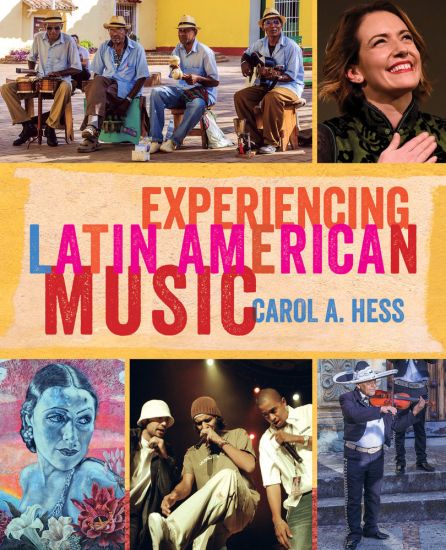
Experiencing Latin American Music draws on human experience as a point of departure for musical understanding. Students explore broad topics—identity, the body, religion, and more—and relate these to Latin American musics while refining their understanding of musical concepts and cultural-historical contexts. With its brisk and engaging writing, this volume covers nearly fifty genres and provides both students and instructors with online access to audio tracks and listening guides. A detailed instructor’s packet contains sample quizzes, clicker questions, and creative, classroom-tested assignments designed to encourage critical thinking and spark the imagination. Remarkably flexible, this innovative textbook empowers students from a variety of disciplines to study a subject that is increasingly relevant in today’s diverse society. In addition to the instructor’s packet, online resources for students include:customized Spotify playlistonline listening guidesaudio sound links to reinforce musical conceptsstimulating activities for individual and group work
Manuel de Falla's El amor brujo

Manuel de Falla's El amor brujo

Carol A. Hess

OXFORD UNIVERSITY PRESS INC
2025
sidottu
El amor brujo (trans. "Love, the Magician") is a theater work by the Spanish classical composer Manuel de Falla. It showcases flamenco, the music of the Gitanos who traditionally form Spain's underclass. When it premiered in Spain in 1915, it proved controversial: some Spanish critics applauded Falla for celebrating the music of a marginalized culture while others attacked his mixing of classical and popular idioms. Since then, El amor brujo has intrigued arrangers and artists. It has been repeatedly reshaped, rearranged, and repackaged, either by Falla himself or by artists ranging from the concert pianist Artur Rubinstein to the super-showman Liberace or to various jazz and pop arrangers. El amor brujo has also figured in soundtracks, whether frothy movie musicals from the 1940s, somber accounts of recent Spanish history, or films on anti-Black racism, including one by Spike Lee. In Manuel de Falla's El amor brujo, author Carol A. Hess explores the ways in which music, class, and race are intertwined in this composition's unusually rich history.