Kirjojen hintavertailu. Mukana 12 390 323 kirjaa ja 12 kauppaa.

Kirjahaku

Etsi kirjoja tekijän nimen, kirjan nimen tai ISBN:n perusteella.

8 kirjaa tekijältä Caroline van Eck

Piranesi's Candelabra and the Presence of the Past

Piranesi's Candelabra and the Presence of the Past

Caroline van Eck

Oxford University Press
2023
sidottu
Near the end of his life, Giovanni Battista Piranesi (1720-78) created three colossal candelabra mainly from fragments of sculpture excavated near the Villa Hadriana in Tivoli, two of which are now in the Ashmolean Museum, and one in the Louvre. Although they were among the most sought-after and prestigious of his works, and fetched enormous prices during Piranesi's life, they suffered a steep decline in appreciation from the 1820s onwards, and even today they are among the least studied of his works. Piranesi's Candelabra and the Presence of the Past uncovers the intense investment, by artists, patrons, collectors, and the public around the start of the nineteenth century in objects that made Graeco-Roman Antiquity present again. Caroline van Eck's study examines how objects make their makers or viewers feel that they are again in the presence of Antiquity, that not only Antiquity has revived, but that classical statues become alive under their gaze. what it takes to make such objects, and what it costs to own them; and about the ramifications of such intense if not excessive attachments to artefacts. This book considers the three candelabra in depth, providing the biography of these objects, from the excavation of the Roman fragments to their entry into private and public collection. Van Eck considers the context that Piranesi gave them by including them in his Vasi, Candelabri e Cippi (1778), to rethink the processes that led to the development of neoclassicism from the perspective of the objects and objectscapes that came into being in Rome at the end of the eighteenth century.
Classical Rhetoric and the Visual Arts in Early Modern Europe

Classical Rhetoric and the Visual Arts in Early Modern Europe

Caroline Van Eck

Cambridge University Press
2014
pokkari
In this book, Caroline van Eck examines how rhetoric and the arts interacted in early modern Europe. She argues that rhetoric, though originally developed for persuasive speech, has always used the visual as an important means of persuasion, and hence offers a number of strategies and concepts for visual persuasion as well. The book is divided into three major sections - theory, invention, and design. Van Eck analyzes how rhetoric informed artistic practice, theory, and perception in early modern Europe. This is the first full-length study to look at the issue of visual persuasion in both architecture and the visual arts, and to investigate what roles rhetoric played in visual persuasion, both from the perspective of artists and that of viewers.
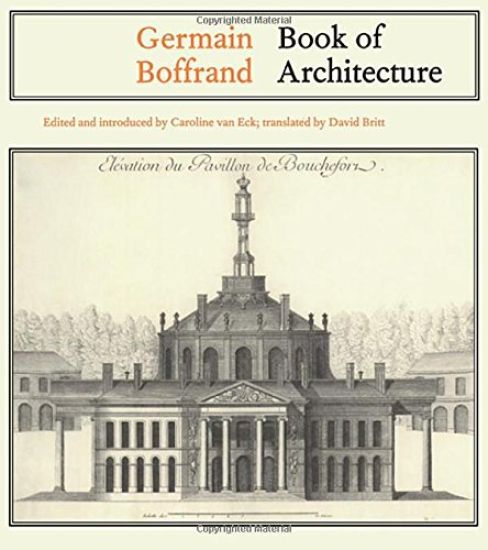
Germain Boffrand

Germain Boffrand

Caroline van Eck

Routledge
2025
sidottu
This title was first published in 2002. Germain Boffrand was one of the great French architects of the early eighteenth century. His work encompassed not only the design of town and country houses for the wealthy but also mines, bridges and hospitals. His Livre d’Architecture is one of the most original books on architecture ever written in France. Taking the Art of Poetry by the Latin poet Horace as its starting point, it developed an aesthetic of architecture focused on character, style and the emotional impact of a building that influenced Blondel, Le Camus de Mezieres and Soane, and is still central to contemporary debate about the nature and meaning of architecture. Translated for the first time by David Britt, Boffrand’s text is here accompanied by an extensive introduction and notes by Caroline van Eck who situates Boffrand within the main issues of eighteenth-century architectural aesthetics. Beautifully illustrated, including all the pictures chosen by Boffrand for his original publication, this book is an invaluable tool for teaching the history of architectural theory and an essential work for any architectural library. Germain Boffrand is published with the assistance of the Getty Foundation.
Art, Agency and Living Presence

Art, Agency and Living Presence

Caroline van Eck

De Gruyter Akademie Forschung
2015
sidottu
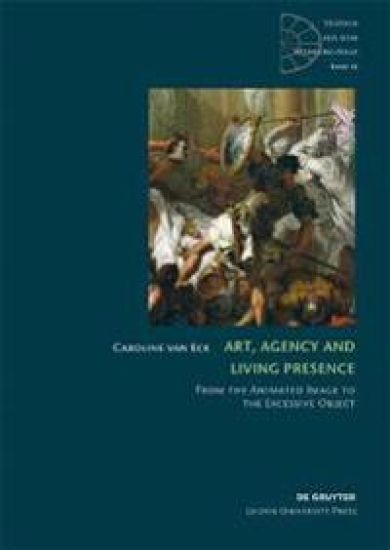
Throughout history, and all over the world, viewers have treated works of art as if they are living beings: speaking to them, falling in love with them, kissing or beating them. Although over the past 20 years the catalogue of individual cases of such behavior towards art has increased immensely, there are few attempts at formulating a theoretical account of them, or writing the history of how such responses were considered, defined or understood. That is what this book sets out to do: to reconstruct some crucial chapters in the history of thought about such reflections in Western Europe, and to offer some building blocks towards a theoretical account of such responses, drawing on the work of Aby Warburg and Alfred Gell.
Piranesi und sein Museum / Piranesi and his Museum

Piranesi und sein Museum / Piranesi and his Museum

Caroline van Eck

Deutscher Kunstverlag
2019
isokokoinen pokkari
The development or change of styles is usually considered as a process directed by persons: the artist, the patron, and sometimes intended audience or public. This book offers a different perspective on style formation, taking as a starting point the presence and agency of artefacts. Inspired by recent innovative concepts in archaeology, and psychology, it focuses on the decades around 1800, and reconstructs how the new object scapes that came into being in Rome and Paris, as a result of the massive migration of objects caused by the political upheavals of the period 1789-1815, shaped the formation of Neo-Classicism. The author offers explanations of style formation that go beyond traditional artistic or aesthetic considerations. The laboratory for this investigation is Piranesi's Museo, the artefacts that were created there, and their biographies.
Dealing with the Visual

Dealing with the Visual

Caroline van Eck; Edward Winters

CRC Press Inc
2017
sidottu
One of the issues underlying current debates between practitioners of art history, visual culture and aesthetics is whether the visual is a unique, irreducible category, or whether it can be assimilated with the textual or verbal without any significant loss. Can paintings, buildings or installations be 'read' in the way texts are read or deciphered, or do works of visual art ask for their own kind of appreciation? This is not only a question of choosing the right method in dealing with visual works of art, but also an issue that touches on the roots of the disciplines involved: can a case be made for the visual as an irreducible category of art, and if so, how is it best studied and appreciated? In this anthology, this question is approached from the angles of three disciplines: aesthetics, visual culture and art history. Unlike many existing overviews of visual culture studies, it includes both painting and architecture, and investigates historical ways of defining and appreciating the visual in their own, contemporary terms. Dealing with the Visual will be of great use to advanced students because it offers an overview of current debates, and to graduate students and professionals in the field because the essays offer in-depth investigations of the methodological issues involved and various historical ways of defining visuality. The topics included range from early modern ways of viewing pictures and sixteenth-century views of Palladio's villas in their landscape settings to contemporary debate about whether there is life yet in painting.
Dealing with the Visual

Dealing with the Visual

Caroline van Eck; Edward Winters

TAYLOR FRANCIS LTD
2022
nidottu
One of the issues underlying current debates between practitioners of art history, visual culture and aesthetics is whether the visual is a unique, irreducible category, or whether it can be assimilated with the textual or verbal without any significant loss. Can paintings, buildings or installations be 'read' in the way texts are read or deciphered, or do works of visual art ask for their own kind of appreciation? This is not only a question of choosing the right method in dealing with visual works of art, but also an issue that touches on the roots of the disciplines involved: can a case be made for the visual as an irreducible category of art, and if so, how is it best studied and appreciated? In this anthology, this question is approached from the angles of three disciplines: aesthetics, visual culture and art history. Unlike many existing overviews of visual culture studies, it includes both painting and architecture, and investigates historical ways of defining and appreciating the visual in their own, contemporary terms. Dealing with the Visual will be of great use to advanced students because it offers an overview of current debates, and to graduate students and professionals in the field because the essays offer in-depth investigations of the methodological issues involved and various historical ways of defining visuality. The topics included range from early modern ways of viewing pictures and sixteenth-century views of Palladio's villas in their landscape settings to contemporary debate about whether there is life yet in painting.
Theatricality in Early Modern Art and Architecture

Theatricality in Early Modern Art and Architecture

Caroline van Eck; Stijn Bussels

Wiley-Blackwell (an imprint of John Wiley Sons Ltd)
2011
nidottu
Theatricality in Early Modern Art and Architecture offers the first systematic investigation of exchanges between the arts, architecture and the theatre. The authors present many new instances of the interaction between the arts, providing a theoretical and historiographical context for these interactions. Offers the first systematic investigation of exchanges between the arts, architecture and the theatre, not simply the influence of the theatre on the arts, and vice versaDevelops a theoretical and methodological model to study such exchanges and interactionsPresents many new, hitherto unknown instances of the interaction between the arts, particularly architecture, and the theatre, and provides such interactions with a theoretical and historiographical contextAuthors have opened up new ways of analyzing theatricality both in the arts, architecture and the theatre