Kirjojen hintavertailu. Mukana 11 342 296 kirjaa ja 12 kauppaa.

Kirjahaku

Etsi kirjoja tekijän nimen, kirjan nimen tai ISBN:n perusteella.

8 kirjaa tekijältä Carrie Gibson

Empire's Crossroads

Empire's Crossroads

Carrie Gibson

Black Cat
2015
nidottu
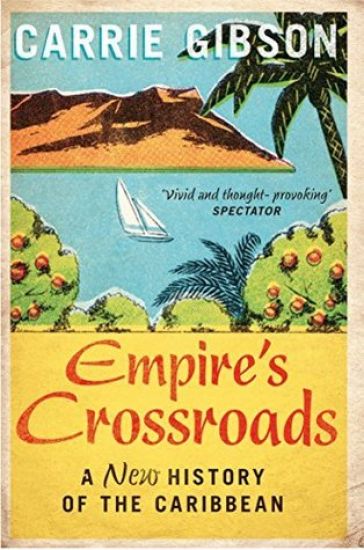
Ever since Christopher Columbus stepped off the Santa Maria and announced that he had arrived in the Orient, the Caribbean has been a stage for projected fantasies and competition between world powers. In Empire's Crossroads, historian Carrie Gibson offers a vivid, panoramic view of this complex region and its rich, important history. That fateful landing in 1492 soon launched a savage competition for West Indian territory that would last centuries. Gibson compellingly traces the ups and downs of European imperial expansion--including the first cash crops, failed settlements, and pirating on the open seas--but she also brilliantly describes daily life on the islands. Creole societies complicated traditional ideas about class and race, and by the end of the eighteenth century, plantation slaves in Saint-Domingue had launched the Haitian Revolution, the world's only successful slave revolt. As European control of the Caribbean loosened over the next 150 years, America was on the rise, ushering in a new era of foreign influence and the birth of the tourism industry that still thrives today. Incredibly multi-faceted and approachably written, Empire's Crossroads encompasses the narratives of more than twenty islands and reinterprets five centuries of history have been underappreciated for far too long.
El Norte

El Norte

Carrie Gibson

Black Cat
2020
nidottu
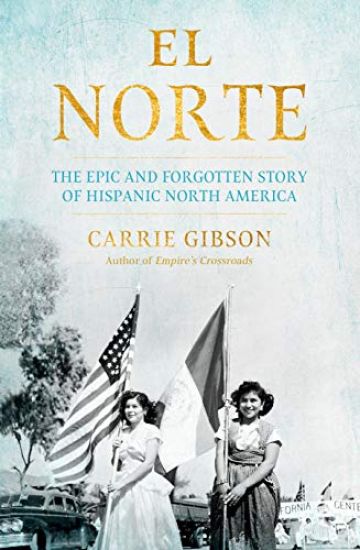
Because of our shared English language, as well as the celebrated origin tales of the Mayflower and the rebellion of the British colonies, the United States has prized its Anglo heritage above all others. However, as Carrie Gibson explains with great depth and clarity in El Norte, the nation has much older Spanish roots--ones that have long been unacknowledged or marginalized. The Hispanic past of the United States predates the arrival of the Pilgrims by a century, and has been every bit as important in shaping the nation as it exists today. El Norte chronicles the sweeping and dramatic history of Hispanic North America from the arrival of the Spanish in the early 16th century to the present--from Ponce de Leon's initial landing in Florida in 1513 to Spanish control of the vast Louisiana territory in 1762 to the Mexican-American War in 1846 and up to the more recent tragedy of post-hurricane Puerto Rico and the ongoing border acrimony with Mexico. Interwoven in this stirring narrative of events and people are cultural issues that have been there from the start but which are unresolved to this day: language, belonging, community, race, and nationality. Seeing them play out over centuries provides vital perspective at a time when it is urgently needed. In 1883, Walt Whitman meditated on his country's Spanish past: "We Americans have yet to really learn our own antecedents, and sort them, to unify them," predicting that "to that composite American identity of the future, Spanish character will supply some of the most needed parts." That future is here, and El Norte, a stirring and eventful history in its own right, will make a powerful impact on our national understanding.
The Great Resistance

The Great Resistance

Carrie Gibson

GROVE PRESS / ATLANTIC MONTHLY PRESS
2026
sidottu
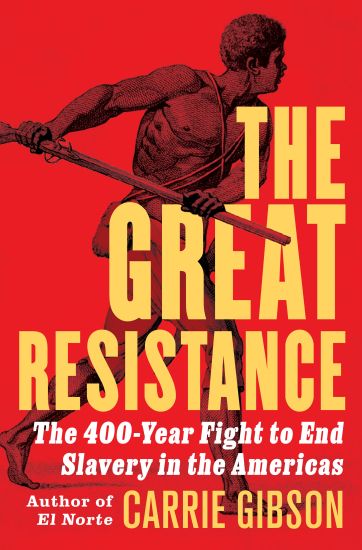
For more than four centuries, enslaved people across the Americas, from the United States and the Caribbean to Mexico and Brazil, fought any way they could to gain their freedom. For the first time, their dramatic stories are gathered in one sweeping narrative that offers a message of inspiration in our own time."Among the emancipators are the millions whose stories will never be known. They lived the struggle. They were the great resistance." Thus does acclaimed historian Carrie Gibson conclude her magisterial chronicle of four centuries of effort by enslaved people in the western hemisphere to gain their freedom. "Freedom is an idea," she writes, and the actions of the thousands who fought to escape slavery made clear that "freedom had to be for everyone, otherwise it was a lie."The horrific enslavement by Europeans of twelve million Africans taken to the Americas has been widely written about, and important individual slave revolts have been recorded; but Gibson tells a larger story, portraying the multitude of freedom struggles across the entire hemisphere--from North America to the Caribbean to Brazil--as one long-running quest for freedom. From the first African revolt in 1521 on the island of Hispaniola, to the 18th-century Maroon Wars on Jamaica and the revolution that gave Haiti its independence, and thousands of smaller acts of defiance in between, Gibson vividly chronicles the continuum of resistance that eventually ended the slave trade and, with Brazil's decision in 1888, the institution of slavery itself.This was the most diverse ongoing insurrection the world has ever known, and the way it was responded to shaped every nation in the Americas in meaningful ways. "If scholars were to emphasize the efforts of the enslaved more than the condition of slavery," historian Vincent Brown has written, "we might at least tell richer stories about how the endeavors of the weakest and most abject have at times reshaped the world." With its deep scholarship and rich narrative, The Great Resistance is a major contribution to the literature around slavery and freedom and, in our time, a tribute to the persistence of the human spirit to overcome even the darkest of circumstances.
Empire's Crossroads

Empire's Crossroads

Carrie Gibson

Pan Books
2015
pokkari
In Empire's Crossroads, Carrie Gibson offers readers a vivid, authoritative and action-packed history of the Caribbean. For Gibson, everything was created in the West Indies: the Europe of today, its financial foundations built with sugar money: the factories and mills built as a result of the work of slaves thousands of miles away; the idea of true equality as espoused in Saint Domingue in the 1790s; the slow progress to independence; and even globalization and migration, with the ships passing to and fro taking people and goods in all possible directions, hundreds of years before the term 'globalization' was coined. From Cuba to Haiti, from Dominica to Martinique, from Jamaica to Trinidad, the story of the Caribbean is not simply the story of slaves and masters - but of fortune-seekers and pirates, scientists and servants, travellers and tourists. It is not only a story of imperial expansion - European and American - but of global connections, and also of life as it is lived in the islands, both in the past and today.
The Great Resistance

The Great Resistance

Carrie Gibson

John Murray Press
2026
sidottu
The Great Resistance is the story of the struggle for abolition, starting from the earliest runaway slaves in the 1500s to the end of slavery in Brazil in 1888, with a focus on the enslaved people who fought for their own freedom. For too long the story of slave liberation has focused on the role of white allies - important though they were - and the larger imperial publics and governments who changed their minds about the status of the very people they had earlier been happy to enslave.The story of abolition is neither smooth nor linear, and to understand its jagged and often contradictory course it is necessary to look at a wider historical horizon, one that takes in not only Britain and the United States, but also Spanish America and Brazil. It is also a story intimately intertwined with political revolutions and the rise of the nation-state. There is no explaining the establishment of western democracy without the inclusion of the debates around slavery and abolition.The Great Resistance offers the opportunity to think about freedom from the ground up, from the actions and words of people who were born into or escaped bondage. At a time when all post-slavery societies - not least Britain and the US - are facing serious questions about social and racial inequality, The Great Resistance provides a radical new interpretation of abolition, set against a sweeping historical landscape that takes in the entire hemisphere.
El Norte

El Norte

Carrie Gibson

Grove Press / Atlantic Monthly Press
2020
nidottu
For reasons of language and history, the United States has prized its Anglo heritage above all others. However, as Carrie Gibson explains with great depth and clarity in El Norte, America has much older Spanish roots - ones that have long been unacknowledged or marginalized. The Hispanic past of the United States predates the arrival of the Pilgrims by a century and has been every bit as important in shaping the nation. El Norte chronicles the sweeping and dramatic history of Hispanic North America from the arrival of the Spanish to the present - from Ponce de Leon's initial landing in Florida in 1513 to Spanish control of the vast Louisiana territory in 1762 to the Mexican-American War in 1846 and up to the more recent tragedy of post-hurricane Puerto Rico and the ongoing border acrimony with Mexico. Interwoven in this stirring narrative of events and people are cultural issues that have been there from the start and remain unresolved: language, belonging, community, race and nationality. Seeing them play out over centuries provides vital perspective at a time when it is urgently needed. In 1883, Walt Whitman wrote 'to that composite American identity of the future, Spanish character will supply some of the most needed parts.' That future is here, and El Norte, an emotive and eventful history in its own right, will have a powerful impact on our perception of the United States.
El Norte

El Norte

Carrie Gibson

Grove Press / Atlantic Monthly Press
2019
sidottu
For reasons of language and history, the United States has prized its Anglo heritage above all others. However, as Carrie Gibson explains with great depth and clarity in El Norte, America has much older Spanish roots - ones that have long been unacknowledged or marginalized. The Hispanic past of the United States predates the arrival of the Pilgrims by a century and has been every bit as important in shaping the nation. El Norte chronicles the sweeping and dramatic history of Hispanic North America from the arrival of the Spanish to the present - from Ponce de Leon's initial landing in Florida in 1513 to Spanish control of the vast Louisiana territory in 1762 to the Mexican-American War in 1846 and up to the more recent tragedy of post-hurricane Puerto Rico and the ongoing border acrimony with Mexico. Interwoven in this stirring narrative of events and people are cultural issues that have been there from the start and remain unresolved: language, belonging, community, race and nationality. Seeing them play out over centuries provides vital perspective at a time when it is urgently needed. In 1883, Walt Whitman wrote 'to that composite American identity of the future, Spanish character will supply some of the most needed parts.' That future is here, and El Norte, an emotive and eventful history in its own right, will have a powerful impact on our perception of the United States.