Kirjojen hintavertailu. Mukana 11 342 296 kirjaa ja 12 kauppaa.

Kirjahaku

Etsi kirjoja tekijän nimen, kirjan nimen tai ISBN:n perusteella.

4 kirjaa tekijältä Carson Holloway

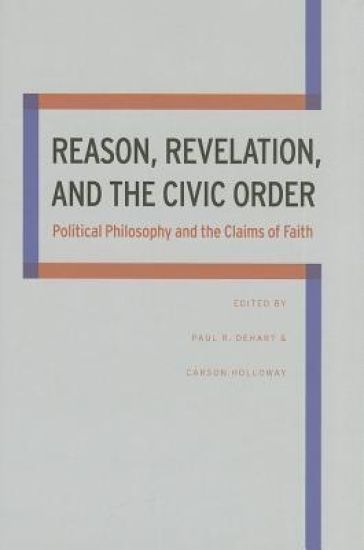
Reason, Revelation, and the Civic Order

Reason, Revelation, and the Civic Order

Carson Holloway

Northern Illinois University Press
2014
sidottu
While the dominant approaches to the current study of political philosophy are various, with some friendlier to religious belief than others, almost all place constraints on the philosophic and political role of revelation. Mainstream secular political theorists do not entirely disregard religion. But to the extent that they pay attention, their treatment of religious belief is seen more as a political or philosophic problem to be addressed rather than as a positive body of thought from which we might derive important insights about the nature of politics and the truth of the human condition. In a one-of-a-kind collection, DeHart and Holloway bring together leading scholars from various fields, including political science, philosophy, and theology, to challenge the prevailing orthodoxy and to demonstrate the role that religion can and does play in political life. Contributing authors include such important thinkers as Peter Augustine Lawler, Robert C. Koons, J. Budziszewski, Francis J. Beckwith, and James Stoner.
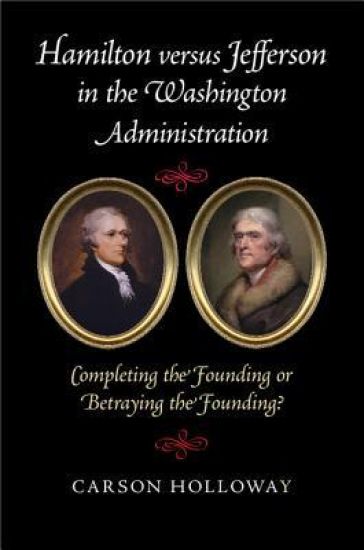
Hamilton versus Jefferson in the Washington Administration

Hamilton versus Jefferson in the Washington Administration

Carson Holloway

Cambridge University Press
2015
sidottu
By the middle of 1792, just a little more than three years after America's new government under the Constitution had been set in motion, Alexander Hamilton and Thomas Jefferson - President George Washington's two most important cabinet secretaries and two of the most eminent men among the American founders - had become open and bitter political enemies. Their dispute was not personal but political in the highest sense. Each believed that the debate between them was over regime principles. Each believed that he was protecting the newly established republic, and that the other was laboring to destroy it. Carson Holloway's Hamilton versus Jefferson in the Washington Administration examines Hamilton and Jefferson's differences, seeking to explain why these great founders came to disagree so profoundly and vehemently about the political project to which both were committed and had dedicated so much thought and effort.
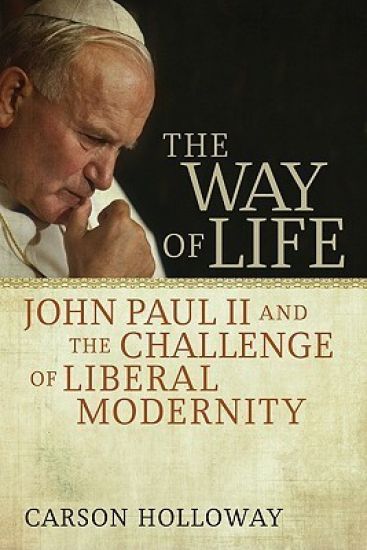
The Way of Life

The Way of Life

Carson Holloway

Baylor University Press
2008
nidottu
The passing of John Paul II provoked questions about the Pope, particularly in his relation to modernity. Was he opposed to the tenets of modernity, as some critics claimed? Or did he accommodate modernity in a way no Pope ever had, as his champions asserted? In The Way of Life, Carson Holloway examines the fundamental philosophers of modernity-from Hobbes to Toqueville-to suggest that John Paul II's critique of modernity is intended not to reject, but to improve. Thus, claims Holloway, it is appropriate for liberal modernity to attend to the Pope's thought, receiving it not as the attack of an enemy but as the criticism of a candid friend.
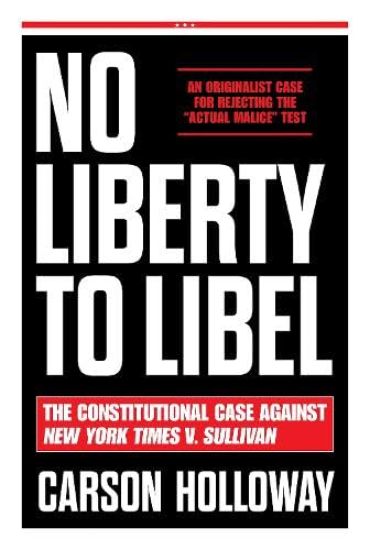
Actual Malice

Actual Malice

Carson Holloway

ENCOUNTER BOOKS,USA
2026
sidottu
In Restoring the First Amendment, Carson Holloway contends that the Supreme Court should revisit and reject the “actual malice” doctrine introduced in the famed libel case, New York Times v. Sullivan (1964). Though many have heralded Sullivan as a landmark ruling in defense of First Amendment freedoms, Holloway contends that the Court in this case erred radically in its interpretation of the Constitution. According to the Sullivan Court’s novel “actual malice” standard, to recover damages certain libel plaintiffs—public officials and public figures—must show not only that they were victims of defamatory falsehood, but also that their defamers acted with knowledge that the publication was false, or at least with reckless disregard for its truth or falsity. As Holloway demonstrates, the Sullivan doctrine’s two-tier system of libel law—with one standard for ordinary persons and another for the prominent—that has no roots in the original understanding of the freedom of the press, or in the tradition of American law that prevailed from the Founding up to the time the Sullivan ruling was handed down. This tradition held more simply and consistently that libel was an exercise not of liberty but of license, and hence outside the scope of the freedom of the press. Holloway concludes that a Supreme Court committed to interpreting the Constitution faithfully—that is, according to its text, original meaning, and historical understanding—must reject New York Times v. Sullivan as a product of judicial policymaking untethered to the real meaning of the First Amendment.