Kirjojen hintavertailu. Mukana 12 016 292 kirjaa ja 12 kauppaa.

Kirjahaku

Etsi kirjoja tekijän nimen, kirjan nimen tai ISBN:n perusteella.

10 kirjaa tekijältä Cary Nelson

Israel Denial

Israel Denial

Cary Nelson

Indiana University Press
2019
pokkari
Israel Denial is the first book to offer detailed analyses of the work faculty members have published—individually and collectively—in support of the Boycott, Divestment, and Sanctions (BDS) movement; it contrasts their claims with options for promoting peace. The faculty discussed here have devoted a significant part of their professional lives to delegitimizing the Jewish state. While there are beliefs they hold in common—including the conviction that there is nothing good to say about Israel—they also develop distinctive arguments designed to recruit converts to their cause in novel ways. They do so both as writers and as teachers; Israel Denial is the first to give substantial attention to anti-Zionist pedagogy. No effort to understand the BDS movement's impact on the academy and public policy can be complete without the kind of understanding this book offers. A co-publication of the Academic Engagement Network
Israel Denial

Israel Denial

Cary Nelson

Indiana University Press
2019
sidottu
Israel Denial is the first book to offer detailed analyses of the work faculty members have published—individually and collectively—in support of the Boycott, Divestment, and Sanctions (BDS) movement; it contrasts their claims with options for promoting peace. The faculty discussed here have devoted a significant part of their professional lives to delegitimizing the Jewish state. While there are beliefs they hold in common—including the conviction that there is nothing good to say about Israel—they also develop distinctive arguments designed to recruit converts to their cause in novel ways. They do so both as writers and as teachers; Israel Denial is the first to give substantial attention to anti-Zionist pedagogy. No effort to understand the BDS movement's impact on the academy and public policy can be complete without the kind of understanding this book offers. A co-publication of the Academic Engagement Network
Revolutionary Memory

Revolutionary Memory

Cary Nelson

Routledge
2001
sidottu
Revolutionary Memory is the most important book yet to be published about the vital tradition of leftwing American Poetry. As Cary Nelson shows, it is not only our image of the past but also our sense of the present and future that changes when we recover these revolutionary memories. Making a forceful case for political poetry as poetry, Nelson brings to bear his extraordinary knowledge of American poets, radical movements, and social struggles in order to bring out an undervalued strength in a literature often left at the canon's edge. Focused in part of the red decade of the 1930s, RevolutionaryMemory revitalizes biographical criticism for writers on the margin and shows us for the first time how progressive poets fused their work into a powerful chorus of political voices. Richly detailed and beautifully illustrated with period engravings and woodcuts, Revolutionary Memory brings that chorus dramatically to life and set a cultural agenda for future work.
Revolutionary Memory

Revolutionary Memory

Cary Nelson

Routledge
2003
nidottu
Revolutionary Memory is the most important book yet to be published about the vital tradition of leftwing American Poetry. As Cary Nelson shows, it is not only our image of the past but also our sense of the present and future that changes when we recover these revolutionary memories. Making a forceful case for political poetry as poetry, Nelson brings to bear his extraordinary knowledge of American poets, radical movements, and social struggles in order to bring out an undervalued strength in a literature often left at the canon's edge. Focused in part of the red decade of the 1930s, RevolutionaryMemory revitalizes biographical criticism for writers on the margin and shows us for the first time how progressive poets fused their work into a powerful chorus of political voices. Richly detailed and beautifully illustrated with period engravings and woodcuts, Revolutionary Memory brings that chorus dramatically to life and set a cultural agenda for future work.
No University Is an Island

No University Is an Island

Cary Nelson

New York University Press
2011
pokkari
The modern university is sustained by academic freedom; it guarantees higher education's independence, its quality, and its success in educating students. The need to uphold those values would seem obvious. Yet the university is presently under siege from all corners; workers are being exploited with paltry salaries for full-time work, politics and profit rather than intellectual freedom govern decision-making, and professors are being monitored for the topics they teach. No University Is an Island offers a comprehensive account of the social, political, and cultural forces undermining academic freedom. At once witty and devastating, it confronts these threats with exceptional frankness, then offers a prescription for higher education's renewal. In an insider's account of how the primary organization for faculty members nationwide has fought the culture wars, Cary Nelson, the current President of the American Association of University Professors, unveils struggles over governance and unionization and the increasing corporatization of higher education. Peppered throughout with previously unreported, and sometimes incendiary, higher education anecdotes, Nelson is at his flame-throwing best. will be the benchmark against which we measure the current definitive struggle for academic freedom. The book calls on higher education's advocates of both the Left and the Right to temper conviction with tolerance and focus on higher education's real injustices. Nelson demands we stop denying teachers, student workers, and other employees a living wage and basic rights. He urges unions to take up the larger cause of justice. And he challenges his own and other academic organizations to embrace greater democracy. With broad and crucial implications for the future, No University Is an Island will be the benchmark against which we measure the current definitive struggle for academic freedom.
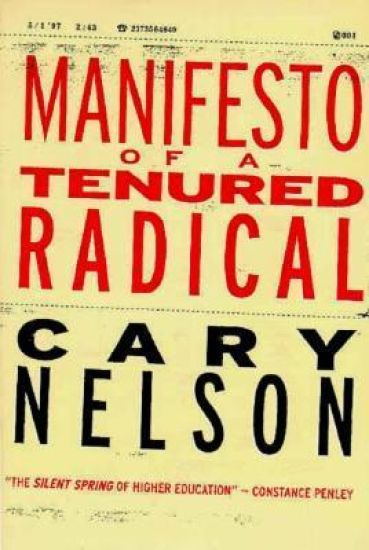
Manifesto of a Tenured Radical

Manifesto of a Tenured Radical

Cary Nelson

New York University Press
1997
sidottu
In an age when innovative scholarly work is at an all-time high, the academy itself is being rocked by structural change. Funding is plummeting. Tenure increasingly seems a prospect for only the elite few. Ph.D.'s are going begging for even adjunct work. Into this tumult steps Cary Nelson, with a no- holds-barred account of recent developments in higher education. Eloquent and witty, Manifesto of a Tenured Radical urges academics to apply the theoretical advances of the last twenty years to an analysis of their own practices and standards of behavior. In the process, Nelson offers a devastating critique of current inequities and a detailed proposal for change in the form of A Twelve-Step Program for Academia.
Manifesto of a Tenured Radical

Manifesto of a Tenured Radical

Cary Nelson

New York University Press
1997
pokkari
In an age when innovative scholarly work is at an all-time high, the academy itself is being rocked by structural change. Funding is plummeting. Tenure increasingly seems a prospect for only the elite few. Ph.D.'s are going begging for even adjunct work. Into this tumult steps Cary Nelson, with a no- holds-barred account of recent developments in higher education. Eloquent and witty, Manifesto of a Tenured Radical urges academics to apply the theoretical advances of the last twenty years to an analysis of their own practices and standards of behavior. In the process, Nelson offers a devastating critique of current inequities and a detailed proposal for change in the form of A Twelve-Step Program for Academia.
No University Is an Island

No University Is an Island

Cary Nelson

New York University Press
2010
sidottu
The modern university is sustained by academic freedom; it guarantees higher education's independence, its quality, and its success in educating students. The need to uphold those values would seem obvious. Yet the university is presently under siege from all corners; workers are being exploited with paltry salaries for full-time work, politics and profit rather than intellectual freedom govern decision-making, and professors are being monitored for the topics they teach. No University Is an Island offers a comprehensive account of the social, political, and cultural forces undermining academic freedom. At once witty and devastating, it confronts these threats with exceptional frankness, then offers a prescription for higher education's renewal. In an insider's account of how the primary organization for faculty members nationwide has fought the culture wars, Cary Nelson, the current President of the American Association of University Professors, unveils struggles over governance and unionization and the increasing corporatization of higher education. Peppered throughout with previously unreported, and sometimes incendiary, higher education anecdotes, Nelson is at his flame-throwing best. will be the benchmark against which we measure the current definitive struggle for academic freedom. The book calls on higher education's advocates of both the Left and the Right to temper conviction with tolerance and focus on higher education's real injustices. Nelson demands we stop denying teachers, student workers, and other employees a living wage and basic rights. He urges unions to take up the larger cause of justice. And he challenges his own and other academic organizations to embrace greater democracy. With broad and crucial implications for the future, No University Is an Island will be the benchmark against which we measure the current definitive struggle for academic freedom.


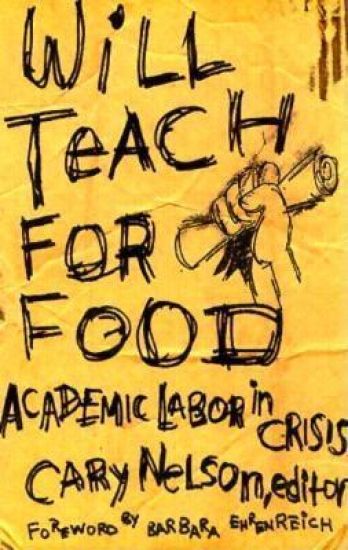
Will Teach For Food

Will Teach For Food

Cary Nelson

University of Minnesota Press
1997
nidottu
Academic labour has never been more vulnerable to exploitation, or more galvanized to action. Shrinking budgets, threats to tenure, job shortages for new PhDs, and an increasing reliance on graduate students and adjunct professors for teaching are the harsh reality on campuses all across the country. In this study, a group of scholars and activists address the state of the unions, and examine the issues behind the developing crisis in the academy. When graduate students at Yale University held a "grade strike" during the 1995-96 academic year, they were protesting against policies like downsizing, subcontracting, outsourcing - all of the strategies currently wreaking havoc with the larger US workforce. The debates at Yale mirror those on many campuses: whether graduate student teaching assistants are students or employees of the university; whether faculty are professional employees (and therefore part of university administration) or staff; what constitutes a reasonable teaching load and fair compensation. Here, participants in the Yale student strike describe the chronology of events and examine their larger implications, looking outward toward what workers on other campuses can learn from this student strike. Other articles assess the effect "corporate" universities have on the communities that surround them, place the strike in the context of US labour history, and analyze the effect technology has on academic freedom.
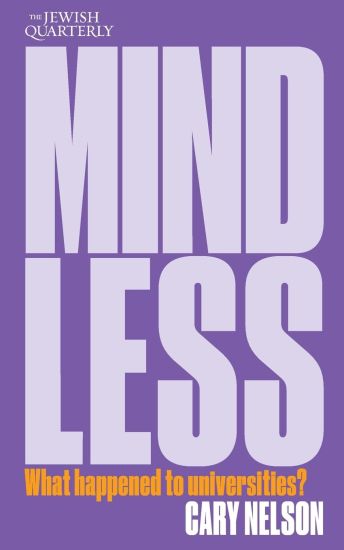
Mindless

Mindless

Cary Nelson

Jewish Quarterly
2025
pokkari
Extremism, antisemitism and intolerance are thriving on campus. How did this happen?"Some programmes are well on their way to running Zionists out of their unit. That will put an end to complaints of antisemitism." --Cary NelsonAfter October 7, the university - an institution dedicated to the search for truth, knowledge and freedom - became overrun by a toxic and dangerous fervour. Civil discourse was abandoned as campuses became the epicentre of hate speech, conspiracy theories and antisemitism. Yet, as Cary Nelson reveals, this betrayal of the university's ideals was decades in the making.In this groundbreaking essay, Nelson, an academic and writer whose years of involvement in university organisations has made him a leading expert on higher education, explains the causes of the institutional failure that has been evident on campuses worldwide. Mindless shows how universities came to abandon a commitment to shared intellectual principles and fractured into disciplines that - unconstrained and unchecked - slid towards conformity and indoctrination.