Kirjojen hintavertailu. Mukana 11 627 484 kirjaa ja 12 kauppaa.

Kirjahaku

Etsi kirjoja tekijän nimen, kirjan nimen tai ISBN:n perusteella.

19 kirjaa tekijältä Catherine Belsey

Poststructuralism: A Very Short Introduction

Poststructuralism: A Very Short Introduction

Catherine Belsey

Oxford University Press
2002
nidottu
Poststructuralism changes the way we understand the relations between human beings, their culture, and the world. Following a brief account of the historical relationship between structuralism and poststructuralism, this Very Short Introduction traces the key arguments that have led poststructuralists to challenge traditional theories of language and culture. Whilst the author discusses such well-known figures as Barthes, Foucault, Derrida, and Lacan, she also draws pertinent examples from literature, art, film, and popular culture, unfolding the postructuralist account of what it means to be a human being. ABOUT THE SERIES: The Very Short Introductions series from Oxford University Press contains hundreds of titles in almost every subject area. These pocket-sized books are the perfect way to get ahead in a new subject quickly. Our expert authors combine facts, analysis, perspective, new ideas, and enthusiasm to make interesting and challenging topics highly readable.
Poststructuralism

Poststructuralism

Catherine Belsey

Oxford University Press
2022
nidottu
Very Short Introductions: Brilliant, Sharp, Inspiring Poststructuralism challenges traditional ways of thinking about human beings and our relation to the world. Language, meaning, and culture are all reappraised, and with them assumptions about what it's possible for us to know. More interested in posing sharply focused questions than in reassuring with certainties, its theorists tend to clarify the options, while leaving them open to debate. At once sceptical towards inherited authority and positive about future possibilities, poststructuralism asks above all that we reflect on its findings. In this Very Short Introduction, Catherine Belsey traces the key arguments that have led poststructuralists to challenge traditional theories of language and culture. In this new edition, such well-known figures as Barthes, Foucault, and Derrida are joined by less famous theorists, and examples are drawn from both high art and popular culture. Shakespeare features alongside advertising and Christmas cards, as well as Lewis Carroll, Marcel Duchamp, Toni Morrison, and the tantalizing lithographs of M. C. Escher. ABOUT THE SERIES: The Very Short Introductions series from Oxford University Press contains hundreds of titles in almost every subject area. These pocket-sized books are the perfect way to get ahead in a new subject quickly. Our expert authors combine facts, analysis, perspective, new ideas, and enthusiasm to make interesting and challenging topics highly readable.
Culture and the Real

Culture and the Real

Catherine Belsey

Routledge
2004
sidottu
What makes us the people we are? Culture evidently plays a part, but how large a part? Is culture alone the source of our identities? Some have argued that human nature is the foundation of culture, others that culture is the foundation of human identity. Catherine Belsey calls for a more nuanced, relational account of what it is to be human, and in doing so puts forward a significant new theory of culture.Culture and the Real explains with Professor Belsey's characteristic lucidity the views of recent theorists, including Jean-François Lyotard, Judith Butler and Slavoj Zizek, as well as their debt to the earlier work of Kant and Hegel, in order to take issue with their accounts of what it is to be human. To explore the human, she demonstrates, is to acknowledge the relationship between culture and what we don't know: not the familiar world picture presented to us by culture as 'reality', but the unsayable, or the strange region that lies beyond culture, which Lacan has called 'the real'. Culture, she argues, registers a sense of its own limits in ways more subtle than the theorists allow.This volume builds on the insights of Belsey's influential Critical Practice to provide not only an accessible introduction to contemporary theories of what it is to be human, but a major new contribution to current debates about culture. Taking examples from film and art, fiction and poetry, Culture and the Real is essential reading for those studying or working in cultural criticism, within the fields of English, Cultural Studies, Film Studies and Art History.
Culture and the Real

Culture and the Real

Catherine Belsey

Routledge
2004
nidottu
What makes us the people we are? Culture evidently plays a part, but how large a part? Is culture alone the source of our identities? Some have argued that human nature is the foundation of culture, others that culture is the foundation of human identity. Catherine Belsey calls for a more nuanced, relational account of what it is to be human, and in doing so puts forward a significant new theory of culture.Culture and the Real explains with Professor Belsey's characteristic lucidity the views of recent theorists, including Jean-François Lyotard, Judith Butler and Slavoj Zizek, as well as their debt to the earlier work of Kant and Hegel, in order to take issue with their accounts of what it is to be human. To explore the human, she demonstrates, is to acknowledge the relationship between culture and what we don't know: not the familiar world picture presented to us by culture as 'reality', but the unsayable, or the strange region that lies beyond culture, which Lacan has called 'the real'. Culture, she argues, registers a sense of its own limits in ways more subtle than the theorists allow.This volume builds on the insights of Belsey's influential Critical Practice to provide not only an accessible introduction to contemporary theories of what it is to be human, but a major new contribution to current debates about culture. Taking examples from film and art, fiction and poetry, Culture and the Real is essential reading for those studying or working in cultural criticism, within the fields of English, Cultural Studies, Film Studies and Art History.
Critical Practice

Critical Practice

Catherine Belsey

Routledge
2002
sidottu
What is poststructuralist theory, and what difference does it make to literary criticism? Where do we find the meaning of the text: in the author's head? in the reader's? Or do we, instead, make meaning in the practice of reading itself? If so, what part do our own values play in the process of interpretation? And what is the role of the text? Catherine Belsey considers these and other questions concerning the relations between human beings and language, readers and texts, writing and cultural politics. Assuming no prior knowledge of poststructuralism, Critical Practice guides the reader confidently through the maze of contemporary theory. It simply and lucidly explains the views of key figures such as Louis Althusser, Roland Barthes, Jacques Lacan and Jacques Derrida, and shows their theories at work in readings of familiar literary texts.Critical Practice argues that theory matters, because it makes a difference to what we do when we read, opening up new possibilities for literary and cultural analysis. Poststructuralism, in conjunction with psychoanalysis and deconstruction, makes radical change to the way we read both a priority and a possibility.With a new chapter, updated guidance on further reading and revisions throughout, this second edition of Critical Practice is the ideal guide to the present and future of literary studies.
Critical Practice

Critical Practice

Catherine Belsey

Routledge
2002
nidottu
What is poststructuralist theory, and what difference does it make to literary criticism? Where do we find the meaning of the text: in the author's head? in the reader's? Or do we, instead, make meaning in the practice of reading itself? If so, what part do our own values play in the process of interpretation? And what is the role of the text? Catherine Belsey considers these and other questions concerning the relations between human beings and language, readers and texts, writing and cultural politics. Assuming no prior knowledge of poststructuralism, Critical Practice guides the reader confidently through the maze of contemporary theory. It simply and lucidly explains the views of key figures such as Louis Althusser, Roland Barthes, Jacques Lacan and Jacques Derrida, and shows their theories at work in readings of familiar literary texts.Critical Practice argues that theory matters, because it makes a difference to what we do when we read, opening up new possibilities for literary and cultural analysis. Poststructuralism, in conjunction with psychoanalysis and deconstruction, makes radical change to the way we read both a priority and a possibility.With a new chapter, updated guidance on further reading and revisions throughout, this second edition of Critical Practice is the ideal guide to the present and future of literary studies.
Desire

Desire

Catherine Belsey

JOHN WILEY AND SONS LTD
1994
nidottu
In the light of poststructuralist theory, and with reference to the work of Lacan and Derrida in particular, Catherine Belsey argues that fiction - including poetry, drama and film - is paradoxically the most serious location of writing about desire in Western cultura. Beginning with the celebration of true love in contemporary popular romance, and the reluctant scepticism of postmodern novels, she goes on to explore past representation of passion by Chretien de Troyes, Malory, Spenser, Donne, Keats, Edgar Allan Poe, Tennyson and Bram Stoker. Belsey also discusses the role of desire in the utopian writings of Plato, More and William Morris, as well as its treatment by a range of speculative feminists, from Charlotte perkins Gilman to Marge Piercy.
Shakespeare in Theory and Practice

Shakespeare in Theory and Practice

Catherine Belsey

Edinburgh University Press
2008
sidottu
Theory is valuable to the degree that it enables us to read differently: a nuanced approach shows that the most obvious interpretation is never the whole story. In these essays, brought together here for the first time, world-renowned critic Catherine Belsey puts theory to work in order to register Shakespeare's powers of seduction, together with his moment in history. Teasing out the meanings of the narrative poems, as well as some of the more familiar plays, Shakespeare in Theory and Practice demonstrates the possibilities of an attention to textuality that also draws on the archive. A reading of the Sonnets, written specially for this book, analyses their intricate and ambivalent inscription of desire. Belsey has been intimately involved with poststructuralism as it has emerged and developed in the English-speaking world. While the earliest essays published here are strongly influenced by Roland Barthes and Louis Althusser, both writers acknowledged a debt to the psychoanalytic account of representation as always unstable, designed at once to reveal and to repress, and Belsey's later work has come to owe more to Lacanian psychoanalysis, in addition to Derridean deconstruction.Between them, these essays trace the progress of theory in the course of three decades, while a new introduction offers a narrative and analytical overview, from a participant's perspective, of some of its key implications. Written with verve and conviction, this book shows how texts can be seen to offer access to the dissonances of the past when theory finds an outcome in practice. Key Features *A very special critic writing on the central figure of English literature *Provides an exemplary demonstration of poststructuralist theory at work *Pays particular attention to desire as a theme and as a component of interpretation *Provides close readings of the texts combining the historical and theoretical
Shakespeare in Theory and Practice

Shakespeare in Theory and Practice

Catherine Belsey

Edinburgh University Press
2010
nidottu
Theory is valuable to the degree that it enables us to read differently: a nuanced approach shows that the most obvious interpretation is never the whole story. In these essays, brought together here for the first time, world-renowned critic Catherine Belsey puts theory to work in order to register Shakespeare's powers of seduction, together with his moment in history. Teasing out the meanings of the narrative poems, as well as some of the more familiar plays, Shakespeare in Theory and Practice demonstrates the possibilities of an attention to textuality that also draws on the archive. A reading of the Sonnets, written specially for this book, analyses their intricate and ambivalent inscription of desire. Belsey has been intimately involved with poststructuralism as it has emerged and developed in the English-speaking world. While the earliest essays published here are strongly influenced by Roland Barthes and Louis Althusser, both writers acknowledged a debt to the psychoanalytic account of representation as always unstable, designed at once to reveal and to repress, and Belsey's later work has come to owe more to Lacanian psychoanalysis, in addition to Derridean deconstruction. Between them, these essays trace the progress of theory in the course of three decades, while a new introduction offers a narrative and analytical overview, from a participant's perspective, of some of its key implications. Written with verve and conviction, this book shows how texts can be seen to offer access to the dissonances of the past when theory finds an outcome in practice. Key Features *A very special critic writing on the central figure of English literature *Provides an exemplary demonstration of poststructuralist theory at work *Pays particular attention to desire as a theme and as a component of interpretation *Provides close readings of the texts combining the historical and theoretical
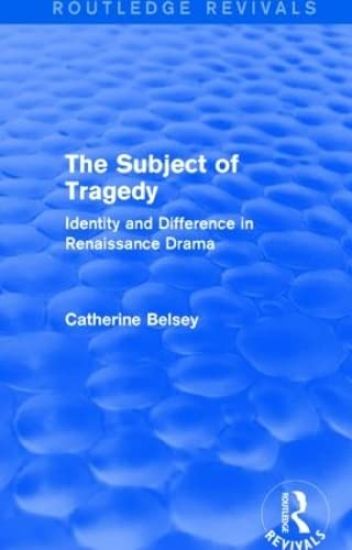
The Subject of Tragedy (Routledge Revivals)
First published in 1985, The Subject of Tragedy takes the drama of the sixteenth and seventeenth centuries as the starting point for an analysis of the differential identities of man and woman. Catherine Belsey charts, in a range of fictional and non-fictional texts, the production in the Renaissance of a meaning for subjectivity that is identifiably modern. The subject of liberal humanism – self-determining, free origin of language, choice and action – is highlighted as the product of a specific period in which man was the subject to which woman was related.
The Subject of Tragedy (Routledge Revivals)
First published in 1985, The Subject of Tragedy takes the drama of the sixteenth and seventeenth centuries as the starting point for an analysis of the differential identities of man and woman. Catherine Belsey charts, in a range of fictional and non-fictional texts, the production in the Renaissance of a meaning for subjectivity that is identifiably modern. The subject of liberal humanism – self-determining, free origin of language, choice and action – is highlighted as the product of a specific period in which man was the subject to which woman was related.
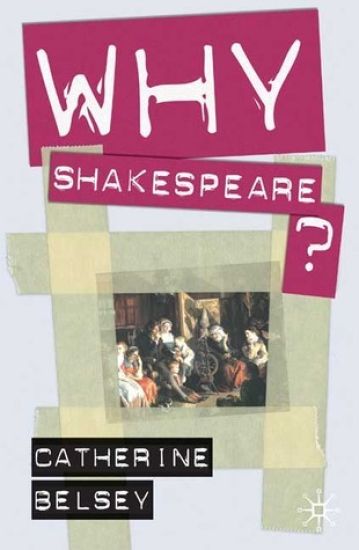
Why Shakespeare?

Why Shakespeare?

Catherine Belsey

Red Globe Press
2007
sidottu
Why is Shakespeare as highly regarded now as he ever has been? This book's answer to this question counters claims that Shakespeare's iconic status is no more than an accident of history. The plays, Belsey argues, entice us into a world we recognize by retelling traditional fairy tales with a difference, each chapter providing a detailed reading.
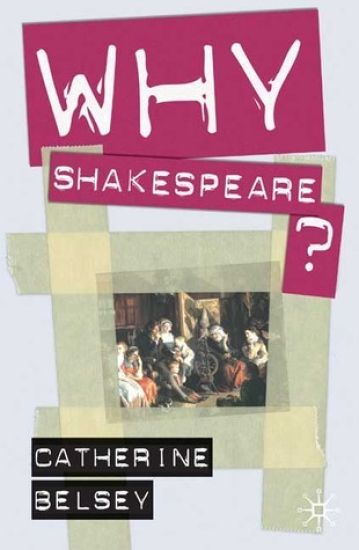
Why Shakespeare?

Why Shakespeare?

Catherine Belsey

Red Globe Press
2007
nidottu
Why is Shakespeare as highly regarded now as he ever has been? This book's answer to this question counters claims that Shakespeare's iconic status is no more than an accident of history. The plays, Belsey argues, entice us into a world we recognize by retelling traditional fairy tales with a difference, each chapter providing a detailed reading.
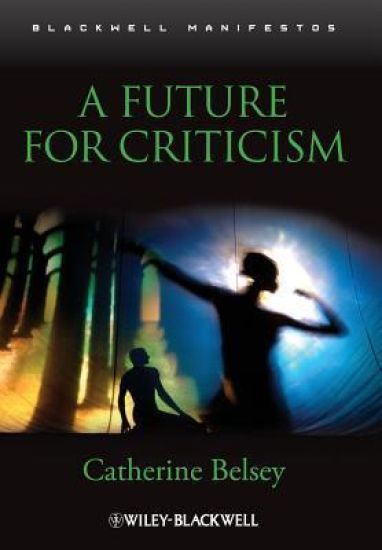
A Future for Criticism

A Future for Criticism

Catherine Belsey

Wiley-Blackwell (an imprint of John Wiley Sons Ltd)
2011
sidottu
A Future for Criticism considers why fiction gives so much pleasure, and the neglect of this issue in contemporary criticism. Offers a brief, lively, and accessible account of a new direction for critical practice, from one of Britain's most prominent literary theorists and criticsProposes a new path for future criticism, more open to reflecting on the pleasures of fictionWritten in a clear, jargon-free style, and illustrated throughout with numerous examples
Romeo and Juliet: Language and Writing

Romeo and Juliet: Language and Writing

Catherine Belsey

The Arden Shakespeare
2014
nidottu
Everyone knows the story of the star-crossed lovers but close attention to the language of the play can deepen and darken the legend. As icons of passion, Romeo and Juliet reveal the recklessness, as well as the idealism, of desire in a violent world. Catherine Belsey shows how you can tease out the play’s subtle meanings and goes on to discuss key adaptations, including the classic Baz Lurhmann film.
Romeo and Juliet: Language and Writing

Romeo and Juliet: Language and Writing

Catherine Belsey

The Arden Shakespeare
2014
sidottu
Everyone knows the story of the star-crossed lovers but close attention to the language of the play can deepen and darken the legend. As icons of passion, Romeo and Juliet reveal the recklessness, as well as the idealism, of desire in a violent world. Catherine Belsey shows how you can tease out the play’s subtle meanings and goes on to discuss key adaptations, including the classic Baz Lurhmann film.
Tales of the Troubled Dead

Tales of the Troubled Dead

Catherine Belsey

Edinburgh University Press
2019
sidottu
Considers the ways ghost stories appeal to our uneasy relationship with conventional good sense.What do they want, the ghosts that, even in the age of science, still haunt our storytelling? Catherine Belsey's answer to the question traces Gothic writing and tales of the uncanny from the ancient past to the present from Homer and the Icelandic sagas to Lincoln in the Bardo.Taking Shakespeare's Ghost in Hamlet as a turning point in the history of the genre, she uncovers the old stories the play relies on, as well as its influence on later writing. This ghostly trail is vividly charted through accredited records of apparitions and fiction by such writers as Ann Radcliffe, Washington Irving, Emily Bronte, Nathaniel Hawthorne, Henry James, M. R. James and Susan Hill. In recent blockbusting movies, too, ghost stories bring us fragments of news from the unknown.
Tales of the Troubled Dead

Tales of the Troubled Dead

Catherine Belsey

Edinburgh University Press
2019
nidottu
Considers the ways ghost stories appeal to our uneasy relationship with conventional good sense.What do they want, the ghosts that, even in the age of science, still haunt our storytelling? Catherine Belsey's answer to the question traces Gothic writing and tales of the uncanny from the ancient past to the present from Homer and the Icelandic sagas to Lincoln in the Bardo.Taking Shakespeare's Ghost in Hamlet as a turning point in the history of the genre, she uncovers the old stories the play relies on, as well as its influence on later writing. This ghostly trail is vividly charted through accredited records of apparitions and fiction by such writers as Ann Radcliffe, Washington Irving, Emily Bronte, Nathaniel Hawthorne, Henry James, M. R. James and Susan Hill. In recent blockbusting movies, too, ghost stories bring us fragments of news from the unknown.
Criticism

Criticism

Catherine Belsey

Profile Books Ltd
2016
nidottu
Ideas in Profile: Small Introductions to Big Topics At the heart of criticism lies one question: What do you think of it? Every time we comment on an artefact, whether a poem, a play, a painting, a novel or a piano concerto, we are acting as critics, making our own judgements and interpretations. Among the most fundamental of human intellectual activities, criticism offers a starting point for many of our journeys towards understanding. Focusing particularly on stories, plays and poems, Criticism traces the central concepts and controversies in criticism, from Plato to Derrida, and from Romanticism to the death of the author. In the process, it reflects on criticism itself, the possibilities and options that confront casual readers, as well as reviewers, members of reading groups, students and teachers of English. How far do we make conscious choices about how and what we read (or view)? What do we conventionally look for in fiction? And what might we look for if we went beyond the conventional?