Kirjojen hintavertailu. Mukana 11 342 296 kirjaa ja 12 kauppaa.

Kirjahaku

Etsi kirjoja tekijän nimen, kirjan nimen tai ISBN:n perusteella.

20 kirjaa tekijältä Catherine Wilson

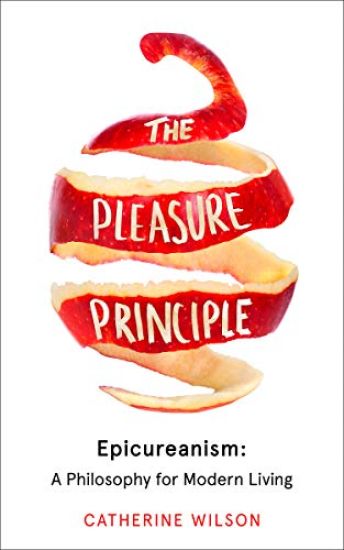
The Pleasure Principle

The Pleasure Principle

Catherine Wilson

HarperCollins Publishers Ltd
2019
sidottu
In our troubled world, looking back to ancient wisdom can shed light on fresh solutions. For years, many of us have upheld the Stoic belief in ‘no pain, no gain.’ But when the pace of modern life and the demands of jobs and family overwhelm us, punishing exercise regimes, productivity apps and early morning starts may not be the best solution. According to the pleasure-centric philosophy of Epicureanism, life can be good without great sacrifice. By consciously practicing ‘choice and avoidance’ – by being strategic about our recreational, professional and familial pursuits – we can live with less fear and regret. By understanding our place in a world that came about by chance, we can gain greater perspective on our role within it and where our priorities should lie. No honest philosopher can give you a formula for happiness, but in The Pleasure Principle, Professor Catherine Wilson explores how Epicureanism can provide a framework for thinking about life’s key issues, including family, death, politics, religion, wealth, science, and love.

Kant and the Naturalistic Turn of 18th Century Philosophy

Kant and the Naturalistic Turn of 18th Century Philosophy

Catherine Wilson

Oxford University Press
2022
sidottu
Kant's philosophy is usually treated according to 'internalist' textual methodology rather than contextually according to 'externalist' methodology. Kant and the Naturalistic Turn of 18th Century Philosophy presents transcendental idealism, the metaphysics of morals, and other Kantian innovations in philosophy as a reaction to 18th century developments in the life and human sciences. It interprets Kant's metaphysics as motivated by, on one hand, anxiety over the moral dangers he perceived in the empiricism of Buffon, Hume, Smith, and certain German materialists; and, on the other, his theological scepticism. Topics treated include cosmology and the fate of the earth, the mechanical philosophy and the problems of life, mind, and matter, historical pessimism, warfare and class consciousness, and the role of women in 18th century society. This book sheds new light on all major aspects of Kant's philosophy and opens avenues for further research.
Moral Animals

Moral Animals

Catherine Wilson

Clarendon Press
2007
nidottu
In Moral Animals Catherine Wilson develops a theory of morality based on two fundamental premises: first that moral progress implies the evolution of moral ideals involving restraint and sacrifice; second that human beings are outfitted by nature with selfish motivations, intentions, and ambitions that place constraints on what morality can demand of them. Normative claims, she goes on to show, can be understood as projective hypotheses concerning the conduct of realistically-described nonideal agents in preferred fictional worlds. Such claims differ from empirical hypotheses, insofar as they cannot be verified by observation and experiment. Yet many, though not all, moral claims are susceptible of confirmation to the extent that they command the agreement of well-informed inquirers. With this foundation in place, Wilson turns to a defence of egalitarianism intended to address the objection that the importance of our non-moral projects, our natural acquisitiveness and partiality, and our meritocratic commitments render social equality a mere abstract ideal. Employing the basic notion of a symmetrical division of the co-operative surplus, she argues that social justice with respect to global disparities in well-being, and in the condition of women relative to men, depends on the relinquishment of natural and acquired advantage that is central to the concept of morality.
Epicureanism at the Origins of Modernity

Epicureanism at the Origins of Modernity

Catherine Wilson

Oxford University Press
2008
sidottu
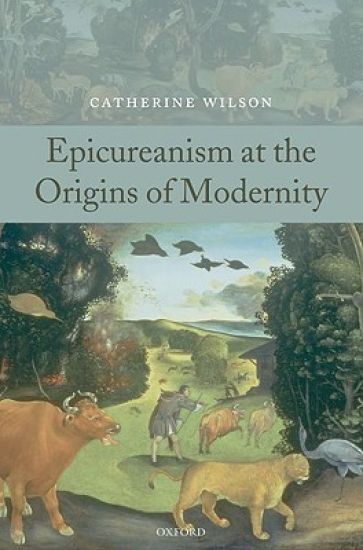
This landmark study examines the role played by the rediscovery of the writings of the ancient atomists, Epicurus and Lucretius, in the articulation of the major philosophical systems of the seventeenth century, and, more broadly, their influence on the evolution of natural science and moral and political philosophy. The target of sustained and trenchant philosophical criticism by Cicero, and of opprobrium by the Christian Fathers of the early Church, for its unflinching commitment to the absence of divine supervision and the finitude of life, the Epicurean philosophy surfaced again in the period of the Scientific Revolution, when it displaced scholastic Aristotelianism. Both modern social contract theory and utilitarianism in ethics were grounded in its tenets. Catherine Wilson shows how the distinctive Epicurean image of the natural and social worlds took hold in philosophy, and how it is an acknowledged, and often unacknowledged presence in the writings of Descartes, Gassendi, Hobbes, Boyle, Locke, Leibniz, Berkeley. With chapters devoted to Epicurean physics and cosmology, the corpuscularian or "mechanical" philosophy, the question of the mortality of the soul, the grounds of political authority, the contested nature of the experimental philosophy, sensuality, curiosity, and the role of pleasure and utility in ethics, the author makes a persuasive case for the significance of materialism in seventeenth-century philosophy without underestimating the depth and significance of the opposition to it, and for its continued importance in the contemporary world. Lucretius's great poem, On the Nature of Things, supplies the frame of reference for this deeply-researched inquiry into the origins of modern philosophy. .
Moral Animals

Moral Animals

Catherine Wilson

Clarendon Press
2004
sidottu
In Moral Animals, Catherine Wilson develops a theory of morality based on two fundamental premises: first that moral progress implies the evolution of moral ideals involving restraint and sacrifice; second that human beings are outfitted by nature with selfish motivations, intentions, and ambitions that place constraints on what morality can demand of them. Normative claims, she goes on to show, can be understood as projective hypotheses concerning the conduct of realistically-described nonideal agents in preferred fictional worlds. Such claims differ from empirical hypotheses, insofar as they cannot be verified by observation and experiment. Yet many, though not all, moral claims are susceptible of confirmation to the extent that they command the agreement of well-informed inquirers. With this foundation in place, Wilson turns to a defence of egalitarianism intended to address the objection that the importance of our non-moral projects, our natural acquisitiveness and partiality, and our meritocratic commitments render social equality a mere abstract ideal. Employing the basic notion of a symmetrical division of the co-operative surplus, she argues that social justice with respect to global disparities in well-being, and in the condition of women relative to men, depends on the relinquishment of natural and acquired advantage that is central to the concept of morality.
Epicureanism at the Origins of Modernity

Epicureanism at the Origins of Modernity

Catherine Wilson

Oxford University Press
2010
nidottu
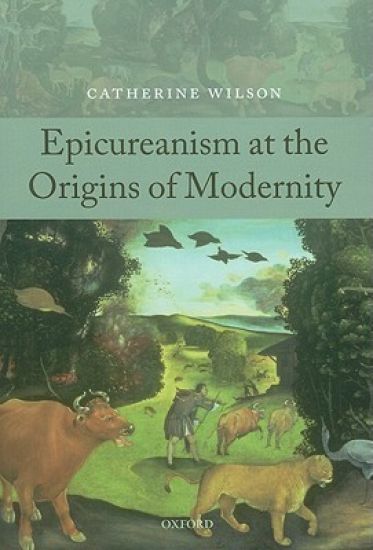
This landmark study examines the role played by the rediscovery of the writings of the ancient atomists, Epicurus and Lucretius, in the articulation of the major philosophical systems of the seventeenth century, and, more broadly, their influence on the evolution of natural science and moral and political philosophy. The target of sustained and trenchant philosophical criticism by Cicero, and of opprobrium by the Christian Fathers of the early Church, for its unflinching commitment to the absence of divine supervision and the finitude of life, the Epicurean philosophy surfaced again in the period of the Scientific Revolution, when it displaced scholastic Aristotelianism. Both modern social contract theory and utilitarianism in ethics were grounded in its tenets. Catherine Wilson shows how the distinctive Epicurean image of the natural and social worlds took hold in philosophy, and how it is an acknowledged, and often unacknowledged presence in the writings of Descartes, Gassendi, Hobbes, Boyle, Locke, Leibniz, Berkeley. With chapters devoted to Epicurean physics and cosmology, the corpuscularian or "mechanical" philosophy, the question of the mortality of the soul, the grounds of political authority, the contested nature of the experimental philosophy, sensuality, curiosity, and the role of pleasure and utility in ethics, the author makes a persuasive case for the significance of materialism in seventeenth-century philosophy without underestimating the depth and significance of the opposition to it, and for its continued importance in the contemporary world. Lucretius's great poem, On the Nature of Things, supplies the frame of reference for this deeply-researched inquiry into the origins of modern philosophy. .
Epicureanism

Epicureanism

Catherine Wilson

Oxford University Press
2015
nidottu
Epicureanism is commonly associated with a carefree view of life and the pursuit of pleasures, particularly the pleasures of the table. However it was a complex and distinctive system of philosophy that emphasized simplicity and moderation, and considered nature to consist of atoms and the void. Epicureanism is a school of thought whose legacy continues to reverberate today. In this Very Short Introduction, Catherine Wilson explains the key ideas of the School, comparing them with those of the rival Stoics and with Kantian ethics, and tracing their influence on the development of scientific and political thought from Locke, Newton, and Galileo to Rousseau, Marx, Bentham, and Mill. She discusses the adoption and adaptation of Epicurean motifs in science, morality, and politics from the 17th Century onwards and contextualises the significance of Epicureanism in modern life. ABOUT THE SERIES: The Very Short Introductions series from Oxford University Press contains hundreds of titles in almost every subject area. These pocket-sized books are the perfect way to get ahead in a new subject quickly. Our expert authors combine facts, analysis, perspective, new ideas, and enthusiasm to make interesting and challenging topics highly readable.
Descartes's Meditations

Descartes's Meditations

Catherine Wilson

Cambridge University Press
2003
pokkari
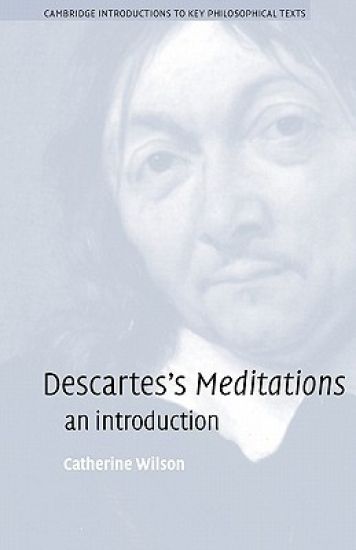
In this new introduction to a classic philosophical text, Catherine Wilson examines the arguments of Descartes’ famous Meditations, the book which launched modern philosophy. Drawing on the reinterpretations of Descartes’ thought of the past twenty-five years, she shows how Descartes constructs a theory of the mind, the body, nature, and God from a premise of radical uncertainty. She discusses in detail the historical context of Descartes’ writings and their relationship to early modern science, and at the same time she introduces concepts and problems that define the philosophical enterprise as it is understood today. Following closely the text of the Meditations and meant to be read alongside them, this survey is accessible to readers with no previous background in philosophy. It is well-suited to university-level courses on Descartes, but can also be read with profit by students in other disciplines.
Descartes's Meditations

Descartes's Meditations

Catherine Wilson

Cambridge University Press
2003
sidottu
In this new introduction to a classic philosophical text, Catherine Wilson examines the arguments of Descartes’ famous Meditations, the book which launched modern philosophy. Drawing on the reinterpretations of Descartes’ thought of the past twenty-five years, she shows how Descartes constructs a theory of the mind, the body, nature, and God from a premise of radical uncertainty. She discusses in detail the historical context of Descartes’ writings and their relationship to early modern science, and at the same time she introduces concepts and problems that define the philosophical enterprise as it is understood today. Following closely the text of the Meditations and meant to be read alongside them, this survey is accessible to readers with no previous background in philosophy. It is well-suited to university-level courses on Descartes, but can also be read with profit by students in other disciplines.
The Invisible World

The Invisible World

Catherine Wilson

Princeton University Press
1997
pokkari
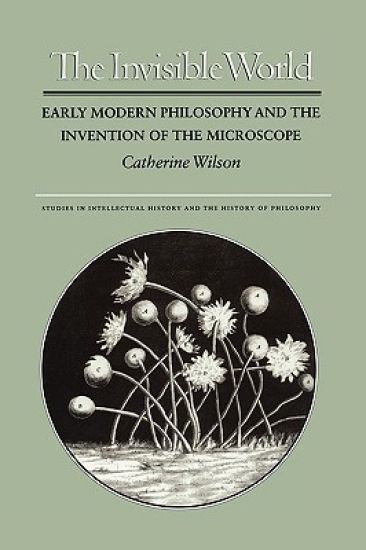
In the seventeenth century the microscope opened up a new world of observation, and, according to Catherine Wilson, profoundly revised the thinking of scientists and philosophers alike. The interior of nature, once closed off to both sympathetic intuition and direct perception, was now accessible with the help of optical instruments. The microscope led to a conception of science as an objective, procedure-driven mode of inquiry and renewed interest in atomism and mechanism. Focusing on the earliest forays into microscopical research, from 1620 to 1720, this book provides us with both a compelling technological history and a lively assessment of the new knowledge that helped launch philosophy into the modern era. Wilson argues that the discovery of the microworld--and the apparent role of living animalcula in generation, contagion, and disease--presented metaphysicians with the task of reconciling the ubiquity of life with human-centered theological systems. It was also a source of problems for philosophers concerned with essences, qualities, and the limits of human knowledge, whose positions are echoed in current debates about realism and instrument-mediated knowledge. Covering the contributions of pioneering microscopists (Leeuwenhoek, Swammerdam, Malpighi, Grew, and Hooke) and the work of philosophers interested in the microworld (Bacon, Descartes, Leibniz, Malebranche, Locke, and Berkeley), she challenges historians who view the abstract sciences as the sole catalyst of the Scientific Revolution as she stresses the importance of observational and experimental science to the modern intellect.
Leibniz's metaphysics

Leibniz's metaphysics

Catherine Wilson

Princeton University Press
2015
pokkari
This study of the metaphysics of G. W. Leibniz gives a clear picture of his philosophical development within the general scheme of seventeenth-century natural philosophy. Catherine Wilson examines the shifts in Leibniz's thinking as he confronted the major philosophical problems of his era. Beginning with his interest in artificial languages and calculi for proof and discovery, the author proceeds to an examination of Leibniz's early theories of matter and motion, to the phenomenalistic turn in his theory of substance and his subsequent de-emphasis of logical determinism, and finally to his doctrines of harmony and optimization. Specific attention is given to Leibniz's understanding of Descartes and his successors, Malebranche and Spinoza, and the English philosophers Newton, Cudworth, and Locke.Wilson analyzes Leibniz's complex response to the new mechanical philosophy, his discontent with the foundations on which it rested, and his return to the past to locate the resources for reconstructing it. She argues that the continuum-problem is the key to an understanding not only of Leibniz's monadology but also of his views on the substantiality of the self and the impossibility of external causal influence. A final chapter considers the problem of Leibniz-reception in the post-Kantian era, and the difficulty of coming to terms with a metaphysics that is not only philosophically "critical" but, at the same time, "compensatory."Originally published in 1990.The Princeton Legacy Library uses the latest print-on-demand technology to again make available previously out-of-print books from the distinguished backlist of Princeton University Press. These editions preserve the original texts of these important books while presenting them in durable paperback and hardcover editions. The goal of the Princeton Legacy Library is to vastly increase access to the rich scholarly heritage found in the thousands of books published by Princeton University Press since its founding in 1905.
Leibniz's Metaphysics

Leibniz's Metaphysics

Catherine Wilson

Princeton University Press
2016
sidottu
This study of the metaphysics of G. W. Leibniz gives a clear picture of his philosophical development within the general scheme of seventeenth-century natural philosophy. Catherine Wilson examines the shifts in Leibniz's thinking as he confronted the major philosophical problems of his era. Beginning with his interest in artificial languages and calculi for proof and discovery, the author proceeds to an examination of Leibniz's early theories of matter and motion, to the phenomenalistic turn in his theory of substance and his subsequent de-emphasis of logical determinism, and finally to his doctrines of harmony and optimization. Specific attention is given to Leibniz's understanding of Descartes and his successors, Malebranche and Spinoza, and the English philosophers Newton, Cudworth, and Locke.Wilson analyzes Leibniz's complex response to the new mechanical philosophy, his discontent with the foundations on which it rested, and his return to the past to locate the resources for reconstructing it. She argues that the continuum-problem is the key to an understanding not only of Leibniz's monadology but also of his views on the substantiality of the self and the impossibility of external causal influence. A final chapter considers the problem of Leibniz-reception in the post-Kantian era, and the difficulty of coming to terms with a metaphysics that is not only philosophically "critical" but, at the same time, "compensatory."Originally published in 1990.The Princeton Legacy Library uses the latest print-on-demand technology to again make available previously out-of-print books from the distinguished backlist of Princeton University Press. These editions preserve the original texts of these important books while presenting them in durable paperback and hardcover editions. The goal of the Princeton Legacy Library is to vastly increase access to the rich scholarly heritage found in the thousands of books published by Princeton University Press since its founding in 1905.
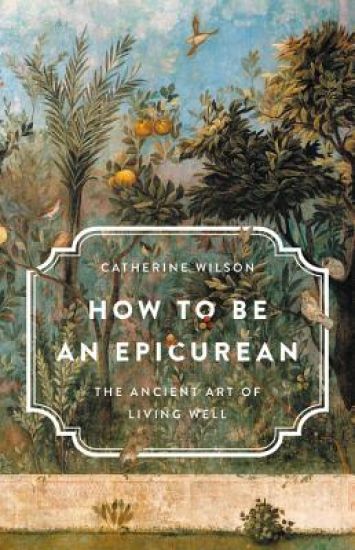
How to Be an Epicurean: The Ancient Art of Living Well
A leading philosopher shows that if the pursuit of happiness is the question, Epicureanism is the answer Epicureanism has a reputation problem, bringing to mind gluttons with gout or an admonition to eat, drink, and be merry. In How to Be an Epicurean, philosopher Catherine Wilson shows that Epicureanism isn't an excuse for having a good time: it's a means to live a good life. Although modern conveniences and scientific progress have significantly improved our quality of life, many of the problems faced by ancient Greeks -- love, money, family, politics -- remain with us in new forms. To overcome these obstacles, the Epicureans adopted a philosophy that promoted reason, respect for the natural world, and reverence for our fellow humans. By applying this ancient wisdom to a range of modern problems, from self-care routines and romantic entanglements to issues of public policy and social justice, Wilson shows us how we can all fill our lives with purpose and pleasure.