Kirjojen hintavertailu. Mukana 11 348 342 kirjaa ja 12 kauppaa.

Kirjahaku

Etsi kirjoja tekijän nimen, kirjan nimen tai ISBN:n perusteella.

4 kirjaa tekijältä Cato Gulaker

Satan, the Heavenly Adversary of Man

Satan, the Heavenly Adversary of Man

Cato Gulaker

T. T.Clark Ltd
2020
sidottu
Cato Gulaker employs narrative criticism to explore where the depiction of Satan found in the Book of Revelation is positioned on the axis of two divergent roles. The literary character of Satan is commonly perceived to gradually evolve from the first divine agents in the Hebrew Bible, representing the darker sides of the divine governing of affairs (Job 1–2; Zech 3; 1 Chr 21:1; Num 22:22, 32), to the full-blown enemy of God of the post-biblical era. However, Gulaker posits that texts referring to Satan in between these two poles are not uniform and diverge considerably. This book argues for a new way of perceiving Satan in Revelation that provides a more probable reading, as it creates less narrative dissonance than the alternative of the ancient combat myth/cosmic conflict between Satan and God. From this reading emerges a subdued Satan more akin to its Hebrew Bible hypotexts and Second Temple Judaism parallels – one that fits seamlessly with the theology, cosmology and the overarching plot of the narrative itself. Gulaker explores the functions of Satan in a text written relatively late compared to the rest of the New Testament, but with strong affinities to the Hebrew Bible, concluding that Satan is characterized more as the leash, rod, and sifting device in the hand of God, than as his enemy.
Satan, the Heavenly Adversary of Man

Satan, the Heavenly Adversary of Man

Cato Gulaker

BLOOMSBURY PUBLISHING PLC
2022
nidottu
Cato Gulaker employs narrative criticism to explore where the depiction of Satan found in the Book of Revelation is positioned on the axis of two divergent roles. The literary character of Satan is commonly perceived to gradually evolve from the first divine agents in the Hebrew Bible, representing the darker sides of the divine governing of affairs (Job 1–2; Zech 3; 1 Chr 21:1; Num 22:22, 32), to the full-blown enemy of God of the post-biblical era. However, Gulaker posits that texts referring to Satan in between these two poles are not uniform and diverge considerably. This book argues for a new way of perceiving Satan in Revelation that provides a more probable reading, as it creates less narrative dissonance than the alternative of the ancient combat myth/cosmic conflict between Satan and God. From this reading emerges a subdued Satan more akin to its Hebrew Bible hypotexts and Second Temple Judaism parallels – one that fits seamlessly with the theology, cosmology and the overarching plot of the narrative itself. Gulaker explores the functions of Satan in a text written relatively late compared to the rest of the New Testament, but with strong affinities to the Hebrew Bible, concluding that Satan is characterized more as the leash, rod, and sifting device in the hand of God, than as his enemy.
For Those Given

For Those Given

Cato Gulaker

PETER LANG PUBLISHING INC
2022
sidottu
This book provides a literary analysis of New Testament texts on marriage, sex, family, and celibate ideals. It seeks to explore if, how, and eventually to what extent the New Testament favors sexual abstinence. The core of this study consequently consists of fresh perspectives on the issue of sexual abstinence in the New Testament through close readings of 1 Cor 7, Gal 3:28, Matt 19:10–12, and Mark 12:18–27/Matt 22:23–33/Luke 20:27–40, with a keen eye to the many ambassadors of abstinence in the texts—characters exhibiting sexual abstinence given a favorable characterization and function. As a comprehensive literary analysis of these texts from this perspective lacks precedent in contemporary biblical scholarship, the study is a valuable contribution to the ongoing scholarly debate on the biblical views on sex and marriage.
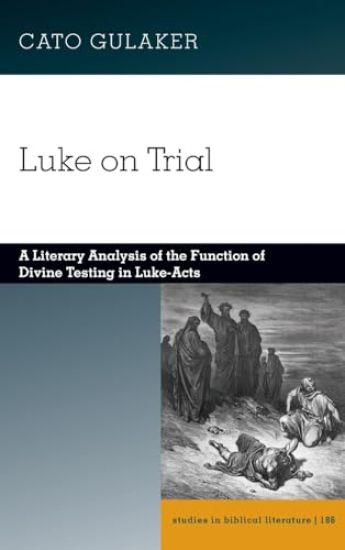
Luke on Trial

Luke on Trial

Cato Gulaker

PETER LANG PUBLISHING INC
2024
sidottu
This book presents a significant new interpretation of the role of divine testing in Luke-Acts. By using narrative criticism, fresh insights are offered on these texts, which are often considered "difficult" or "unintelligible" by modern readers. Author Cato Gulaker argues that the numerous allusions to divine testing make good sense within the theological rationale of Luke, including the idea of praying to God in order for him not to lead his petitioners into temptation. As this element of the New Testament writings in general, and Luke in particular, is frequently overlooked in academic publications, this book will be vital for scholars, clergy, and general readers interested in the theology and cosmology of the two-part Lukan narrative. "One of the main themes in Luke’s Gospel and Acts of the Apostles is that life is a series of trials, and that God Himself is the tester-in-chief. Gulaker brings this theme to the fore as never before, and shows us the true meaning of ‘lead us not into temptation.’" —Henry Ansgar Kelly, Distinguished Research Professor, English Department, University of California, Los Angeles "In this careful study of Luke-Acts, Cato Gulaker argues that the figure of Satan should be interpreted as an agent of divine testing within a monistic worldview. Rather than an independent cosmic enemy of God and the church, Satan operates with divine authority to test, validate or disqualify the discipleship of members of the Christian community. Gulaker’s highly stimulating work continues to cast new light on the shadowy figure of Satan in the New Testament." —Paul Middleton, Professor of New Testament and Early Christianity, University of Chester