Kirjojen hintavertailu. Mukana 12 016 292 kirjaa ja 12 kauppaa.

Kirjahaku

Etsi kirjoja tekijän nimen, kirjan nimen tai ISBN:n perusteella.

4 kirjaa tekijältä Chad Wellmon

Becoming Human

Becoming Human

Chad Wellmon

Pennsylvania State University Press
2010
sidottu
Immanuel Kant wrote that his infamously academic, arid philosophy posed three questions: What can I know? What can I do? What can I be permitted to hope for? He then added a fourth that he claimed would subsume them all: What is the human? This last question, he suggested, could be answered by a new science of man called anthropology. In Becoming Human, Chad Wellmon recounts the emergence of anthropology around a question that had become too capacious for a single discipline and too unstable for the distinctions that had come to ground Enlightenment modernity—distinctions between nature and culture, body and mind, human and animal, European and non-European. If, as Friedrich Schlegel wrote, we don’t even know “what the human is,” then what would a science of the human base itself on? How would it be possible and why would it even be necessary? This book is an intellectual and literary history of how these questions took form in late eighteenth-century Germany. By examining this period of anthropological discourse through the works of thinkers such as Kant, Novalis, Schleiermacher, Wilhelm von Humboldt, and Goethe, Wellmon argues that the crisis of a late eighteenth-century anthropology marks the emergence of a modernity that sees itself as condemned to draw its norms and very self-understanding from itself. Modernity became fully modern when it became fully reflexive—that is, sensitive to the paradoxical and possibly futile nature of the modern project.
Becoming Human

Becoming Human

Chad Wellmon

Pennsylvania State University Press
2014
pokkari
Immanuel Kant wrote that his infamously academic, arid philosophy posed three questions: What can I know? What can I do? What can I be permitted to hope for? He then added a fourth that he claimed would subsume them all: What is the human? This last question, he suggested, could be answered by a new science of man called anthropology. In Becoming Human, Chad Wellmon recounts the emergence of anthropology around a question that had become too capacious for a single discipline and too unstable for the distinctions that had come to ground Enlightenment modernity—distinctions between nature and culture, body and mind, human and animal, European and non-European. If, as Friedrich Schlegel wrote, we don’t even know “what the human is,” then what would a science of the human base itself on? How would it be possible and why would it even be necessary? This book is an intellectual and literary history of how these questions took form in late eighteenth-century Germany. By examining this period of anthropological discourse through the works of thinkers such as Kant, Novalis, Schleiermacher, Wilhelm von Humboldt, and Goethe, Wellmon argues that the crisis of a late eighteenth-century anthropology marks the emergence of a modernity that sees itself as condemned to draw its norms and very self-understanding from itself. Modernity became fully modern when it became fully reflexive—that is, sensitive to the paradoxical and possibly futile nature of the modern project.
Organizing Enlightenment

Organizing Enlightenment

Chad Wellmon

Johns Hopkins University Press
2016
pokkari
Since its inception, the research university has been the central institution of knowledge in the West. Today its intellectual authority is being challenged on many fronts, above all by radical technological change. Organizing Enlightenment tells the story of how the university emerged in the early nineteenth century at a similarly fraught moment of cultural anxiety about revolutionary technologies and their disruptive effects on established institutions of knowledge. Drawing on the histories of science, the university, and print, as well as media theory and philosophy, Chad Wellmon explains how the research university and the ethic of disciplinarity it created emerged as the final and most lasting technology of the Enlightenment. Organizing Enlightenment reveals higher education's story as one not only of the production of knowledge but also of the formation of a particular type of person: the disciplinary self. In order to survive, the university would have to institutionalize a new order of knowledge, one that was self-organizing, internally coherent, and embodied in the very character of the modern, critical scholar.
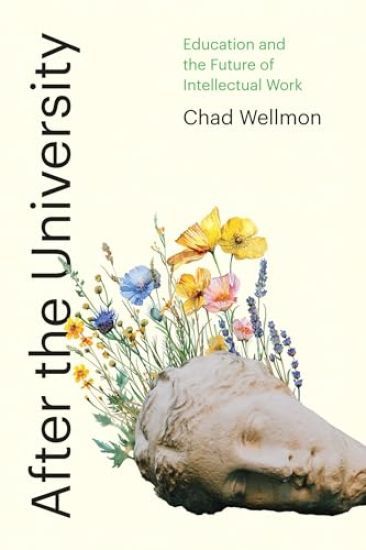
After the University

After the University

Chad Wellmon

Johns Hopkins University Press
2026
sidottu
When the pursuit of knowledge is eclipsed by money and power, what remains of higher learning? What is a university for? Is it a sanctuary for disciplined study, or has it become something else entirely? In After the University, Chad Wellmon traces the long and often uneasy relationship between higher learning and the institutions that claim to protect it. Moving from the guilds of medieval Paris and the knowledge factories of Enlightenment-era Göttingen to the research empires of Berlin and Berkeley, Wellmon shows how the modern university has repeatedly reshaped itself to serve shifting social and political demands. Across centuries, the goods of disciplined study—the joy of reading, the virtues of intellectual rigor, and the possibility of self-formation—have been overshadowed by the pursuit of external rewards such as money, prestige, and power. Part institutional history and part philosophical reflection, After the University examines how today's institutions defend themselves not in the name of learning but in the language of productivity, innovation, and economic utility. Drawing on his experiences as a scholar, teacher, administrator, and witness to crises such as white supremacist marches and the COVID-19 pandemic, Wellmon illustrates how universities justify themselves through the outputs of graduates, research discoveries, and workforce training while leaving unmentioned the very practices that once defined them. Despite this transformation, Wellmon argues that the university's current state of turmoil exposes a new, enticing possibility: recognizing the practices of disciplined study as goods worth valuing in and of themselves rather than simply as means to other ends. With insight and urgency, After the University asks whether our institutions can still nurture intellectual desire—or whether we must find new homes for the life of the mind.