Kirjojen hintavertailu. Mukana 11 627 220 kirjaa ja 12 kauppaa.

Kirjahaku

Etsi kirjoja tekijän nimen, kirjan nimen tai ISBN:n perusteella.

6 kirjaa tekijältä Chandra Shekhar Kumar

Advanced C++ FAQs: Volumes 1 & 2

Advanced C++ FAQs: Volumes 1 & 2

Chandra Shekhar Kumar

Createspace Independent Publishing Platform
2014
nidottu
This book is a combination of the following two books: Advanced C++ FAQs: Volume 1: FundamentalsAdvanced C++ FAQs: Volume 2: Generic Programming Advanced C++ FAQs: Volume 1: FundamentalsThis book is not an introduction to C++. It assumes that the reader is aware of the basics of C++98 and C++03 and is keen to expand her horizon to latest and greatest in the present and future of C++, including C++11 and C++1y(aka C++14). It contains selected fundamental problems with detailed solutions to all of these which will help the reader to hone her skills to solve a particular problem. Advanced C++ FAQs: Volume 2: Generic ProgrammingThis book is sequel to the first volume Advanced C++ FAQs: Volume 1: Fundamentals. It contains selected generic programming problems with detailed solutions. Algorithms1.1 Efficient Insertion in Vector 1.2 reverse algorithm for forward iterators ... 1.4 swapping unequal sections 1.5 rotate algorithm ... 1.9 Avoid Raw Loops ... 1.13 better algorithm than std:: rotate ... 1.16 reverse algorithm dispatch 1.17 Efficient Algorithm for reverse ... 1.21 is partitioned algorithm 1.22 Bisection Algorithm ... 1.25 advance and next 1.26 custom iota... Utilities2.1 std:: move is rvalue cast 2.2 std:: move if noexcept 2.3 std:: forward ... 2.6 is same Templates3.1 alias template 3.2 template parameter pack 3.3 override virtual and template ... ClassesNamespacesType SpecifiersConstant ExpressionC++14... 8.4 auto return type in function declaration ... 8.6 return type deduction for lambdas 8.7 decltype(auto) ... 8.9 explicit instantiation and auto 8.10 return type deduction and virtual ... 8.12 generalized lambda capture 8.13 generic lambda and product vector ... MiscellaneousMore C++1410.1 variable templates ... 10.5 static data member template ... 10.7 default argument and specialization of variable template10.8 lambda and variable template ... 10.15 auto variable template and generic lambda 10.16 constexpr member functions and implicit const 10.17 constexpr constructor and initialization ... 10.23 deprecated attribute 10.24 Member initializers and aggregate class ... 10.31 Type Transformation Aliases ... 10.33 make unique as perfect forwarding guy ...10.37 make unique and default initialization 10.38 make unique and array T n] ... 10.43 Extend make unique: T N] 10.44 allocate unique 10.45 Compile-time integer sequences ... 10.47 std:: index sequence 10.48 Custom Sequence: Addition ... 10.55 sfinae and represent type of function 10.56 metafunction: check presence of type member 10.57 std:: common type and sfinae Foundation11.1 private cast 11.2 Value Type Deduction Framework ...11.5 Template Alias and Rebind Template 11.6 Template Alias and Non Deducible Context ... 11.8 Template Alias and Specialization ... 11.13 std:: copy backward ... 11.18 iota n: iota for writing n items 11.19 Reverse iota ... 11.24 Preventing Name Hijacking ... 11.29 Move Constructor and unique pointer 11.30 Find First Null Pointer in a Container 11.31 Average of variable number of arguments ....11.33 Exchange Utility 11.34 Addressing Tuple By Type 11.35 Quoted manipulators 11.36 Null Iterator
C++14 FAQs

C++14 FAQs

Chandra Shekhar Kumar

Createspace Independent Publishing Platform
2014
nidottu
This book contains selected questions related to C++14 with detailed solutions to all of these which will help the reader to hone her skills to solve a particular problem. Primary sources of this collection are: Advanced C++ FAQs: Volume 1: Fundamentals Advanced C++ FAQs: Volume 2: Generic Programming Advanced C++ FAQs: Volumes 1 & 2 This book is not an introduction to C++. It assumes that the reader isaware of the basics of C++98 and C++03 and wants to expand her horizonto latest and greatest in C++14(aka C++1y). The problems are marked ona scale of one(*)(simplest) to five stars(*****)(hardest).Forthcoming volumes will strengthen this particular approach spanningvarious areas of C++. variable templates Constexpr static data members of class templates constexpr function templates .... static data member template specialization of variable template default argument and specialization of variable template lambda and variable template variable templates variables vary auto variable templates valid specialization but error ? variable templates and lambda revisited Incremental improvement to integral constant is same musings auto variable template and generic lambda constexpr member functions and implicit const .... constexpr vs static vs uninitialized constexpr vs member function revisited deprecated attribute Member initializers and aggregate class .... Data Member initializers time duration literals ... Compile Time binary Literal Operator Square Literal Operator Type Transformation Aliases unique ptr vs make unique as function argument make unique as perfect forwarding guy make unique and new .... make unique and default initialization with T ] Extend make unique: Support list initialization T ] Extend make unique: Value Initialize T ] Extend make unique: T N] allocate unique Compile-time integer sequences Simplified Creation of std:: integer sequence std:: index sequence Custom Sequence: Addition .... Custom Sequence: Split Extract from tuple convert std:: array to std:: tuple Piecewise construction of std:: pair Compile Time Integer Sequence Simplified sfinae and represent type of function metafunction: check presence of type member std:: common type and sfinae Contextual Conversion Single quotation mark as digit separator Binary Literals auto return type in function declaration return type deduction for function return type deduction for lambdas .... decltype(auto) return type deduction for function templates explicit instantiation and auto return type deduction and virtual deduce return type generalized lambda capture generic lambda and product vector generic lambda generic lambda definition conversion function of generic lambda generic lambda quiz Preventing Name Hijacking Find First Null Pointer in a Container Generic Operator Functors Exchange Utility Addressing Tuple By Type Quoted manipulators Null Iterator std:: move is rvalue cast C++14 Compiler
Conceptual Trigonometry Part I: A Companion to S. L. Loney's Plane Trigonometry Part I

Conceptual Trigonometry Part I: A Companion to S. L. Loney's Plane Trigonometry Part I

Chandra Shekhar Kumar

Createspace Independent Publishing Platform
2018
nidottu
Conceptual Trigonometry Part I: A Companion to S. L. Loney's Plane Trigonometry Part I. This work contains conceptual solutions to the problems and exercises given in the text book of Plane Trigonometry by S. L. Loney's including variations of problems, solutions, methods and approaches. These solutions strengthen and enliven the inherent multi-concepts to enrich the heritage set forth by S. L. Loney. The present work will serve as a complete guide to private students reading the subject with few or no opportunities of instruction. This will save the time and lighten the work of Teachers as well. This book helps in acquiring a better understanding of the basic principles of Plane Trigonometry and in revising a large amount of the subject matter quickly. Care has been taken, as in the forthcoming ones, to present the solutions with multi-concepts and beyond in a simple natural manner, in order to meet the difficulties which are most likely to arise, and to render the work intelligible and instructive.
Conceptual Kinematics: A Companion to I. E. Irodov's Problems in General Physics

Conceptual Kinematics: A Companion to I. E. Irodov's Problems in General Physics

Chandra Shekhar Kumar

Createspace Independent Publishing Platform
2018
nidottu
Conceptual Kinematics: A Companion to I. E. Irodov's Problems in General Physics. This work contains several variations of problems, solutions, methods, approaches related to Kinematics of I. E. Irodov's Problems in General Physics. These solutions strengthen and enliven the inherent multi-concepts including (but not limited to) analytics, graphical geometry, calculus, trigonometric geometry, scalar/vector algebra, differential equations, extrema without calculus to enrich the heritage set forth by I. E. Irodov. The present work will serve as a complete guide to private students reading the subject with few or no opportunities of instruction. This will save the time and lighten the work of Teachers as well. This book helps in acquiring a better understanding of the basic principles of Kinematics and in revising a large amount of the subject matter quickly. Care has been taken, as in the forthcoming ones, to present the solutions with multi-concepts and beyond in a simple natural manner, in order to meet the difficulties which are most likely to arise, and to render the work intelligible and instructive.
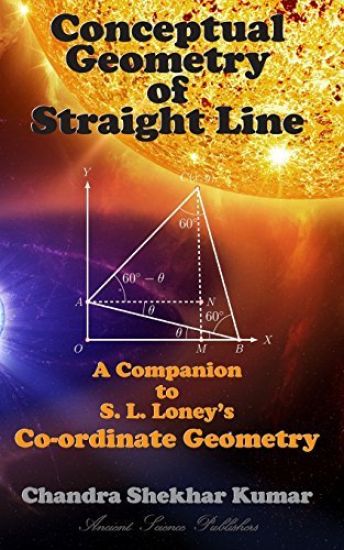
Conceptual Geometry of Straight Line: A Companion to S. L. Loney's Co-ordinate Geometry

Conceptual Geometry of Straight Line: A Companion to S. L. Loney's Co-ordinate Geometry

Chandra Shekhar Kumar

Createspace Independent Publishing Platform
2018
nidottu
Conceptual Geometry of Straight Line: A Companion to S. L. Loney's Co-ordinate Geometry. This work contains conceptual solutions to the problems and exercises given in Chapters I-VI (Covering Straight Line) of S. L. Loney's Co-ordinate Geometry including variations of problems, solutions, methods and approaches. These solutions strengthen and enliven the inherent multi-concepts to enrich the heritage set forth by S. L. Loney. The present work will serve as a complete guide to private students reading the subject with few or no opportunities of instruction. This will save the time and lighten the work of Teachers as well. This book helps in acquiring a better understanding of the basic principles of Straight Line (Co-ordinate Geometry) and in revising a large amount of the subject matter quickly. Care has been taken, as in the forthcoming ones, to present the solutions with multi-concepts and beyond in a simple natural manner, in order to meet the difficulties which are most likely to arise, and to render the work intelligible and instructive.
Solving Problems using Dynamic Programming: A Hacker's Perspective
Solving Problems using Dynamic Programming: A Hacker's Perspective. A hacker's approach to a coding problem is beyond the foundational aspect of underlying genetic and computational structures. A concept becomes not difficult because the complexities built into it are clarified. In a bid to reach the core of the problem, the concept is split-broken into fragments, complexities are exposed and delicate points are examined. Then the concept is recomposed to make it integral and as a result, this reintegrated concept becomes sufficiently simple and comprehensible. This helps build a hacker's insight to reveal the internal structure and internal logic of the concepts, algorithms and mathematical theorems. Beautiful (C++) code snippets. Unique yogic exposition to coding. (Ancient Science Hackers) This book provides a hacker's perspective to solving problems using dynamic programming. Written in an extremely lively form of problems and solutions (including code in modern C++ and pseudo style), this leads to extreme simplification of optimal coding with great emphasis on unconventional and integrated science of dynamic Programming. Though aimed primarily at serious programmers, it imparts the knowledge of deep internals of underlying concepts and beyond to computer scientists alike.