Kirjojen hintavertailu. Mukana 12 016 292 kirjaa ja 12 kauppaa.

Kirjahaku

Etsi kirjoja tekijän nimen, kirjan nimen tai ISBN:n perusteella.

3 kirjaa tekijältä Charles D. Freilich

Israeli National Security

Israeli National Security

Charles D. Freilich

Oxford University Press Inc
2018
sidottu
National security has been at the forefront of the Israeli experience for seven decades, with threats ranging from terrorism, to vast rocket and missile arsenals, and even existential nuclear dangers. Yet, despite its overwhelming preoccupation with foreign and defense affairs, Israel does not have a formal national security strategy. In Israeli National Security, Chuck Freilich presents an authoritative analysis of the military, diplomatic, demographic, and societal challenges Israel faces today, to propose a comprehensive and long-term Israeli national security strategy. The heart of the new strategy places greater emphasis on restraint, defense, and diplomacy as means of addressing the challenges Israel faces, along with the military capacity to deter and, if necessary, defeat Israel's adversaries, while also maintaining the resolve of its society. By bringing Israel's most critical debates about the Palestinians, demography, Iran, Hezbollah, Hamas, US relations and nuclear strategy into sharp focus, the strategy Freilich proposes addresses the primary challenges Israel must address in order to chart its national course. The most comprehensive study of Israel's national security to date, this book presents the first public proposal for a comprehensive Israeli national security strategy and prescribes an actionable course forward.
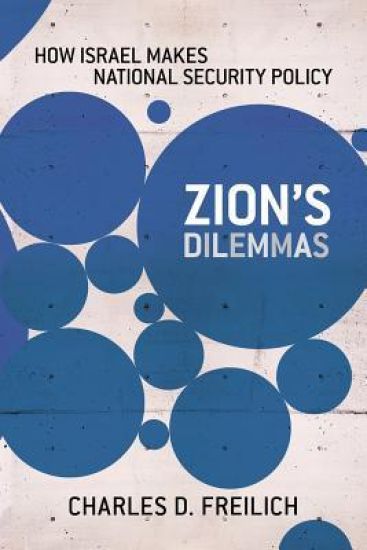
Zion's Dilemmas

Zion's Dilemmas

Charles D. Freilich

Cornell University Press
2012
sidottu
In Zion's Dilemmas, a former deputy national security advisor to the State of Israel details the history and, in many cases, the chronic inadequacies in the making of Israeli national security policy. Charles D. Freilich identifies profound, ongoing problems that he ascribes to a series of factors: a hostile and highly volatile regional environment, Israel's proportional representation electoral system, and structural peculiarities of the Israeli government and bureaucracy. Freilich uses his insider understanding and substantial archival and interview research to describe how Israel has made strategic decisions and to present a first of its kind model of national security decision-making in Israel. He analyzes the major events of the last thirty years, from Camp David I to the 1982 invasion of Lebanon, through Camp David II, the Gaza Disengagement Plan of 2005, and the second Lebanon war of 2006. In these and other cases he identifies opportunities forgone, failures that resulted from a flawed decision-making process, and the entanglement of Israeli leaders in an inconsistent, highly politicized, and sometimes improvisational planning process. The cabinet is dysfunctional and Israel does not have an effective statutory forum for its decision-making—most of which is thus conducted in informal settings. In many cases policy objectives and options are poorly formulated. For all these problems, however, the Israeli decision-making process does have some strengths, among them the ability to make rapid and flexible responses, generally pragmatic decision-making, effective planning within the defense establishment, and the skills and motivation of those involved. Freilich concludes with cogent and timely recommendations for reform.
Zion's Dilemmas

Zion's Dilemmas

Charles D. Freilich

Cornell University Press
2014
pokkari
In Zion's Dilemmas, a former deputy national security advisor to the State of Israel details the history and, in many cases, the chronic inadequacies in the making of Israeli national security policy. Charles D. Freilich identifies profound, ongoing problems that he ascribes to a series of factors: a hostile and highly volatile regional environment, Israel's proportional representation electoral system, and structural peculiarities of the Israeli government and bureaucracy. Freilich uses his insider understanding and substantial archival and interview research to describe how Israel has made strategic decisions and to present a first of its kind model of national security decision-making in Israel. He analyzes the major events of the last thirty years, from Camp David I to the 1982 invasion of Lebanon, through Camp David II, the Gaza Disengagement Plan of 2005, and the second Lebanon war of 2006. In these and other cases he identifies opportunities forgone, failures that resulted from a flawed decision-making process, and the entanglement of Israeli leaders in an inconsistent, highly politicized, and sometimes improvisational planning process. The cabinet is dysfunctional and Israel does not have an effective statutory forum for its decision-making—most of which is thus conducted in informal settings. In many cases policy objectives and options are poorly formulated. For all these problems, however, the Israeli decision-making process does have some strengths, among them the ability to make rapid and flexible responses, generally pragmatic decision-making, effective planning within the defense establishment, and the skills and motivation of those involved. Freilich concludes with cogent and timely recommendations for reform.