Kirjojen hintavertailu. Mukana 11 342 296 kirjaa ja 12 kauppaa.

Kirjahaku

Etsi kirjoja tekijän nimen, kirjan nimen tai ISBN:n perusteella.

2 kirjaa tekijältä Charles E. Watson

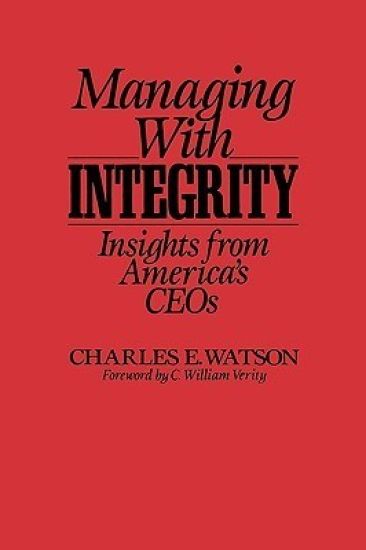
Managing with Integrity

Managing with Integrity

Charles E. Watson

Praeger Publishers Inc
1991
sidottu
This compelling work draws on the experiences of America's most successful business leaders to examine the issue of character in business. Based on interviews with 125 CEOs of major U.S. corporations, Managing with Integrity shows how it is possible for the businessperson to do what is right and run a profitable company at the same time. A wealth of practical examples and anecdotes demonstrates that even today, corporate America's most powerful figures tend to place what is ethical over what is expedient and adhere to a higher standard than is generally assumed by the public. By revealing the strategies these leaders employ in the face of the myriad challenges to character encountered in the day-to-day business world, the author provides invaluable insights for executives, managers, supervisors, professionals, and entrepreneurs confronted with their own ethical dilemmas. Readers will find Managing with Integrity both an unusually candid look at the dimensions of executive decision making and an eminently practical guide to the development of a workable moral philosophy for business.Is it possible for a decent human being to succeed in business? How does one find meaning in the business life? These are some of the questions asked by the author as he explores the difficulties associated with ethical thinking within the context of business. Finding that those persons and organizations that aspire to serve worthwhile purposes are ultimately the most profitable, he shows how businesses can and do prosper when high ethical and moral standards underlie executive decision making. Finally, the author examines the concept of success in business and describes the various dimensions of success which are most mentioned most often by the senior executives interviewed for the book. Written in an engaging and nontechnical style and filled with hundreds of real-world examples, Managing with Integrity offers an important counterweight to the cynicism that so often pervades popular thinking about corporate America.
How Honesty Pays

How Honesty Pays

Charles E. Watson

Praeger Publishers Inc
2005
sidottu
Against the all-too-familiar backdrop of corporate scandal and greed, Charles Watson provides what he calls a blueprint to help working men and women, from the tops of organizations to the bottoms, step forward and help restore and defend the integrity of business. Step by step, he outlines fifteen fundamental commandments of honest business—from put people first to be your own person—common-sensical approaches to making decisions, solving problems, and taking action in ways that deliver results without compromising on principles. Using dozens of compelling examples, from companies large and small, Watson demonstrates how honesty, integrity, and trust are at the root of such essential business concepts as creativity and innovation, risk taking, collaboration, attracting and retaining talented people, and anticipating and exceeding customer expectations. He also tackles such complex issues as how to prevent an ethical ego from becoming arrogant and how to stand your ground when faced with unethical competition, resistance from above or below, or the temptation to take the path of least resistance. Ultimately, he provides practical, not abstract or theoretical, recommendations for developing individuals and organizations that encourage authentic relationships, act in ways that society admires, and have the boldness to initiate action with conviction.Watson also tackles such complex issues as how to prevent an ethical ego from becoming arrogant and how to stand your ground when faced with unethical competition, resistance from above or below, or the temptation to take the path of least resistance. He reminds us that integrity is derived from the Latin integritas—oneness, a consistency of purpose, word, and deed. Applying this principle, he provides practical, not abstract or theoretical, recommendations for developing individuals and organizations that encourage authentic relationships, celebrate positive achievements, act in ways that society admires, and have the boldness to initiate action with conviction. Ultimately, Watson demonstrates that with courage and humility you can, indeed, do well by doing good—not only at work, but in all aspects of your life.