
Kirjahaku
Etsi kirjoja tekijän nimen, kirjan nimen tai ISBN:n perusteella.
8 kirjaa tekijältä Charles K. Rowley
This book is a key example of the emergence of public choice theory by an economist who was to become one of its major exponents. It combines a detailed, critical study of the Monopolies Commission, with an analysis of the economic issues involved in monopoly supervision and control.
This book is a key example of the emergence of public choice theory by an economist who was to become one of its major exponents. It combines a detailed, critical study of the Monopolies Commission, with an analysis of the economic issues involved in monopoly supervision and control.
'They have built a dam across the rivers of justice and then they complain of the drought in the field below.' - With these stinging words W. Clarke Durrant III, then Chairman of the Legal Services Corporation, admonished the American Bar Association in 1987 for its use of monopoly prices to exclude less affluent Americans from access to civil justice.The Right to Justice reviews the history of legal services in the US from its origins in the 1890s to the multi-million dollar Federal program of the late 20th century. But this is no ordinary text. Charles Rowley skilfully shows how government transfers tend to be dissipated in competitive rent-seeking by special interest groups, that much of what is left tends to be subverted to the agendas of the more powerful groups and that the residuals tend to be inefficiently managed by a poorly monitored and ideologically motivated supply bureaucracy. The upshot is that customer preferences play little or no role in the allocation of resources within the legal services budget.In a veritable tour de force, Charles Rowley places the US Federal legal services program on the scholarly rack of public choice - which analyses individual behaviour in terms of universal self-seeking motivations in a political market. He offers a convincing unique explanation of the forces that have subverted a well meaning attempt to assist poor Americans into a co ordinated attack on the central institutions of the family, capitalism and of Madisonian Republicanism which together constitute the essence of the American dream.
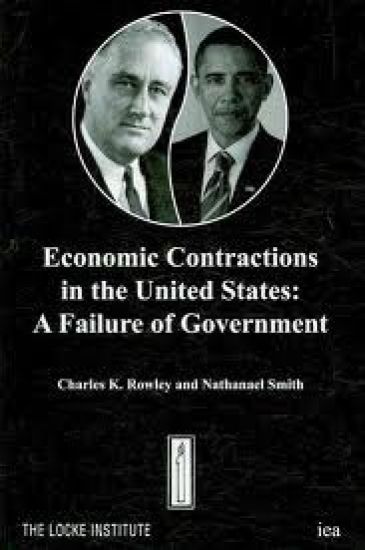
Economic Contractions in the United States
Charles K. Rowley; Nathanael Smith
Institute of Economic Affairs
2009
nidottu
This monograph provides a detailed explanation how the Great Depression and the current financial crisis and economic contraction in the United States were both caused by and exacerbated by government, not by capitalism. The monograph provides a well-reasoned free market alternative to current statist policies with respect to economic recovery in the United States.

TRADE PROTECTION IN THE UNITED STATES
Charles K. Rowley; Willem Thorbecke; Richard E. Wagner
Edward Elgar Publishing Ltd
1995
sidottu
Trade policy in the United States since 1930 is rigorously evaluated in this major new book. Using public choice analysis to identify and explain protectionist behavior, Charles K. Rowley, Willem Thorbecke and Richard E. Wagner demonstrate why unilateral free trade cannot be achieved through the normal political process and make a strong case for constitutional reform.Trade Protection in the United States analyzes the history of US trade policy to explain why interest groups are able to foster protectionist policies despite the advantages which free trade offers consumers. The authors also explain why the principles of managed trade - as epitomized in the institution of the GATT - are inevitably subverted by protectionism. This important book concludes with a vigorous justification of unilateral free trade and makes a convincing case for protecting the freedom to trade through an amendment to the US constitution.Applying recent developments in constitutional political economy to a key policy issue, this book will be welcomed by economists, political scientists and lawyers as a major statement of the right to trade.
This book offers an analytic history of Britannia (first England and Wales and then Great Britain) over eight hundred years of political turmoil, intermingled with economic stagnation, followed by the engine of the industrial revolution. The book draws on economics, political science, public choice, philosophy and the law to probe in depth into the evolution of Britannia from an impoverished feudal and then post-feudal autocracy into a constitutional monarchy with limited suffrage that provided the fulcrum for industrial and commercial success, making Britannia, by 1884, the richest nation, per capita, on the planet. The book challenges head-on the Whiggist liberal notion of Macaulay and Trevelyan that the path from oppression to freedom was one of unimpeded progress. Among its novel features, the book draws upon the dictator’s handbook, as modeled by Bueno de Mesquita and Alistair Smith to evaluate the period of varying autocracy, 1066-1688. The book draws upon modern public choice theory and legal history to evaluate the fragile, corrupt constitutional monarchy that oversaw the initial phase of post-Glorious Revolution Britannia, 1689-1775. At each stage, the philosophical battle between those who sought order and unity and those who sought individual liberty is meticulously outlined. The book draws on the contributions of the Scottish Enlightenment (Hume, Ferguson and Smith) and of classical liberal philosophy (John Stuart Mill) to explain the final vault of Britannia from a weak and corrupt to a robust and admired constitutional monarchy grounded on the rule of law, over the period 1776-1884.
This book offers an analytic history of Britannia (first England and Wales and then Great Britain) over eight hundred years of political turmoil, intermingled with economic stagnation, followed by the engine of the industrial revolution. The book draws on economics, political science, public choice, philosophy and the law to probe in depth into the evolution of Britannia from an impoverished feudal and then post-feudal autocracy into a constitutional monarchy with limited suffrage that provided the fulcrum for industrial and commercial success, making Britannia, by 1884, the richest nation, per capita, on the planet. The book challenges head-on the Whiggist liberal notion of Macaulay and Trevelyan that the path from oppression to freedom was one of unimpeded progress. Among its novel features, the book draws upon the dictator’s handbook, as modeled by Bueno de Mesquita and Alistair Smith to evaluate the period of varying autocracy, 1066-1688. The book draws upon modern public choice theory and legal history to evaluate the fragile, corrupt constitutional monarchy that oversaw the initial phase of post-Glorious Revolution Britannia, 1689-1775. At each stage, the philosophical battle between those who sought order and unity and those who sought individual liberty is meticulously outlined. The book draws on the contributions of the Scottish Enlightenment (Hume, Ferguson and Smith) and of classical liberal philosophy (John Stuart Mill) to explain the final vault of Britannia from a weak and corrupt to a robust and admired constitutional monarchy grounded on the rule of law, over the period 1776-1884.