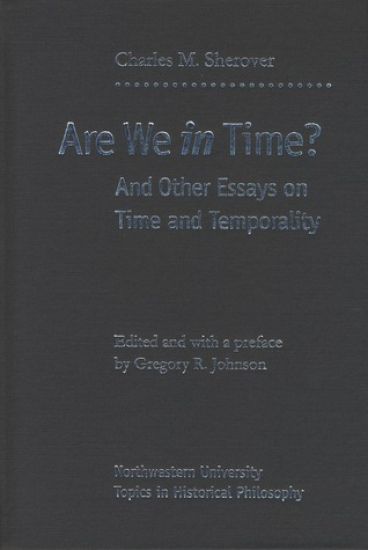
This work shows us that by taking time seriously we can discover something essential to almost every question of human concern. It asks, ""Are we IN time?"" and considers time in conjunction with cognition, morality, action, physical nature, being, God, freedom, and politics. Charles Sherover's essays, while drawing upon Royce, Heidegger, Kant, Leibniz, and even Hartshorne and Bergson, defy categorization by method or school; instead, they reveal the diversity and divergence of thinking about time as well as the myriad features and values within the omnipresence of time and change. The volume gives an overview of the history of thought on time and a clarification of some fundamental conceptual distinctions in temporal ideas. It then offers a critique of Kant, the first thinker to recognize that all human experience has a temporal form. In a series of essays on metaphysics - a corrective to the dominant metaphysical tradition of talking about being as if time does not matter - the work pursues temporal responses to such problems as being, internal relations, individuation, mind, and free will.