Kirjojen hintavertailu. Mukana 12 030 270 kirjaa ja 12 kauppaa.

Kirjahaku

Etsi kirjoja tekijän nimen, kirjan nimen tai ISBN:n perusteella.

6 kirjaa tekijältä Chen Li

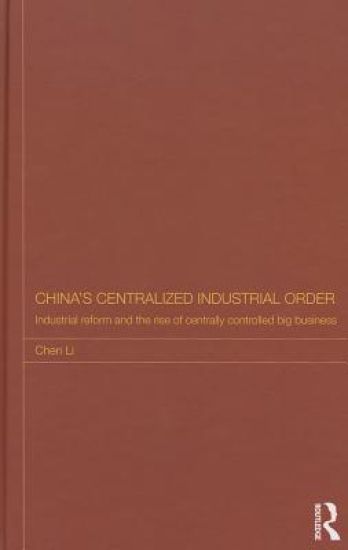
China's Centralized Industrial Order
This book is about the political economy of China’s industrial reform and the rise of a group of Chinese big businesses under the Communist Party and the central state’s control. It examines the origins, evolution and institutional configuration of this centralized system in governing the ‘commanding heights’ of the Chinese industrial economy. Shaped by persistent industrial policies to develop China’s ‘national champions’ enterprises, the core parts of China’s central industrial ministries and mono-bank system have been transformed into a ‘national team’ of giant modern business firms in industries such as oil, power generation, telecommunications, aerospace, aviation, nuclear, shipbuilding, mining, construction, automobile and banking. Through an adaptive process of learning, experimentation and restructuring, the bedrock of the authority relations and control mechanisms among the Party, government bureaucracy and firms has been consolidated rather than dismantled in the system’s transformation. This alternative view of China’s industrial reform presents a direct challenge to the neo-liberal transition model of China’s institutional development and the mainstream Western conceptions of Chinese big business.
China's Centralized Industrial Order
This book is about the political economy of China’s industrial reform and the rise of a group of Chinese big businesses under the Communist Party and the central state’s control. It examines the origins, evolution and institutional configuration of this centralized system in governing the ‘commanding heights’ of the Chinese industrial economy. Shaped by persistent industrial policies to develop China’s ‘national champions’ enterprises, the core parts of China’s central industrial ministries and mono-bank system have been transformed into a ‘national team’ of giant modern business firms in industries such as oil, power generation, telecommunications, aerospace, aviation, nuclear, shipbuilding, mining, construction, automobile and banking. Through an adaptive process of learning, experimentation and restructuring, the bedrock of the authority relations and control mechanisms among the Party, government bureaucracy and firms has been consolidated rather than dismantled in the system’s transformation. This alternative view of China’s industrial reform presents a direct challenge to the neo-liberal transition model of China’s institutional development and the mainstream Western conceptions of Chinese big business.
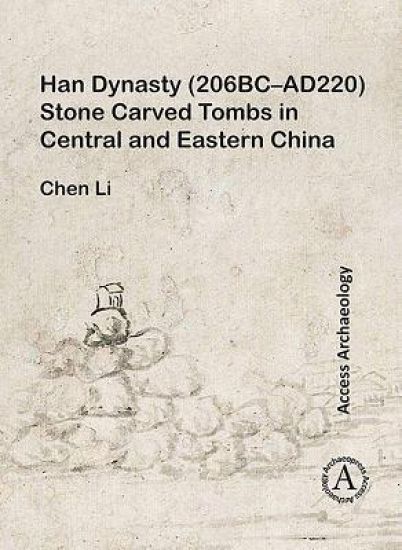
Han Dynasty (206BC–AD220) Stone Carved Tombs in Central and Eastern China
Han Dynasty (206 BC–AD 220) stone carved tombs were constructed from carved stone slabs or a combination of moulded bricks and carved stones, and were distributed in Central and Eastern China. Such multi-chambered stone tombs were very popular among the Han people, but they were entirely new, and were a result of outside stimuli rather than an independent development within China. The stone carved tombs were a result of imitating royal rock-cut tombs, while the rock-cut tombs were stimulated by foreign examples. Moreover, many details of stone carved tombs also had Western features. These exotic elements reflected the desire to assimilate exotica within Chinese traditions. Some details within stone carved tombs showed high level of stone working technologies with Western influences. But in general the level of stone construction of the Han period was relatively low. The methods of construction showed how unfamiliar the Western system was to the Han artisans. Han Dynasty stone carved tombs were hybrids of different techniques, including timber, brick and stone works. From these variations, Han people could choose certain types of tombs to satisfy their specific ritual and economic needs. Not only structures, but also pictorial decorations of stone carved tombs were innovations. The range of image motifs was quite limited. Similar motifs can be found in almost every tomb. Such similarities were partly due to the artisans, who worked in workshops and used repertoires for the carving of images. But these also suggest that the tombs were decorated for certain purposes with a given functional template. Together with different patterns of burial objects and their settings, such images formed a way through which the Han people gave meaning to the afterworld. As the Han Empire collapsed, stone carved tombs ceased being constructed in the Central Plains. However, they set a model for later tombs. The idea of building horizontal stone chamber tombs spread to Han borderlands, and gradually went further east to the Korean Peninsula. In this book, the origins, meanings and influences of Han Dynasty stone carved tombs are presented as a part of the history of interactions between different parts of Eurasia.
Learn Chinese Through Music

Learn Chinese Through Music

Chen Li

Beijing World Publishing Corporation
2010
nidottu
Visste du att det var en attack av blindtarmsinflammation som avslöjade Matisse smak för konst? Att han började med att måla stilleben? Att han ritade porträtten av sina barnbarn i taket på sitt hotellrum i Nice? Att Pablo Picasso förblev hans bästa fiende under hela hans liv? Eller att Andy Warhol sa: "Jag vill vara Matisse" Det är konst, en samling för att (åter)upptäcka de stora konstnärerna i 40 illustrerade meddelanden. • En exakt urval av väsentliga och oväntade verk • Tydliga visuella signaler: tidslinjer, kartor, grafer • Olika rutor: anekdoter, sammanhang, influenser
Content-Based Microscopic Image Analysis

Content-Based Microscopic Image Analysis

Chen Li

Logos Verlag Berlin GmbH
2016
nidottu
In this dissertation, novel Content-based Microscopic Image Analysis (CBMIA) methods, including Weakly Supervised Learning (WSL), are proposed to aid biological studies. In a CBMIA task, noisy image, image rotation, and object recognition problems need to be addressed. To this end, the first approach is a general supervised learning method, which consists of image segmentation, shape feature extraction, classification, and feature fusion, leading to a semi-automatic approach. In contrast, the second approach is a WSL method, which contains Sparse Coding (SC) feature extraction, classification, and feature fusion, leading to a full-automatic approach. In this WSL approach, the problems of noisy image and object recognition are jointly resolved by a region-based classifier, and the image rotation problem is figured out through SC features. To demonstrate the usefulness and potential of the proposed methods, experiments are implemented on different practical biological tasks, including environmental microorganism classification, stem cell analysis, and insect tracking.