
Kirjojen hintavertailu. Mukana 11 244 527 kirjaa ja 12 kauppaa.

Kirjahaku

Etsi kirjoja tekijän nimen, kirjan nimen tai ISBN:n perusteella.

4 kirjaa tekijältä Cheryl Walker

The Nightingale's Burden

The Nightingale's Burden

Cheryl Walker

Indiana University Press
1983
sidottu
In this evocative exploration, Cheryl Walker shows that there is a distinct tradition of women's poetry in America—one that the poets themselves have not always been fully aware of—and that individual poems can be read as manifestations of that tradition. Philomela, the nightingale of literary mythology, serves as a model for women poets, representing simultaneously both their particular forms of power and the frustrating powerlessness imposed on them by the cultural norms for women. The author identifies a number of archetypal motifs: the power fantasy, the sanctuary poem, the renunciation poem, the forbidden lover poem, the "burden of beauty," and the "secret sorrow." Among the poets discussed are Anne Bradstreet, Phillis Wheatley, Lydia Sigourney, Frances Osgood, Julia Ward Howe, Margaret Fuller, Ella Wheeler Wilcox, and Louise Guiney.
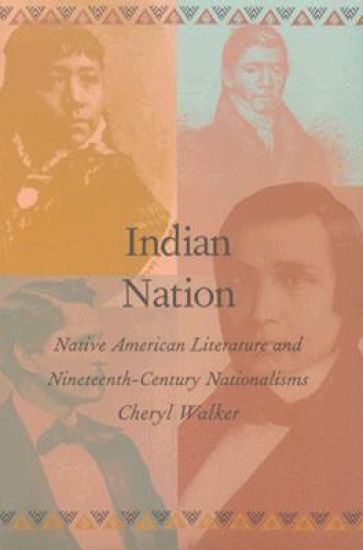
Indian Nation

Indian Nation

Cheryl Walker

Duke University Press
1997
pokkari
Indian Nation documents the contributions of Native Americans to the notion of American nationhood and to concepts of American identity at a crucial, defining time in U.S. history. Departing from previous scholarship, Cheryl Walker turns the "usual" questions on their heads, asking not how whites experienced indigenous peoples, but how Native Americans envisioned the United States as a nation. This project unfolds a narrative of participatory resistance in which Indians themselves sought to transform the discourse of nationhood.Walker examines the rhetoric and writings of nineteenth-century Native Americans, including William Apess, Black Hawk, George Copway, John Rollin Ridge, and Sarah Winnemucca. Demonstrating with unique detail how these authors worked to transform venerable myths and icons of American identity, Indian Nation chronicles Native American participation in the forming of an American nationalism in both published texts and speeches that were delivered throughout the United States. Pottawattomie Chief Simon Pokagon’s "The Red Man’s Rebuke," an important document of Indian oratory, is published here in its entirety for the first time since 1893. By looking at this writing through the lens of the best theoretical work on nationality, postcoloniality, and the subaltern, Walker creates a new and encompassing picture of the relationship between Native Americans and whites. She shows that, contrary to previous studies, America in the nineteenth century was intercultural in significant ways.
Indian Nation

Indian Nation

Cheryl Walker

Duke University Press
1997
sidottu
Indian Nation documents the contributions of Native Americans to the notion of American nationhood and to concepts of American identity at a crucial, defining time in U.S. history. Departing from previous scholarship, Cheryl Walker turns the "usual" questions on their heads, asking not how whites experienced indigenous peoples, but how Native Americans envisioned the United States as a nation. This project unfolds a narrative of participatory resistance in which Indians themselves sought to transform the discourse of nationhood.Walker examines the rhetoric and writings of nineteenth-century Native Americans, including William Apess, Black Hawk, George Copway, John Rollin Ridge, and Sarah Winnemucca. Demonstrating with unique detail how these authors worked to transform venerable myths and icons of American identity, Indian Nation chronicles Native American participation in the forming of an American nationalism in both published texts and speeches that were delivered throughout the United States. Pottawattomie Chief Simon Pokagon’s "The Red Man’s Rebuke," an important document of Indian oratory, is published here in its entirety for the first time since 1893. By looking at this writing through the lens of the best theoretical work on nationality, postcoloniality, and the subaltern, Walker creates a new and encompassing picture of the relationship between Native Americans and whites. She shows that, contrary to previous studies, America in the nineteenth century was intercultural in significant ways.