Kirjojen hintavertailu. Mukana 11 244 527 kirjaa ja 12 kauppaa.

Kirjahaku

Etsi kirjoja tekijän nimen, kirjan nimen tai ISBN:n perusteella.

4 kirjaa tekijältä Chris Bernhardt

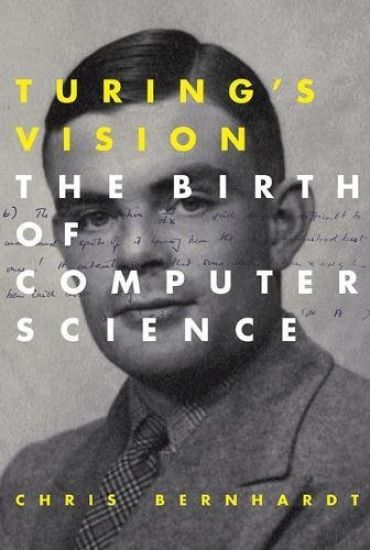
Turing's Vision

Turing's Vision

Chris Bernhardt

MIT Press
2017
pokkari
Turing's fascinating and remarkable theory, which now forms the basis of computer science, explained for the general reader.In 1936, when he was just twenty-four years old, Alan Turing wrote a remarkable paper in which he outlined the theory of computation, laying out the ideas that underlie all modern computers. This groundbreaking and powerful theory now forms the basis of computer science. In Turing's Vision, Chris Bernhardt explains the theory, Turing's most important contribution, for the general reader. Bernhardt argues that the strength of Turing's theory is its simplicity, and that, explained in a straightforward manner, it is eminently understandable by the nonspecialist. As Marvin Minsky writes, "The sheer simplicity of the theory's foundation and extraordinary short path from this foundation to its logical and surprising conclusions give the theory a mathematical beauty that alone guarantees it a permanent place in computer theory." Bernhardt begins with the foundation and systematically builds to the surprising conclusions. He also views Turing's theory in the context of mathematical history, other views of computation (including those of Alonzo Church), Turing's later work, and the birth of the modern computer.In the paper, "On Computable Numbers, with an Application to the Entscheidungsproblem," Turing thinks carefully about how humans perform computation, breaking it down into a sequence of steps, and then constructs theoretical machines capable of performing each step. Turing wanted to show that there were problems that were beyond any computer's ability to solve; in particular, he wanted to find a decision problem that he could prove was undecidable. To explain Turing's ideas, Bernhardt examines three well-known decision problems to explore the concept of undecidability; investigates theoretical computing machines, including Turing machines; explains universal machines; and proves that certain problems are undecidable, including Turing's problem concerning computable numbers.
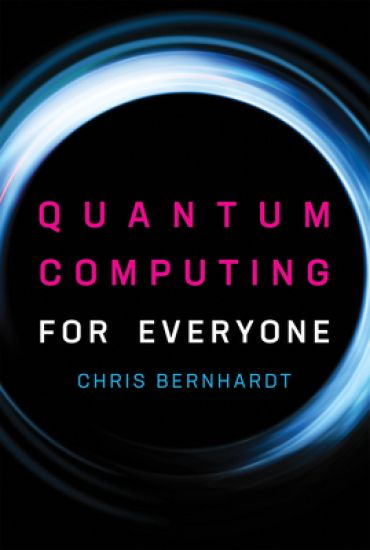
Quantum Computing for Everyone

Quantum Computing for Everyone

Chris Bernhardt

MIT Press
2020
nidottu
FOR NON-EXPERTS: Get an accessible introduction to quantum computing as a mathematician explains quantum algorithms, quantum entanglement, and more. Quantum computing is a beautiful fusion of quantum physics and computer science! Quantum computing incorporates some of the most stunning ideas from 20th-century physics into an entirely new way of thinking about computation. Here, Chris Bernhardt offers an introduction to quantum computing that is accessible to anyone comfortable with high school mathematics. A mathematician himself, Bernhardt simplifies the mathematics and provides elementary examples that illustrate both how the math works and what it means. He explains for the non-expert: • Quantum bits, or qubits—the basic unit of quantum computing • Quantum entanglement and what it means when qubits are entangled • Quantum cryptography • Classical computing topics like bits, gates, and logic • Quantum gates • Quantum algorithms and their speed • Quantum computers and how they’re built • And more! By the end of the book, readers understand that quantum computing and classical computing are not two distinct disciplines, and that quantum computing is the fundamental form of computing.
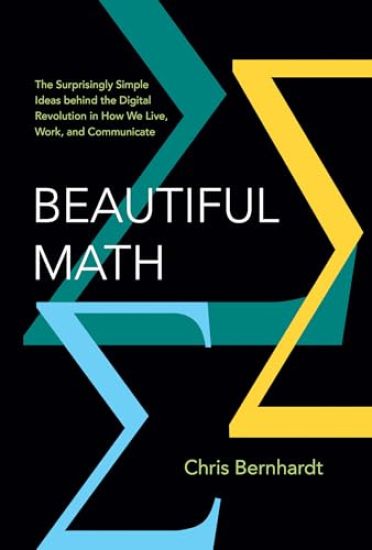
Beautiful Math

Beautiful Math

Chris Bernhardt

MIT PRESS LTD
2024
sidottu
From the bestselling author of Quantum Computing for Everyone, a concise, accessible, and elegant approach to mathematics that not only illustrates concepts but also conveys the surprising nature of the digital information age. Most of us know something about the grand theories of physics that transformed our views of the universe at the start of the twentieth century: quantum mechanics and general relativity. But we are much less familiar with the brilliant theories that make up the backbone of the digital revolution. In Beautiful Math, Chris Bernhardt explores the mathematics at the very heart of the information age. He asks questions such as: What is information? What advantages does digital information have over analog? How do we convert analog signals into digital ones? What is an algorithm? What is a universal computer? And how can a machine learn? The four major themes of Beautiful Math are information, communication, computation, and learning. Bernhardt typically starts with a simple mathematical model of an important concept, then reveals a deep underlying structure connecting concepts from what, at first, appear to be unrelated areas. His goal is to present the concepts using the least amount of mathematics, but nothing is oversimplified. Along the way, Bernhardt also discusses alphabets, the telegraph, and the analog revolution; information theory; redundancy and compression; errors and noise; encryption; how analog information is converted into digital information; algorithms; and finally, neural networks. Historical anecdotes are included to give a sense of the technology at that time, its impact, and the problems that needed to be solved. Taking its readers by the hand, regardless of their math background, Beautiful Math is a fascinating journey through the mathematical ideas that undergird our everyday digital interactions.
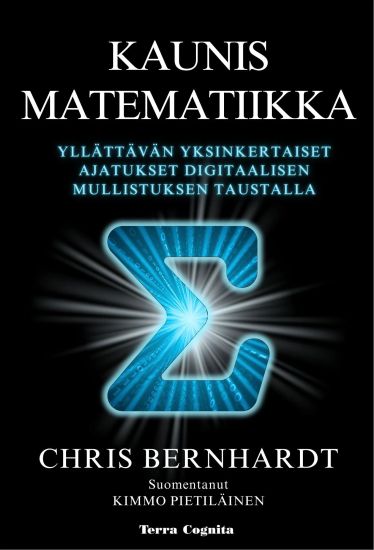
Kaunis matematiikka

Kaunis matematiikka

Chris Bernhardt

Terra Cognita
2025
nidottu
Useimmat tietävät jotakin maailmankuvamme1900-luvulla mullistaneista suurista teorioista, kvanttimekaniikasta ja yleisestä suhteellisuusteoriasta. Harva kuitenkaan tuntee tai on edes kuullut elämämme, työmme ja viestintämme mullistaneen informaatioajan mahdollistaneista nerokkaista teorioista, vaikka niiden tulokset täyttävät arkemme. Kaunis matematiikka -teoksessa tutkitaan näitä teorioita. Kirjassa käsiteltyjä kysymyksiä ovat muun muassa: Mitä on informaatio? Miten analoginen muutetaan digitaaliseksi? Mikä on algoritmi? Mikä on universaali tietokone? Miten kone oppii? Kirjan neljä pääteemaa, informaatio, viestintä, laskenta ja oppiminen vastaavat näihin kysymyksiin. Hämmästyttävintä on, että näiden teorioiden perusteet voi ymmärtää lukiomatematiikalla.