Kirjojen hintavertailu. Mukana 11 244 527 kirjaa ja 12 kauppaa.

Kirjahaku

Etsi kirjoja tekijän nimen, kirjan nimen tai ISBN:n perusteella.

41 kirjaa tekijältä Christa Wolf

The Quest for Christa T.

The Quest for Christa T.

Christa Wolf

Farrar, Straus and Giroux
1979
pokkari
When "The Quest for Christa T. was first published in East Germany ten years ago, there was an immediate storm: bookshops in East Berlin were given instructions to sell it only to well-known customers professionally involved in literary matters; at the annual meeting of East German Writers Conference, Mrs Wolf's new book was condemmed. Yet the novel has nothing eplicity to do with politics.
Nachdenken über Christa T

Nachdenken über Christa T

Christa Wolf

SUHRKAMP VERLAG
2007
pokkari
Nachdenken über Christa T. begründete den Weltruhm Christa Wolfs und gehört zu den wichtigsten Werken der deutschsprachigen Nachkriegsliteratur. Mit nur 36 Jahren stirbt Christa T. an Leukämie. Ihre ehemalige Schulkameradin und Studienfreundin erinnert sich an sie: an eine Frau, die der Forderung nach Anpassung ihre Phantasie, ihr Gewissen und vor allem ihre Sehnsucht nach Selbstverwirklichung entgegensetzt.
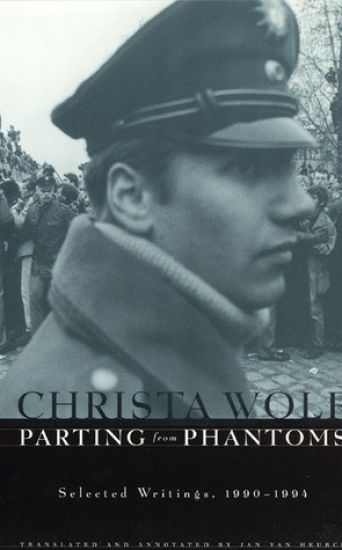
Parting from Phantoms

Parting from Phantoms

Christa Wolf

University of Chicago Press
1998
nidottu
Documenting four painful years in the life of German writer Christa Wolf, this collection of essays, letters and diary entries portrays the cultural and political situation in the former German Democratic Republic. An admired writer, Wolf was reviled after the publication of her novel "What Remains", which was attacked by the press as a belated attempt to establish herself as a victim of the Stasi (the GDR's secret police). The criticism discredited Wolf as a cultural hero in the eyes of many Germans, and plunged her into a deep personal crisis. This volume shows Wolf coming to terms with her ambiguous past and an unforgiving present. Among the writings gathered in this book are discourses with Jurgen Habermas and Gunter Grass, a series of diary entries, and a critical account of Berlin one year after unification, entitled "Whatever Happened to your Smile: Wasteland Berlin 1990". In addition, Wolf defends herself from the media campaign waged against her in Germany. The truth about the GDR, she argues, will be found in its literature, not in the security files used to discredit the GDR's culture.
Cassandra: A Novel and Four Essays

Cassandra: A Novel and Four Essays

Christa Wolf

Farrar, Straus and Giroux
1988
nidottu
In this volume, the distinguished East German writer Christa Wolf retells the story of the fall of Troy, but from the point of view of the woman whose visionary powers earned her contempt and scorn. Written as a result of the author's Greek travels and studies, "Cassandra" speaks to us in a pressing monologue whose inner focal points are patriarchy and war. In the four accompanying pieces, which take the form of travel reports, journal entries, and a letter, Wolf describes the novel's genesis. Incisive and intelligent, the entire volume represents an urgent call to examine the past in order to insure a future.
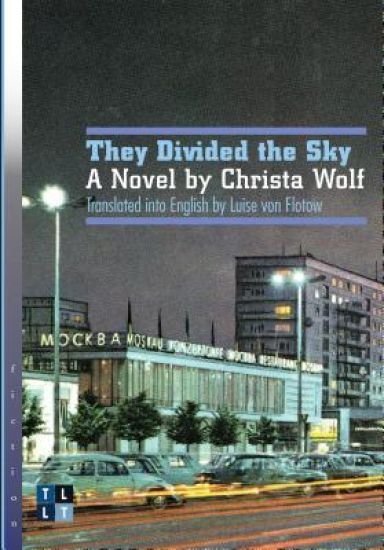
They Divided the Sky

They Divided the Sky

Christa Wolf

University of Ottawa Press
2013
pokkari
First published in 1963, in East Germany, They Divided the Sky tells the story of a young couple, living in the new, socialist, East Germany, whose relationship is tested to the extreme not only because of the political positions they gradually develop but, very concretely, by the Berlin Wall, which went up on August 13, 1961. The story is set in 1960 and 1961, a moment of high political cold war tension between the East Bloc and the West, a time when many thousands of people were leaving the young German Democratic Republic (the GDR) every day in order to seek better lives in West Germany, or escape the political ideology of the new country that promoted the "farmer and peasant" state over a state run by intellectuals or capitalists. The construction of the Wall put an end to this hemorrhaging of human capital, but separated families, friends, and lovers, for thirty years. The conflicts of the time permeate the relations between characters in the book at every level, and strongly affect the relationships that Rita, the protagonist, has not only with colleagues at work and at the teacher's college she attends, but also with her partner Manfred (an intellectual and academic) and his family. They also lead to an accident/attempted suicide that send her to hospital in a coma, and that provide the backdrop for the flashbacks that make up the narrative. Wolf's first full-length novel, published when she was thirty-five years old, was both a great literary success and a political scandal. Accused of having a 'decadent' attitude with regard to the new socialist Germany and deliberately misrepresenting the workers who are the foundation of this new state, Wolf survived a wave of political and other attacks after its publication. She went on to create a screenplay from the novel and participate in making the film version. More importantly, she went on to become the best-known East German writer of her generation, a writer who established an international reputation and never stopped working toward improving the socialist reality of the GDR.
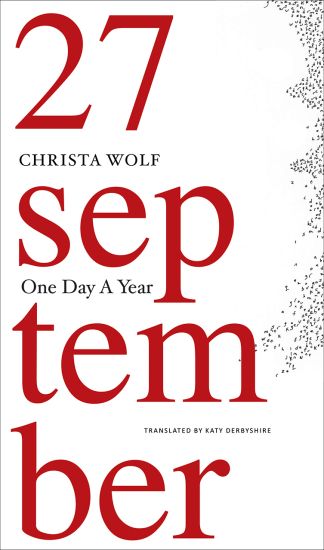
One Day a Year

One Day a Year

Christa Wolf

Seagull Books London Ltd
2017
sidottu
During a 1960 interview, East German writer Christa Wolf was asked a curious question: would she describe in detail what she did on September 27th? Fascinated by considering the significance of a single day over many years, Wolf began keeping a detailed diary of September 27th, a practice which she carried on for more than fifty years until her death in 2011. The first volume of these notes covered 1960 through 2000 was published to great acclaim more than a decade ago. Now translator Katy Derbyshire is bringing the September 27th collection up to date with One Day a Year a collection of Wolf's notes from the last decade of her life. The book is both a personal record and a unique document of our times. With her characteristic precision and transparency, Wolf examines the interplay of the private, subjective, and major contemporary historical events. She writes about Germany after 9/11, about her work on her last great book City of Angels, and also about her exhausting confrontation with old age. One Day a Year is a compelling and personal glimpse into the life of one of the world's greatest writers.
August

August

Christa Wolf

Seagull Books London Ltd
2019
pokkari
Christa Wolf was arguably the best-known and most influential writer in the former East Germany. Having grown up during the Nazi regime, she and her family were forced to flee their home like many others, nearly starving to death in the process. Her earliest novels were controversial because they contained veiled criticisms of the Communist regime which landed her on government watch lists. Her past continued to permeate her work and her life, as she said, “You can only fight sorrow when you look it in the eye.” August is Christa Wolf’s last piece of fiction, written in a single sitting as an anniversary gift to her husband. In it, she revisits her stay at a tuberculosis hospital in the winter of 1946, a real life event that was the inspiration for the closing scenes of her 1976 novel Patterns of Childhood. This time, however, her fictional perspective is very different. The story unfolds through the eyes of August, a young patient who has lost both his parents to the war. He adores an older girl, Lilo, a rebellious teenager who controls the wards. Sixty years later, August reflects on his life and the things that she taught him. Written in taut, affectionate prose, August offers a new entry into Christa Wolf’s work and, incidentally, her first and only male protagonist. More than a literary artifact, this new novel is a perfectly constructed story of a quiet life well lived. For both August and Christa Wolf, the past never dies.
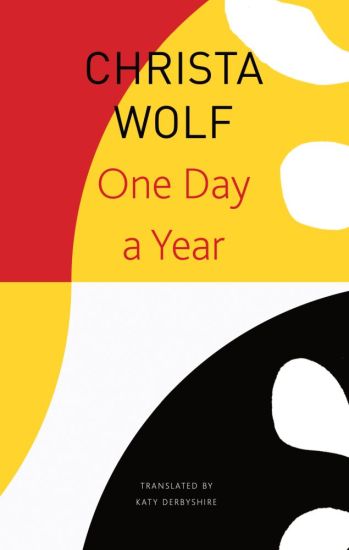
One Day a Year

One Day a Year

Christa Wolf

Seagull Books London Ltd
2021
nidottu
During a 1960 interview, East German writer Christa Wolf was asked a curious question: would she describe in detail what she did on September 27th? Fascinated by considering the significance of a single day over many years, Wolf began keeping a detailed diary of September 27th, a practice which she carried on for more than fifty years until her death in 2011. The first volume of these notes covered 1960 through 2000 was published to great acclaim more than a decade ago. Now translator Katy Derbyshire is bringing the September 27th collection up to date with One Day a Year—a collection of Wolf’s notes from the last decade of her life. The book is both a personal record and a unique document of our times. With her characteristic precision and transparency, Wolf examines the interplay of the private, subjective, and major contemporary historical events. She writes about Germany after 9/11, about her work on her last great book City of Angels, and also about her exhausting confrontation with old age. One Day a Year is a compelling and personal glimpse into the life of one of the world’s greatest writers.
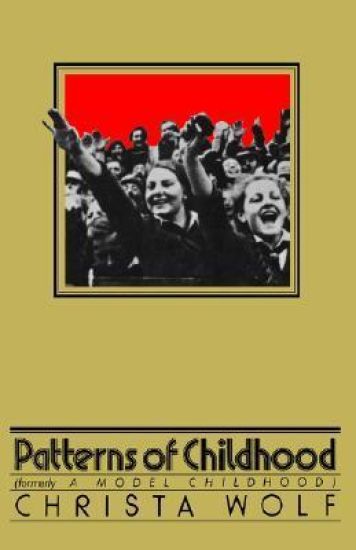
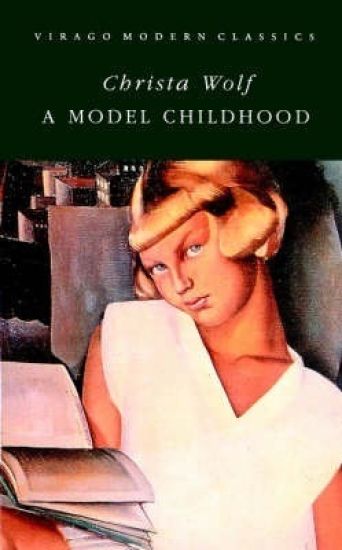
A Model Childhood

A Model Childhood

Christa Wolf

Virago Press Ltd
1983
nidottu
This novel is a testament of what seemed at the time a fairly ordinary childhood, in the bosom of a normal Nazi family in Landsberg. Other work by the author includes The Quest for Christa and No Place on Earth .
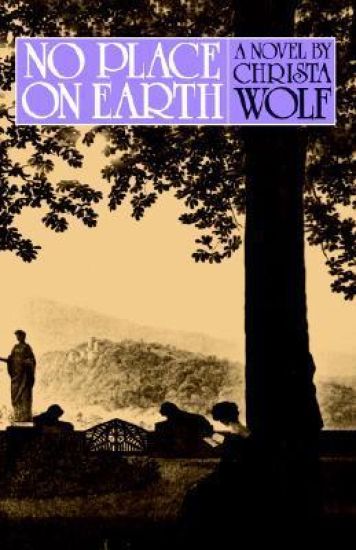
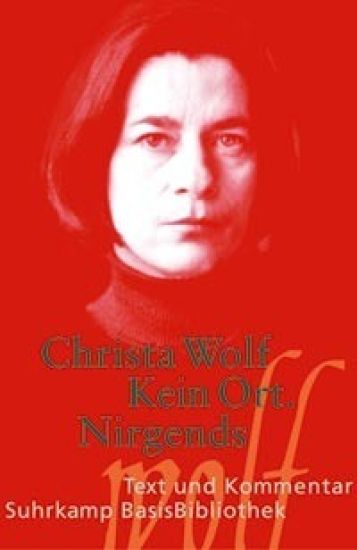
Kein Ort. Nirgends

Kein Ort. Nirgends

Christa Wolf

SUHRKAMP VERLAG
2006
pokkari
Text und Kommentar in einem Band. In der Suhrkamp BasisBibliothek erscheinen literarische Hauptwerke aller Epochen und Gattungen als Arbeitstexte für Schule und Studium. Der vollständige Text wird ergänzt durch anschaulich geschriebene Kommentare.
Kein Ort, nirgends

Kein Ort, nirgends

Christa Wolf

SUHRKAMP VERLAG
2007
pokkari
Christa Wolf, geboren 1929 in Landsberg/Warthe (Gorz?w Wielkopolski), lebt in Berlin und Woserin, Mecklenburg-Vorpommern. Ihr Werk wurde mit zahlreichen Preisen, darunter dem Georg- Büchner-Preis und dem Deutschen Bücherpreis für ihr Gesamtwerk, ausgezeichnet.