Kirjojen hintavertailu. Mukana 11 699 587 kirjaa ja 12 kauppaa.

Kirjahaku

Etsi kirjoja tekijän nimen, kirjan nimen tai ISBN:n perusteella.

19 kirjaa tekijältä Christian Huber

Introduction to Numerical Modeling in the Earth Sciences

Introduction to Numerical Modeling in the Earth Sciences

Christian Huber

Oxford University Press
2025
sidottu
This textbook provides an introduction to the world of numerical modeling in the physical sciences, focusing more specifically on earth and planetary sciences. It is designed to lead the reader through the process of defining the mathematical or physical model of interest and applying numerical methods to approximate and explore the solutions to these models, while also providing a quantitative assessment of the limitations, performance and quality of these approximations. The book is designed to provide a self-contained reference by including the mathematical foundations required to understand the models and their convergence. It includes a detailed discussion of models for ordinary systems of equation and partial differential equations, with pseudo-codes detailing the solution procedure. Examples are drawn from the fields of earth and planetary sciences, including, geochemical box models, non-linear ordinary differential equations describing the evolution of subvolcanic magma chambers, the mass conservation of cosmogenic nuclides in soils, diffusion in minerals, the hillslope equation, the advection-diffusion and wave equations and the shallow water equations. Featuring numerous examples drawn from earth and planetary sciences, the content of this book has been used by the author to teach numerical methods classes at the undergraduate and graduate levels over several years, and will provide an excellent resources for teachers and learners in this area.
Introduction to Numerical Modeling in the Earth Sciences

Introduction to Numerical Modeling in the Earth Sciences

Christian Huber

Oxford University Press
2025
nidottu
This textbook provides an introduction to the world of numerical modeling in the physical sciences, focusing more specifically on earth and planetary sciences. It is designed to lead the reader through the process of defining the mathematical or physical model of interest and applying numerical methods to approximate and explore the solutions to these models, while also providing a quantitative assessment of the limitations, performance and quality of these approximations. The book is designed to provide a self-contained reference by including the mathematical foundations required to understand the models and their convergence. It includes a detailed discussion of models for ordinary systems of equation and partial differential equations, with pseudo-codes detailing the solution procedure. Examples are drawn from the fields of earth and planetary sciences, including, geochemical box models, non-linear ordinary differential equations describing the evolution of subvolcanic magma chambers, the mass conservation of cosmogenic nuclides in soils, diffusion in minerals, the hillslope equation, the advection-diffusion and wave equations and the shallow water equations. Featuring numerous examples drawn from earth and planetary sciences, the content of this book has been used by the author to teach numerical methods classes at the undergraduate and graduate levels over several years, and will provide an excellent resources for teachers and learners in this area.
The Dying Days of the Third Reich

The Dying Days of the Third Reich

Christian Huber

The History Press Ltd
2016
sidottu
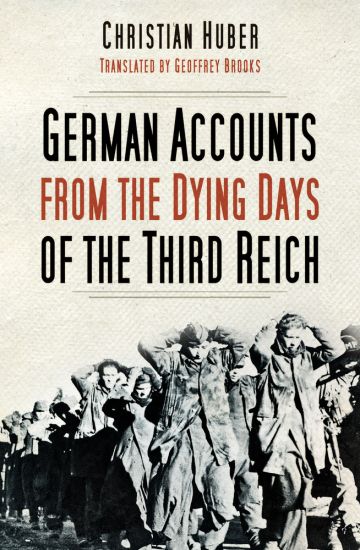
It has taken seventy years for the accounts of ordinary German soldiers during the Second World War to be made widely available to an English-speaking audience. This is hardly surprising given that interest in these important documents has only recently surfaced in Germany, where a long process of coming to terms with the past, or Vergangenheitsbewältigung, has taken place. Unlike other historical depictions of the fall of the Third Reich, Dying Days of the Third Reich presents the authentic voices of those German soldiers who fought on the front line. Throughout we are witness to the kind of bravery, ingenuity and, ultimately, fear that we are so familiar with from the many Allied accounts of this time. Their sense of confusion and terror is palpable as Nazi Germany finally collapses in May 1945, with soldiers fleeing to the American victors instead of the Russians in the hope of obtaining better treatments as a prisoner of war. This collection of first-hand accounts includes the stories of German soldiers fighting the Red Army on the Eastern Front; of Horst Messer, who served on the last East Prussian panzer tank but was captured and spent four years in Russian captivity at Riga; Hans Obermeier, who recounts his capture on the Czech front and escape from Siberia; and a moving account of an anonymous Wehrmacht soldier in Slovakia given orders to execute Russian prisoners.
German Accounts from the Dying Days of the Third Reich

German Accounts from the Dying Days of the Third Reich

Christian Huber

THE HISTORY PRESS LTD
2022
nidottu
Unlike other historical depictions of the fall of the Third Reich, German Accounts from the Dying Days of the Third Reich presents the authentic voices of those German soldiers who fought on the front line. Throughout we are witness to the kind of bravery, ingenuity and, ultimately, fear that we are so familiar with from the many Allied accounts of this time. Their sense of confusion and terror is palpable as Nazi Germany finally collapses in May 1945, with soldiers fleeing to the American victors instead of the Russians in the hope of obtaining better treatments as a prisoner of war.This collection of first-hand accounts include the stories of German soldiers fighting the Red Army on the Eastern Front; of Horst Messer, who served on the last East Prussian panzer tank but was captured and spent four years in Russian captivity at Riga; of Hans Obermeier, who recounts his capture on the Czech front and escape from Siberia; and a moving account of an anonymous Wehrmacht soldier in Slovakia given orders to execute Russian prisoners.
A PRISONER OF STALIN

A PRISONER OF STALIN

Christian Huber

PEN SWORD BOOKS LTD
2022
sidottu
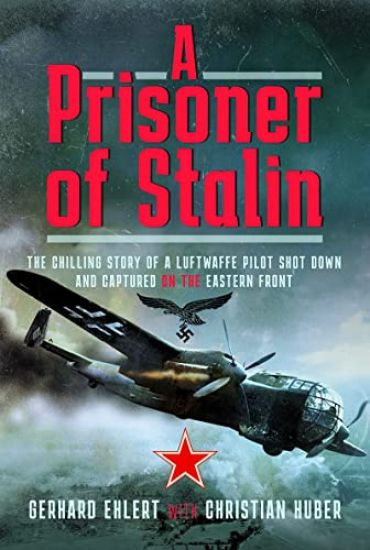
Leutnant Gerhard Ehlert was one of the few survivors of 2. Nachtaufkl rungsstaffel, part of the Luftwaffe's 6th Air Fleet, which operated on Eastern Front during the Second World War. Although he came from a family that spoke out against Hitler and the Nazi regime, he volunteered to join the Luftwaffe. He went on to undertake combat patrols under the most extreme circumstances. Facing hazardous weather conditions - often landing his aircraft blind' in heavy fog - and mountainous odds against Soviet air superiority, Ehlert completed twenty-two sorties before his Dornier Do 217M-1, coded K7+FK, was shot down on 14 June 1944. Despite strenuous efforts to escape the Soviets, along with his rear-gunner Feldwebel Wilhelm Burr, he was captured by the Red Army. What followed changed his life forever. Though interrogated repeatedly, Ehlert revealed nothing about his missions or duties. Then, during his transfer to a prisoner of war camp, he had to face a hostile crowd of Russian civilians who had suffered from the devastating effects of the Luftwaffe's bombs. In the long journey eastwards across the bleak Russian steppes to the camp at Yelabuga, a town in the Republic of Tatarstan, Ehlert reflected on his early years and the road he took to the east and the horrifying situation he was in. But it was not the months he endured in the freezing prisoner of war camp which became his most haunting memory - it was when the war ended. The Russians announced that with peace came new rules. Now the prisoners must work and the food ration would be reduced. Their uniforms were removed, and all privileges of rank dismissed. To the Soviets they were no longer prisoners of war, they were mere criminals and were treated accordingly. Transferred to Bolshoy Bor in the north, day after day the men had to transport logs, even through the snow and ice of winter, with many of the prisoners dying of malnutrition and exposure. The Russians told them they were to rebuild what they destroyed in the Soviet Union'. Ehlert's suffering finally ended in 1949. He was able to return to his parental home, initially being treated as an unwelcome stranger. When he related his story to Christian Huber, Gerhard Ehlert was in his 90s, by then a happy father and grandfather, and undoubtedly a survivor.