Kirjojen hintavertailu. Mukana 11 342 296 kirjaa ja 12 kauppaa.

Kirjahaku

Etsi kirjoja tekijän nimen, kirjan nimen tai ISBN:n perusteella.

5 kirjaa tekijältä Christof Mauch

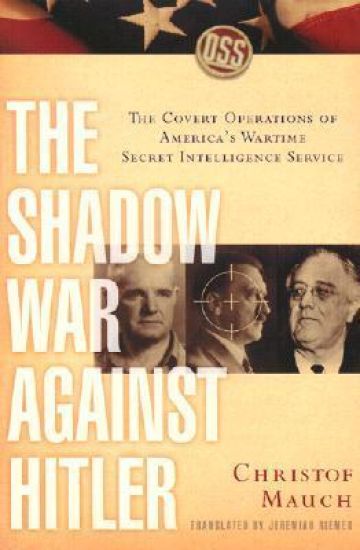
The Shadow War Against Hitler

The Shadow War Against Hitler

Christof Mauch

Columbia University Press
2003
sidottu
Surveying the expanding conflict in Europe during one of his famous fireside chats in 1940, President Franklin Roosevelt ominously warned that "we know of other methods, new methods of attack. The Trojan horse. The fifth column that betrays a nation unprepared for treachery. Spies, saboteurs, and traitors are the actors in this new strategy." Having identified a new type of war-a shadow war-being perpetrated by Hitler's Germany, FDR decided to fight fire with fire, authorizing the formation of the Office of Strategic Services (OSS) to organize and oversee covert operations. Based on an extensive analysis of OSS records, including the vast trove of records released by the CIA in the 1980s and '90s, as well as a new set of interviews with OSS veterans conducted by the author and a team of American scholars from 1995 to 1997, The Shadow War Against Hitler is the full story of America's far-flung secret intelligence apparatus during World War II. In addition to its responsibilities generating, processing, and interpreting intelligence information, the OSS orchestrated all manner of dark operations, including extending feelers to anti-Hitler elements, infiltrating spies and sabotage agents behind enemy lines, and implementing propaganda programs. Planned and directed from Washington, the anti-Hitler campaign was largely conducted in Europe, especially through the OSS's foreign outposts in Bern and London. A fascinating cast of characters made the OSS run: William J. Donovan, one of the most decorated individuals in the American military who became the driving force behind the OSS's genesis; Allen Dulles, the future CIA chief who ran the Bern office, which he called "the big window onto the fascist world"; a veritable pantheon of Ivy League academics who were recruited to work for the intelligence services; and, not least, Roosevelt himself. A major contribution of the book is the story of how FDR employed Hitler's former propaganda chief, Ernst "Putzi" Hanfstengl, as a private spy. More than a record of dramatic incidents and daring personalities, this book adds significantly to our understanding of how the United States fought World War II. It demonstrates that the extent, and limitations, of secret intelligence information shaped not only the conduct of the war but also the face of the world that emerged from the shadows.
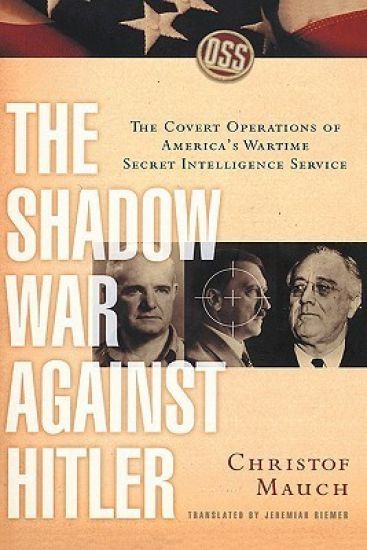
The Shadow War Against Hitler

The Shadow War Against Hitler

Christof Mauch

Columbia University Press
2005
pokkari
Surveying the expanding conflict in Europe during one of his famous fireside chats in 1940, President Franklin Roosevelt ominously warned that "we know of other methods, new methods of attack. The Trojan horse. The fifth column that betrays a nation unprepared for treachery. Spies, saboteurs, and traitors are the actors in this new strategy." Having identified a new type of war-a shadow war-being perpetrated by Hitler's Germany, FDR decided to fight fire with fire, authorizing the formation of the Office of Strategic Services (OSS) to organize and oversee covert operations. Based on an extensive analysis of OSS records, including the vast trove of records released by the CIA in the 1980s and '90s, as well as a new set of interviews with OSS veterans conducted by the author and a team of American scholars from 1995 to 1997, The Shadow War Against Hitler is the full story of America's far-flung secret intelligence apparatus during World War II. In addition to its responsibilities generating, processing, and interpreting intelligence information, the OSS orchestrated all manner of dark operations, including extending feelers to anti-Hitler elements, infiltrating spies and sabotage agents behind enemy lines, and implementing propaganda programs. Planned and directed from Washington, the anti-Hitler campaign was largely conducted in Europe, especially through the OSS's foreign outposts in Bern and London. A fascinating cast of characters made the OSS run: William J. Donovan, one of the most decorated individuals in the American military who became the driving force behind the OSS's genesis; Allen Dulles, the future CIA chief who ran the Bern office, which he called "the big window onto the fascist world"; a veritable pantheon of Ivy League academics who were recruited to work for the intelligence services; and, not least, Roosevelt himself. A major contribution of the book is the story of how FDR employed Hitler's former propaganda chief, Ernst "Putzi" Hanfstengl, as a private spy. More than a record of dramatic incidents and daring personalities, this book adds significantly to our understanding of how the United States fought World War II. It demonstrates that the extent, and limitations, of secret intelligence information shaped not only the conduct of the war but also the face of the world that emerged from the shadows.
Paradise Blues

Paradise Blues

Christof Mauch

White Horse Press
2024
nidottu
Melancholia, hope and America's environments Paradise Blues is an unconventional history of the United States of America, an unusual travel guide that follows and renders visible the country's paths of nature, history and civilisation. Christof Mauch is a leading German historian who has spent many years in the US. Here he attempts, from a European perspective, to grasp the diversity of American culture and the transformation of its environments, combining travel reporting with nature writing, personal observation and philosophical reflection. Mauch seeks the familiar in unfamiliar places and the curious in places that seem common and well- known. His wanderings in space and time, his serendipitous and planned encounters with places and people, bring to light the tension and ambivalence in most Americans' attitudes towards their often-perilous environment, the intertwining throughout history of valuation, conservation and destruction. Interactions between human beings and the environment have settled like sediment down the centuries and may be read in the present - in the form of landscapes and collective memory, in bodies of water and the earth's strata, tree rings and human cells. One of Mauch's dominant themes is that the grand hopes and bitter disappointments of the American paradise are not equally distributed - the blues is the voice of the dispossessed and disadvantaged; and here environmental injustice toward Black, Indigenous and other marginalised people is a recurring and haunting motif. This is a book of melancholia and hope - Mauch exposes the beauty, the imperilment, at times the wreckage, of the American environment. And he shows us that, more powerfully than abstract ideas, governmental edicts or technological forces, stories reveal the infinite discoveries to be made in humans' relationship to nature - in beautiful landscapes where danger lurks as well as in visions and behaviours that change the world and ecosystems. Above all, stories demonstrate that where we come from and where we are going are intimately connected and therefore nothing has to remain as it is.
Poesie - Theologie - Politik

Poesie - Theologie - Politik

Christof Mauch

de Gruyter
1992
sidottu
Diese Arbeit ist die erste umfassende und kritische Studie zum Werk des Schweizer Schriftstellers und Theologen Kurt Marti (*1921). Sie bietet eine ubersichtliche Einfuhrung in Martis Werk, einen Blick auf wichtige biographische Voraussetzungen, eine Serie exemplarischer Gedichtanalysen und -interpretationen, die Bestandsaufnahme charakteristischer Elemente (Mundart, Theologie, Sprachexperiment) und einen Entwurf der theologischen und gesellschaftsorientierten Poetik Kurt Martis. Das Werk Martis wird im Kontext der Schweizer Literaturgeschichte und im Zusammenhang der politischen Gegenwartsdichtung betrachtet. Daruberhinaus vermittelt die Studie exemplarische Einsichten auf dem Gebiet der sog. "christlichen Literatur.""