Kirjojen hintavertailu. Mukana 11 867 526 kirjaa ja 12 kauppaa.

Kirjahaku

Etsi kirjoja tekijän nimen, kirjan nimen tai ISBN:n perusteella.

11 kirjaa tekijältä Christopher Carter

The Spirit of Soul Food

The Spirit of Soul Food

Christopher Carter

University of Illinois Press
2021
sidottu
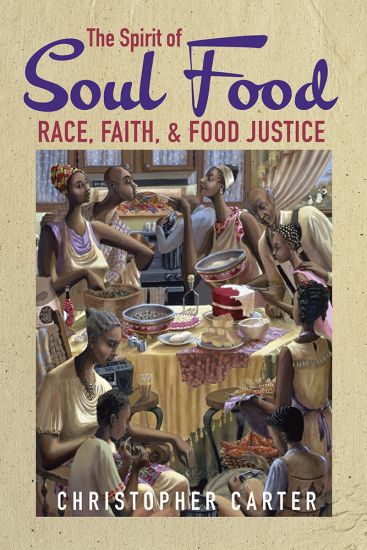
Soul food has played a critical role in preserving Black history, community, and culinary genius. It is also a response to--and marker of--centuries of food injustice. Given the harm that our food production system inflicts upon Black people, what should soul food look like today? Christopher Carter's answer to that question merges a history of Black American foodways with a Christian ethical response to food injustice. Carter reveals how racism and colonialism have long steered the development of US food policy. The very food we grow, distribute, and eat disproportionately harms Black people specifically and people of color among the global poor in general. Carter reflects on how people of color can eat in a way that reflects their cultural identities while remaining true to the principles of compassion, love, justice, and solidarity with the marginalized. Both a timely mediation and a call to action, The Spirit of Soul Food places today's Black foodways at the crossroads of food justice and Christian practice.
The Spirit of Soul Food

The Spirit of Soul Food

Christopher Carter

University of Illinois Press
2021
nidottu
Soul food has played a critical role in preserving Black history, community, and culinary genius. It is also a response to--and marker of--centuries of food injustice. Given the harm that our food production system inflicts upon Black people, what should soul food look like today? Christopher Carter's answer to that question merges a history of Black American foodways with a Christian ethical response to food injustice. Carter reveals how racism and colonialism have long steered the development of US food policy. The very food we grow, distribute, and eat disproportionately harms Black people specifically and people of color among the global poor in general. Carter reflects on how people of color can eat in a way that reflects their cultural identities while remaining true to the principles of compassion, love, justice, and solidarity with the marginalized. Both a timely mediation and a call to action, The Spirit of Soul Food places today's Black foodways at the crossroads of food justice and Christian practice.
Metafilm

Metafilm

Christopher Carter

Ohio State University Press
2018
sidottu
In Metafilm: Materialist Rhetoric and Reflexive Cinema, Christopher Carter examines paradoxical rhetoric in visual culture, analyzing movies that immerse viewers in violent narratives while examining the ethics of the transaction. Featuring the films of Michael Haneke, Atom Egoyan, Ic ar Bolla n, Paul Thomas Anderson, and Ryan Coogler, Carter analyzes how personal conflict intermingles with the inherent violence of warfare, transnational economics, labor exploitation, and racism in genres ranging from horror to historical recreation and from depictions of genocide to records of police brutality. These films, Carter argues, reflect on their construction, distribution, and audience engagement, emphasizing the material design and the economics of rhetoric in ways most films do not. Ultimately, Metafilm reframes materialism as a multimodal composing-in-action, or reflexive materialism, focusing on movies that dramatize their entanglement in economic and historical trauma while provoking forms of resistance during and after viewing. Carter contends that even as we recognize the division of social power in the films, we must also recognize how the concept is subversive and eludes control. In looking at the interplay between the films' content and their production, circulation, and reception, Carter explores how the films persuade us to identify with onscreen worlds before probing our expectations-validating some, rejecting others, and sometimes proposing new ways of watching altogether.
Metafilm

Metafilm

Christopher Carter

Ohio State University Press
2018
pokkari
In Metafilm: Materialist Rhetoric and Reflexive Cinema, Christopher Carter examines paradoxical rhetoric in visual culture, analyzing movies that immerse viewers in violent narratives while examining the ethics of the transaction. Featuring the films of Michael Haneke, Atom Egoyan, Ic ar Bolla n, Paul Thomas Anderson, and Ryan Coogler, Carter analyzes how personal conflict intermingles with the inherent violence of warfare, transnational economics, labor exploitation, and racism in genres ranging from horror to historical recreation and from depictions of genocide to records of police brutality. These films, Carter argues, reflect on their construction, distribution, and audience engagement, emphasizing the material design and the economics of rhetoric in ways most films do not. Ultimately, Metafilm reframes materialism as a multimodal composing-in-action, or reflexive materialism, focusing on movies that dramatize their entanglement in economic and historical trauma while provoking forms of resistance during and after viewing. Carter contends that even as we recognize the division of social power in the films, we must also recognize how the concept is subversive and eludes control. In looking at the interplay between the films' content and their production, circulation, and reception, Carter explores how the films persuade us to identify with onscreen worlds before probing our expectations-validating some, rejecting others, and sometimes proposing new ways of watching altogether.
Rhetorical Exposures

Rhetorical Exposures

Christopher Carter

The University of Alabama Press
2015
sidottu
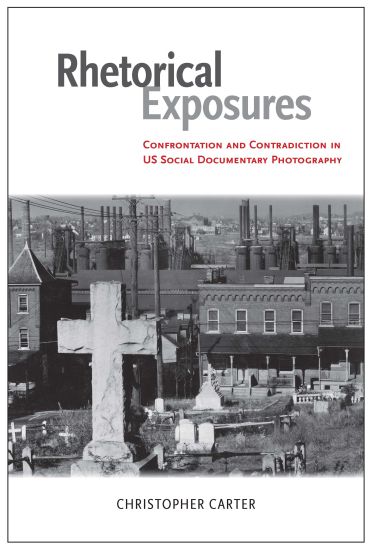
In Rhetorical Exposures, Christopher Carter explores social documentary photography from the nineteenth century to the present to illuminate the political dimensions of photographs that highlight social injustice.Documentary photography aims to capture the material reality of life. In Rhetorical Exposures, Christopher Carter demonstrates how the creation and display of documentary photographs—often now called “imagetexts”—both invite analysis and raise persistent questions about the political and social causes for the bleak scenes of poverty and distress captured on film.Carter’s carefully reasoned monograph examines both formal quali­ties of composition and the historical contexts of the production and display of documentary photographs. In Rhetorical Exposures, Carter explores Jacob Riis’s heart-rending photos of Manhattan’s poor in late nineteenth-century New York, the iconic images of tenant farmers in west Alabama from James Agee and Walker Evans’s Let Us Now Praise Famous Men, Ted Streshinsky’s images of 1960s social movements, Camilo José Vergara’s photographic landscapes of urban dereliction in the 1970s, and Chandra McCormick’s portraits of New Orleans’s Ninth Ward scarred by Hurricane Katrina.While not ascribing specifically political or Marxist intentions to the photographers discussed, Carter frames his arguments in a class-based dialectic that addresses material want as an ineluctable result of social inequality. He argues that social documentary photos have the powerful capacity to prompt viewers to confront injustice. Though photography may induce socially disruptive experiences, it remains vulnerable to the same power dynamics it subverts. Therefore, Carter offers a “rhetoric of exposure” that outlines how such social documentary images can be treated as highly tensioned rhetorical objects. His framework enables the analysis of photographs as heterogeneous records of the interaction of social classes and expressions of specific built environments. Rhetorical Exposures also discusses how photographs interact with oral and print media and relate to public memorials, murals, and graphic novels.As the creation and dissemination of new media continues to evolve in an environment of increasing anxiety about growing financial inequality, Rhetorical Exposures offers a very apt and timely discussion of the ways social documentary photography is created, employed, and understood.
The Corruption of Ethos in Fortress America

The Corruption of Ethos in Fortress America

Christopher Carter

Lexington Books
2020
sidottu
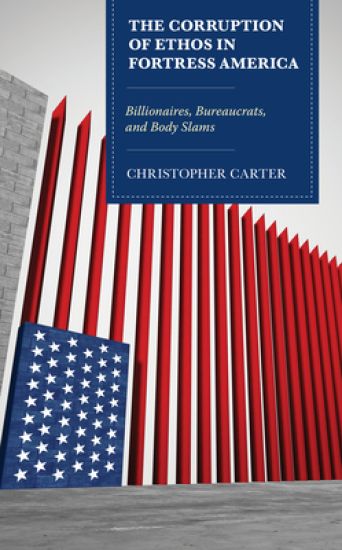
The Corruption of Ethos in Fortress America: Billionaires, Bureaucrats, and Body Slams argues that authoritarian strains of U.S. governance violate the idea of ethos in its ancient, collectivist sense. Christopher Carter posits that this corrupts the cultural “dwelling place” through public relations strategies, policies on race and immigration, and a general disregard for environmental concerns. Donald Trump’s presidency provides a signal instance of the problem, refashioning the dwelling place as a fortress while promoting sweeping forms of exclusion and appealing to power for power’s sake. Carter’s analysis shows that, emboldened by the purported flexibility of truth, Trump’s authoritarian rhetoric underwrites unrestrained policing, militarized borders, populist nationalism, and relentless assaults on investigative journalism. These trends bode ill for human rights and critical education as well as progressive social movements and the forms of life they entail. Worse yet, the corruption of ethos threatens life in general by privileging corporate prerogatives over ecological attunement. In response to those tendencies, Carter highlights modes of activism that merge antiracist and labor rhetoric to offer a more fluid, unpredictably emergent vision of social space, allying with ecofeminism in ways that make that vision durable. Scholars of rhetoric, political science, history, ecology, race studies, and American studies will find this book particularly useful.
The Rhetoric of Dystopia

The Rhetoric of Dystopia

Christopher Carter

BLOOMSBURY PUBLISHING PLC
2024
sidottu
The Rhetoric of Dystopia develops an idea of “emergent metalepsis” that describes the uncanny moments where fictive texts anticipate material events, blurring the boundary between the storyworld and the world of reception. Christopher Carter treats dystopia as rhetoric that shapes collective identities while speeding across platforms and geopolitical borders, at once critiquing and exemplifying the circulation of power relations through varied modes. This rhetoric features rampant viruses, authoritarian governments, corporate behemoths, corrupt educational and scientific institutions, and brutal policing, sometimes amplifying existing trends and sometimes merely documenting them. From Bong Joon-ho to Reed Morano, Octavia Butler to Richard McGuire, artists proffer arguments whose gravity we often fail to register, thus calling into question the uses of media literacy in an age of looming cataclysm. Carter situates this rhetoric within scholarship on literacy, built environments, border policies, global food production, and the Anthropocene.