Kirjojen hintavertailu. Mukana 11 244 527 kirjaa ja 12 kauppaa.

Kirjahaku

Etsi kirjoja tekijän nimen, kirjan nimen tai ISBN:n perusteella.

44 kirjaa tekijältä Christopher Clark

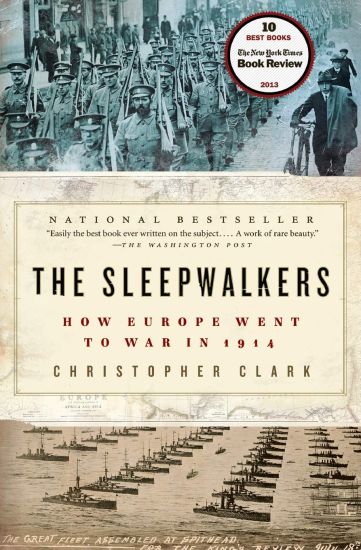
The Sleepwalkers: How Europe Went to War in 1914

The Sleepwalkers: How Europe Went to War in 1914

Christopher Clark

HARPER PERENNIAL
2014
nidottu
"A monumental new volume. . . . Revelatory, even revolutionary. . . . Clark has done a masterful job explaining the inexplicable." -- Boston GlobeOne of The New York Times Book Review's 10 Best Books of the Year - Winner of the Los Angeles Times Book Prize (History)Historian Christopher Clark's riveting account of the explosive beginnings of World War I.Drawing on new scholarship, Clark offers a fresh look at World War I, focusing not on the battles and atrocities of the war itself, but on the complex events and relationships that led a group of well-meaning leaders into brutal conflict.Clark traces the paths to war in a minute-by-minute, action-packed narrative that cuts between the key decision centers in Vienna, Berlin, St. Petersburg, Paris, London, and Belgrade, and examines the decades of history that informed the events of 1914 and details the mutual misunderstandings and unintended signals that drove the crisis forward in a few short weeks.Meticulously researched and masterfully written, The Sleepwalkers is a dramatic and authoritative chronicle of Europe's descent into a war that tore the world apart.
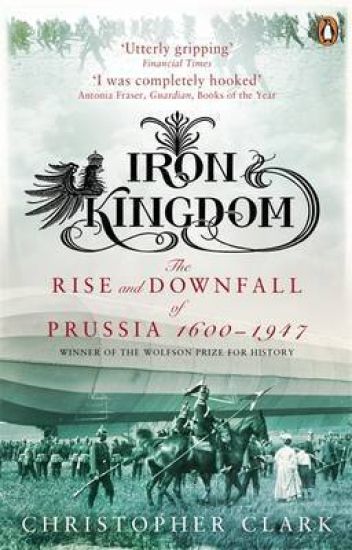
Iron Kingdom

Iron Kingdom

Christopher Clark

Penguin Books Ltd
2007
pokkari
Winner of the Wolfson History Prize, Christopher Clark's Iron Kingdom: The Rise and Downfall of Prussia 1600-1947 is a compelling account of a country that played a pivotal role in Europe's fortunes and fundamentally shaped our world. Prussia began as a medieval backwater, but transformed itself into a major European power and the force behind the creation of the German empire, until it was finally abolished by the Allies after the Second World War. With great flair and authority, Christopher Clark describes Prussia's great battles, dynastic marriages and astonishing reversals of fortune, its brilliant and charismatic leaders from the Hohenzollerns of Brandenburg to Bismarck and Frederick the Great, the military machine and the progressive, enlightened values on which it was built. 'Fascinating ... masterly ... littered with intriguing detail and wry observation' Richard Overy, Daily Telegraph 'A terrific book ... the definitive history of this much-maligned state' Daily Telegraph Books of the Year 'You couldn't have the triumph and the tragedy of Prussia better told' Observer 'A magisterial history of Europe's only extinct power' Financial Times 'Exemplary ... an illuminating, profoundly satisfying work of history' The New York Times Christopher Clark is a lecturer in Modern European History at St Catharine's College, University of Cambridge. He is also the author of Kaiser Wilhelm II: A Life in Power.
The Sleepwalkers

The Sleepwalkers

Christopher Clark

Penguin Books Ltd
2013
pokkari
The pacy, sensitive and formidably argued history of the causes of the First World War, from acclaimed historian and author Christopher ClarkFINANCIAL TIMES BOOKS OF THE YEAR 2014SUNDAY TIMES and INDEPENDENT BOOKS OF THE YEAR 2012Winner of the Los Angeles Times History Book Prize 2014The moments that it took Gavrilo Princip to step forward to the stalled car and shoot dead Franz Ferdinand and his wife were perhaps the most fateful of the modern era. An act of terrorism of staggering efficiency, it fulfilled its every aim: it would liberate Bosnia from Habsburg rule and it created a powerful new Serbia, but it also brought down four great empires, killed millions of men and destroyed a civilization. What made a seemingly prosperous and complacent Europe so vulnerable to the impact of this assassination?In The Sleepwalkers Christopher Clark retells the story of the outbreak of the First World War and its causes. Above all, it shows how the failure to understand the seriousness of the chaotic, near genocidal fighting in the Balkans would drag Europe into catastrophe.Reviews:'Formidable ... one of the most impressive and stimulating studies of the period ever published' Max Hastings, Sunday Times'Easily the best book ever written on the subject ... A work of rare beauty that combines meticulous research with sensitive analysis and elegant prose. The enormous weight of its quality inspires amazement and awe ... Academics should take note: Good history can still be a good story' Washington Post'A lovingly researched work of the highest scholarship. It is hard to believe we will ever see a better narrative of what was perhaps the biggest collective blunder in the history of international relations' Niall Ferguson'[Reading The Sleepwalkers], it is as if a light had been turned on a half-darkened stage of shadowy characters cursing among themselves without reason ... [Clark] demolishes the standard view ... The brilliance of Clark's far-reaching history is that we are able to discern how the past was genuinely prologue ... In conception, steely scholarship and piercing insights, his book is a masterpiece' Harold Evans, New York Times Book Review'Impeccably researched, provocatively argued and elegantly written ... a model of scholarship' Sunday Times Books of the Year'Superb ... effectively consigns the old historical consensus to the bin ... It's not often that one has the privilege of reading a book that reforges our understanding of one of the seminal events of world history' Mail Online'A monumental new volume ... Revelatory, even revolutionary ... Clark has done a masterful job explaining the inexplicable' Boston Globe'Superb ... One of the great mysteries of history is how Europe's great powers could have stumbled into World War I ... This is the single best book I have read on this important topic' Fareed Zakaria'A meticulously researched, superbly organized, and handsomely written account' Military History'Clark is a masterly historian ... His account vividly reconstructs key decision points while deftly sketching the context driving them ... A magisterial work' Wall Street Journal'This compelling examination of the causes of World War I deserves to become the new standard one-volume account of that contentious subject' Foreign Affairs'A brilliant contribution' Times Higher Education'Clark is fully alive to the challenges of the subject ... He provides vivid portraits of leading figures ... [He] also gives a rich sense of what contemporaries believed was at stake in the crises leading up to the war' Irish Times'In recent decades, many analysts had tended to put most blame for the disaster [of the First World War] on Germany. Clark strongly renews an older interpretation which sees the statesmen of many countries as blundering blindly together into war' Stephen Howe, Independent Books of the YearAbout the author:Christopher Clark is Professor of Modern History at the University of Cambridge and a Fellow of St Catharine's College. He is the author of The Politics of Conversion, Kaiser Wilhelm II and Iron Kingdom. Widely praised around the world, Iron Kingdom became a major bestseller. He has been awarded the Officer's Cross of the Order of Merit of the Federal Republic of Germany.
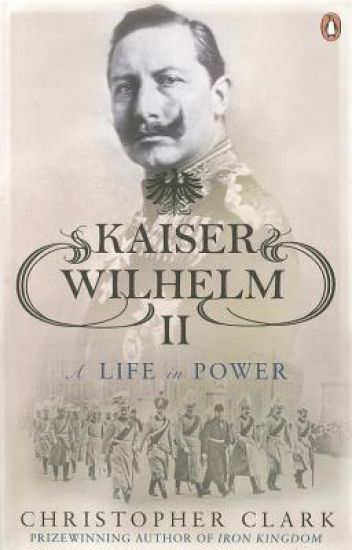
Kaiser Wilhelm II

Kaiser Wilhelm II

Christopher Clark

Penguin Books Ltd
2009
pokkari
Christopher Clark's Kaiser Wilhelm II: A Life in Power is a short, fascinating and accessible biography of one of the 20th century's most important figures.King of Prussia, German Emperor, war leader and defeated exile, Kaiser Wilhelm II was one of the most important - and most controversial - figures in the history of twentieth-century Europe. But how much power did he really have?Christopher Clark, winner of the Wolfson prize for his history of Prussia, Iron Kingdom, follows Kaiser Wilhelm's political career from his youth at the Hohenzollern court through the turbulent decades of the Wilhelmine era into global war and the collapse of Germany in 1918, to his last days. He asks: what was his true role in the events that led to the outbreak of the First World War? What was the nature and extent of his control? What were his political goals and his success in achieving them? How did he project authority and exercise influence? And how did his people really view him?Through original research, Clark presents a fresh new interpretation of this contentious figure, focusing on how his thirty-year reign from 1888 to 1918 affected Germany, and the rest of Europe, for years to come. 'Clark's fresh and enlightening history brings the Kaiser's life into critical and illuminating review' German History Christopher Clark is a lecturer in Modern European History at St Catharine's College, University of Cambridge. His book Iron Kingdom: The Rise and Downfall of Prussia 1600 to 1947 was the winner of the Wolfson Prize for History.
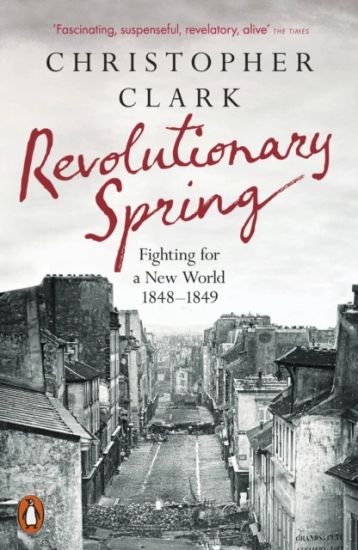
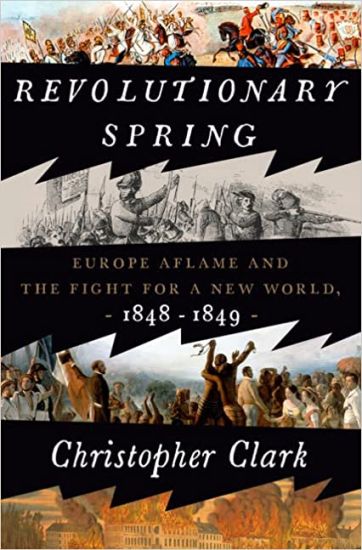
Revolutionary Spring

Revolutionary Spring

Christopher Clark

PENGUIN BOOKS LTD
2024
pokkari
'One of the best history books you will read this decade' History Today'Fascinating, suspenseful, revelatory, alive' The TimesThere can be few more exciting or frightening moments in European history than the spring of 1848. As if by magic, in city after city, from Palermo to Paris to Venice, huge crowds gathered, sometimes peaceful and sometimes violent, and the political order that had held sway since the defeat of Napoleon simply collapsed.Christopher Clark's spectacular new book recreates with verve, wit and insight this extraordinary period. Some rulers gave up at once, others fought bitterly, but everywhere new politicians, beliefs and expectations surged forward. The role of women in society, the end of slavery, the right to work, national independence and the emancipation of the Jews all became live issues.Clark conjures up both this ferment of new ideas and then the increasingly ruthless and effective series of counter-attacks launched by regimes who still turned out to have many cards to play. But even in defeat, exiles spread the ideas of 1848 around the world and - for better and sometimes much worse - a new and very different Europe emerged from the wreckage.
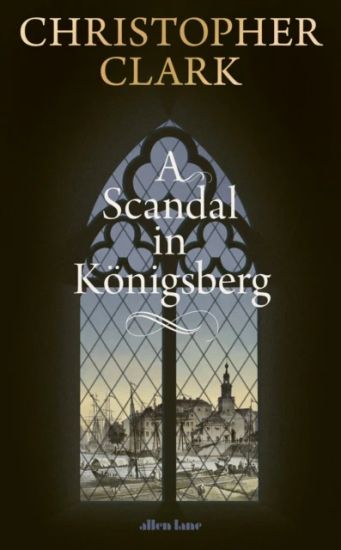
A Scandal in Königsberg

A Scandal in Königsberg

Christopher Clark

PENGUIN BOOKS LTD
2025
sidottu
A remarkable micro-history from the author of The Sleepwalkers and Revolutionary SpringNow part of the Russian Baltic enclave of Kaliningrad, the former Prussian and German port of Königsberg has always been a somewhat sleepy place, doomed to be famous for having once been the residence of Immanuel Kant. But in the late 1830s, just for a short while, it became famous for all the wrong reasons.Christopher Clark’s brilliant new book is the result of many years of fascination with this strange case. Sensational accusations were bandied about, implying that beneath the town’s somnolent surface there were dark erotic currents and wrenching betrayals of trust. For the Prussian authorities this was just the sort of moral collapse they feared most. In the aftermath of the Revolutionary and Napoleonic Wars, which had unsettled a generation, every lapse could be seen as the harbinger of new storms.A Scandal in Königsberg beautifully brings to life a time and a place that we would now situate in the tranquil ‘Biedermeier’ years between the seismic upheavals of the 1810s and 1840s. But there is a timeless quality to this small vortex of turbulence, in which spiritual hunger, vanity, professional rivalry, sexual incontinence, naivety and sheer human waywardness threatened to tear a city apart.
Revolutionary Spring: Europe Aflame and the Fight for a New World, 1848-1849
New York Times Book Review Editors' Choice - From the bestselling author of The Sleepwalkers comes an epic history of the 1848 revolutions that swept Europe, and the charismatic figures who propelled them forward "Refreshingly original . . . Familiar characters are given vibrancy and previously unknown players emerge from the shadows."--The Times (UK) A BEST BOOK OF THE YEAR: New Yorker, The Economist, Financial Times As history, the uprisings of 1848 have long been overshadowed by the French Revolution of 1789 and the Russian revolutions of the early twentieth century. And yet in 1848 nearly all of Europe was aflame with conflict. Parallel political tumults spread like brush fire across the entire continent, leading to significant changes that continue to shape our world today. These battles for the future were fought with one eye kept squarely on the past: The men and women of 1848 saw the urgent challenges of their world as shaped profoundly by the past, and saw themselves as inheritors of a revolutionary tradition. Celebrated Cambridge historian Christopher Clark describes 1848 as "the particle collision chamber at the center of the European nineteenth century," a moment when political movements and ideas--from socialism and democratic radicalism to liberalism, nationalism, corporatism, and conservatism--were tested and transformed. The insurgents asked questions that sound modern to our ears: What happens when demands for political or economic liberty conflict with demands for social rights? How do we reconcile representative and direct forms of democracy? How is capitalism connected to social inequality? The revolutions of 1848 were short-lived, but their impact on public life and political thought throughout Europe and beyond has been profound. Meticulously researched, elegantly written, and filled with a cast of charismatic figures, including the social theorist Alexis de Tocqueville, the writer George Sand, and the troubled priest F licit de Lamennais, who struggled to reconcile his faith with politics, Revolutionary Spring offers a new understanding of 1848 that suggests chilling parallels to our present moment. "Looking back at the revolutions from the end of the first quarter of the twenty-first century, it is impossible not to be struck by the resonances," Clark writes. "If a revolution is coming for us, it may look something like 1848."
Clare: The Killing of a Gentle Activist

Clare: The Killing of a Gentle Activist

Christopher Clark

TAFELBERG PUBLISHERS LTD
2022
nidottu
Clare Stewart’s body was found by cattle herders in a shallow ditch, presided over by red aloes, in Manguzi, KZN on 24 November 1993. The ANC activist, recruited by Umkhonto we Sizwe commander Ronnie Kasrils, had been missing for two weeks. This gripping account of the mystery surrounding Clare’s killing touches on the fragility of memory, family heartbreak, apartheid-era evil and on what went wrong with our democracy.
Iron Kingdom: The Rise and Downfall of Prussia, 1600-1947
In the aftermath of World War II, Prussia--a centuries-old state pivotal to Europe's development--ceased to exist. In their eagerness to erase all traces of the Third Reich from the earth, the Allies believed that Prussia, the very embodiment of German militarism, had to be abolished. But as Christopher Clark reveals in this pioneering history, Prussia's legacy is far more complex. Though now a fading memory in Europe's heartland, the true story of Prussia offers a remarkable glimpse into the dynamic rise of modern Europe. What we find is a kingdom that existed nearly half a millennium ago as a patchwork of territorial fragments, with neither significant resources nor a coherent culture. With its capital in Berlin, Prussia grew from being a small, poor, disregarded medieval state into one of the most vigorous and powerful nations in Europe. Iron Kingdom traces Prussia's involvement in the continent's foundational religious and political conflagrations: from the devastations of the Thirty Years War through centuries of political machinations to the dissolution of the Holy Roman Empire, from the enlightenment of Frederick the Great to the destructive conquests of Napoleon, and from the "iron and blood" policies of Bismarck to the creation of the German Empire in 1871, and all that implied for the tumultuous twentieth century. By 1947, Prussia was deemed an intolerable threat to the safety of Europe; what is often forgotten, Clark argues, is that it had also been an exemplar of the European humanistic tradition, boasting a formidable government administration, an incorruptible civil service, and religious tolerance. Clark demonstrates how a state deemed the bane of twentieth-century Europe has played an incalculable role in Western civilization's fortunes. Iron Kingdom is a definitive, gripping account of Prussia's fascinating, influential, and critical role in modern times.
Time and Power

Time and Power

Christopher Clark

PRINCETON UNIVERSITY PRESS
2019
sidottu
From the author of the national bestseller The Sleepwalkers, a book about how the exercise of power is shaped by different concepts of timeThis groundbreaking book presents new perspectives on how the exercise of power is shaped by different notions of time. Acclaimed historian Christopher Clark draws on four key figures from German history—Friedrich Wilhelm of Brandenburg-Prussia, Frederick the Great, Otto von Bismarck, and Adolf Hitler—to look at history through a temporal lens and ask how historical actors and their regimes embody unique conceptions of time.Inspired by the insights of Reinhart Koselleck and François Hartog, two pioneers of the “temporal turn” in historiography, Clark shows how Friedrich Wilhelm rejected the notion of continuity with the past, believing instead that a sovereign must liberate the state from the entanglements of tradition to choose freely among different possible futures. He demonstrates how Frederick the Great abandoned this paradigm for a neoclassical vision of history in which sovereign and state transcend time altogether, and how Bismarck believed that the statesman’s duty was to preserve the timeless permanence of the state amid the torrent of historical change. Clark describes how Hitler did not seek to revolutionize history like Stalin and Mussolini, but instead sought to evade history altogether, emphasizing timeless racial archetypes and a prophetically foretold future.Elegantly written and boldly innovative, Time and Power takes readers from the Thirty Years’ War to the fall of the Third Reich, revealing the connection between political power and the distinct temporalities of the leaders who wield it.
Time and Power

Time and Power

Christopher Clark

Princeton University Press
2021
pokkari
From the bestselling author of The Sleepwalkers, a book about how the exercise of power is shaped by different concepts of timeThis groundbreaking book presents new perspectives on how the exercise of power is shaped by different notions of time. Acclaimed historian Christopher Clark draws on four key figures from German history—Friedrich Wilhelm of Brandenburg-Prussia, Frederick the Great, Otto von Bismarck, and Adolf Hitler—to look at history through a temporal lens and ask how historical actors and their regimes embody unique conceptions of time. Elegantly written and boldly innovative, Time and Power reveals the connection between political power and the distinct temporalities of the leaders who wield it.
The Roots of Rural Capitalism

The Roots of Rural Capitalism

Christopher Clark

Cornell University Press
1992
pokkari
Between the late colonial period and the Civil War, the countryside of the American northeast was largely transformed. Rural New England changed from a society of independent farmers relatively isolated from international markets into a capitalist economy closely linked to the national market, an economy in which much farming and manufacturing output was produced by wage labor. Using the Connecticut Valley as an example, The Roots of Rural Capitalism demonstrates how this important change came about. Christopher Clark joins the active debate on the "transition to capitalism" with a fresh interpretation that integrates the insights of previous studies with the results of his detailed research. Largely rejecting the assumption of recent scholars that economic change can be explained principally in terms of markets, he constructs a broader social history of the rural economy and traces the complex interactions of social structure, household strategies, gender relations, and cultural values that propelled the countryside from one economic system to another. Above all, he shows that people of rural Massachusetts were not passive victims of changes forced upon them, but actively created a new economic world as they tried to secure their livelihoods under changing demographic and economic circumstances. The emergence of rural capitalism, Clark maintains, was not the result of a single "transition"; rather, it was an accretion of new institutions and practices that occurred over two generations, and in two broad chronological phases. It is his singular contribution to demonstrate the coexistence of a family-based household economy (persisting well into the nineteenth century) and the market-oriented system of production and exchange that is generally held to have emerged full-blown by the eighteenth century. He is adept at describing the clash of values sustaining both economies, and the ways in which the rural household-based economy, through a process he calls "involution," ultimately gave way to a new order. His analysis of the distinctive role of rural women in this transition constitutes a strong new element in the study of gender as a factor in the economic, social, and cultural shifts of the period. Sophisticated in argument and engaging in presentation, this book will be recognized as a major contribution to the history of capitalism and society in nineteenth-century America.
Tangled Strings

Tangled Strings

Christopher Clark

Christopher Clark
2018
nidottu
An international gambling thriller Clawing your way up through the minor leagues of tennis to reach the ATP tour is difficult enough. But when unseen match fixers threaten and bully players to throw matches so they can cash in on rigged bets, it becomes a matter of life and death. Caught between unyielding pressure and their own ambition, a handful of aspiring players fight back. The odds are against them, and the stakes couldn't be higher as they take on the gamblers, all the while fighting to earn their place in the top tier of international tennis.
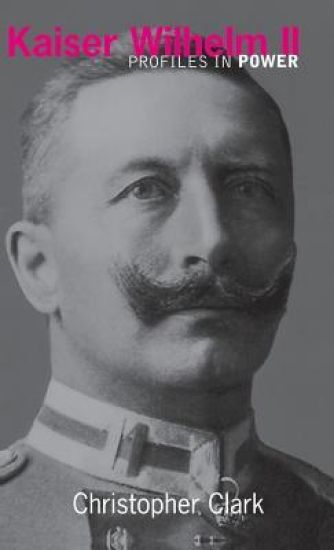
Kaiser Wilhelm II

Kaiser Wilhelm II

Christopher Clark

Routledge
2015
sidottu
Kaiser Wilhelm II is one of the key figures in the history of twentieth-century Europe: King of Prussia and German Emperor from 1888 to the collapse of Germany in 1918 and a crucial player in the events that led to the outbreak of World War I. Following Kaiser Wilhelm's political career from his youth at the Hohenzollern court through the turbulent peacetime decades of the Wilhelmine era into global war and exile, the book presents a new interpretation of this controversial monarch and assesses the impact on Germany of his forty-year reign.