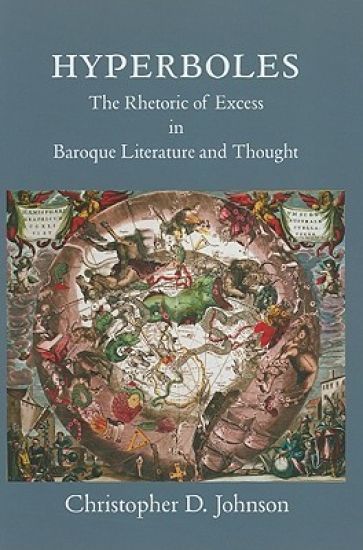
This book offers a detailed, comparatist defense of hyperbole in the Baroque period. Focusing on Spanish and Mexican lyric (Góngora, Quevedo, and Sor Juana), English drama (King Lear and translations of Seneca), and French philosophy (Descartes and Pascal), Christopher D. Johnson reads Baroque hyperbole as a sophisticated, often sublime, frequently satiric means of making sense of worlds and selves in crisis and transformation. Grounding his readings of hyperbole in the history of rhetoric and literary imitation, Johnson traces how rhetorical excess acquires specific cultural, political, aesthetic, and epistemological value. Hyperboles also engages more recent critiques of hyperbolic thought (Wittgenstein, Derrida, and Cavell), as it argues that hyperbole is the primary engine of a poetics and metaphysics of immanence.
The work of German cultural theorist and art historian Aby Warburg (1866–1929) has had a lasting effect on how we think about images. This book is the first in English to focus on his last project, the encyclopedic Atlas of Images: Mnemosyne. Begun in earnest in 1927, and left unfinished at the time of Warburg's death in 1929, the Atlas consisted of sixty-three large wooden panels covered with black cloth. On these panels Warburg carefully, intuitively arranged some thousand black-and-white photographs of classical and Renaissance art objects, as well as of astrological and astronomical images ranging from ancient Babylon to Weimar Germany. Here and there, he also included maps, manuscript pages, and contemporary images taken from newspapers. Trying through these constellations of images to make visible the many polarities that fueled antiquity's afterlife, Warburg envisioned the Atlas as a vital form of metaphoric thought. While the nondiscursive, frequently digressive character of the Atlas complicates any linear narrative of its themes and contents, Christopher D. Johnson traces several thematic sequences in the panels. By drawing on Warburg's published and unpublished writings and by attending to Warburg's cardinal idea that "pathos formulas" structure the West's cultural memory, Johnson maps numerous tensions between word and image in the Atlas. In addition to examining the work itself, he considers the literary, philosophical, and intellectual-historical implications of the Atlas. As Johnson demonstrates, the Atlas is not simply the culmination of Warburg's lifelong study of Renaissance culture but the ultimate expression of his now literal, now metaphoric search for syncretic solutions to the urgent problems posed by the history of art and culture.
New Contexts for Eighteenth-Century British Fiction is a collection of thirteen essays honoring Professor Jerry C. Beasley, who retired from the University of Delaware in 2005. The essays, written by friends, collaborators and former students, reflect the scholarly interests that defined Professor Beasley's career and point to new directions of critical inquiry. The initial essays, which discuss Tobias Smollett, Elizabeth Singer Rowe, and Samuel Richardson, suggest new directions in biographical writing, including the intriguing discourse of "life writing" explored by Paula Backscheider. Subsequent essays enrich understandings of eighteenth-century fiction by examining lesser-known works by Jane Barker, Eliza Haywood, and Charlotte Lennox. Many of the essays, especially those that focus on Smollett, use political pamphlets, material artifacts, and urban legends to place familiar novels in new contexts. The collection's final essay demonstrates the vital importance of bibliographic study.