Kirjojen hintavertailu. Mukana 11 862 814 kirjaa ja 12 kauppaa.

Kirjahaku

Etsi kirjoja tekijän nimen, kirjan nimen tai ISBN:n perusteella.

5 kirjaa tekijältä Christopher G. Small

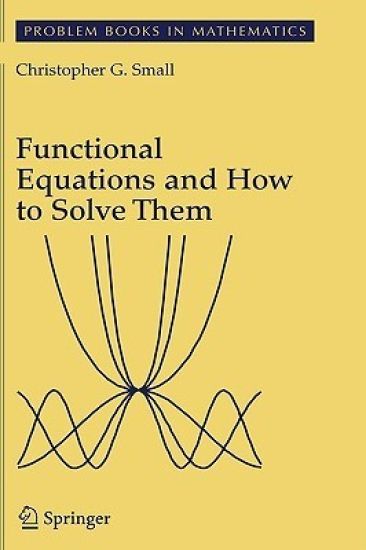
Functional Equations and How to Solve Them

Functional Equations and How to Solve Them

Christopher G. Small

Springer-Verlag New York Inc.
2006
sidottu
Over the years, a number of books have been written on the theory of functional equations. However, very little has been published which helps readers to solve functional equations in mathematics competitions and mathematical problem solving. This book fills that gap. The student who encounters a functional equation on a mathematics contest will need to investigate solutions to the equation by finding all solutions, or by showing that all solutions have a particular property. The emphasis here will be on the development of those tools which are most useful in assigning a family of solutions to each functional equation in explicit form. At the end of each chapter, readers will find a list of problems associated with the material in that chapter. The problems vary greatly, with the easiest problems being accessible to any high school student who has read the chapter carefully. The most difficult problems will be a reasonable challenge to advanced students studying for the International Mathematical Olympiad at the high school level or the William Lowell Putnam Competition for university undergraduates. The book ends with an appendix containing topics that provide a springboard for further investigation of the concepts of limits, infinite series and continuity.
Functional Equations and How to Solve Them

Functional Equations and How to Solve Them

Christopher G. Small

Springer-Verlag New York Inc.
2007
nidottu
Over the years, a number of books have been written on the theory of functional equations. However, very little has been published which helps readers to solve functional equations in mathematics competitions and mathematical problem solving. This book fills that gap. The student who encounters a functional equation on a mathematics contest will need to investigate solutions to the equation by finding all solutions, or by showing that all solutions have a particular property. The emphasis here will be on the development of those tools which are most useful in assigning a family of solutions to each functional equation in explicit form. At the end of each chapter, readers will find a list of problems associated with the material in that chapter. The problems vary greatly, with the easiest problems being accessible to any high school student who has read the chapter carefully. The most difficult problems will be a reasonable challenge to advanced students studying for the International Mathematical Olympiad at the high school level or the William Lowell Putnam Competition for university undergraduates. The book ends with an appendix containing topics that provide a springboard for further investigation of the concepts of limits, infinite series and continuity.
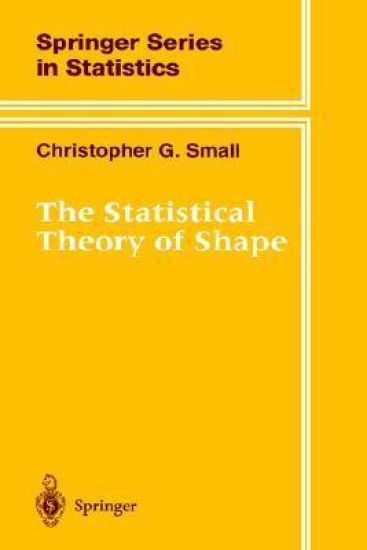
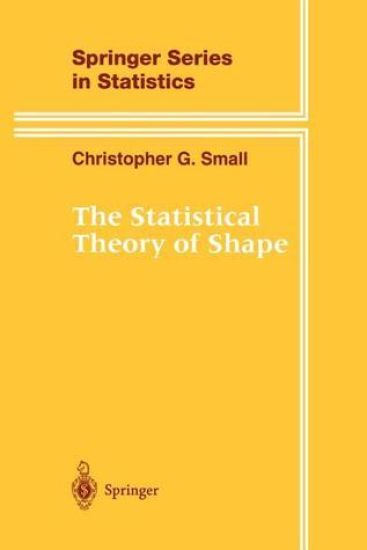
The Statistical Theory of Shape

The Statistical Theory of Shape

Christopher G. Small

Springer-Verlag New York Inc.
1996
sidottu
In general terms, the shape of an object, data set, or image can be de­ fined as the total of all information that is invariant under translations, rotations, and isotropic rescalings. Thus two objects can be said to have the same shape if they are similar in the sense of Euclidean geometry. For example, all equilateral triangles have the same shape, and so do all cubes. In applications, bodies rarely have exactly the same shape within measure­ ment error. In such cases the variation in shape can often be the subject of statistical analysis. The last decade has seen a considerable growth in interest in the statis­ tical theory of shape. This has been the result of a synthesis of a number of different areas and a recognition that there is considerable common ground among these areas in their study of shape variation. Despite this synthesis of disciplines, there are several different schools of statistical shape analysis. One of these, the Kendall school of shape analysis, uses a variety of mathe­ matical tools from differential geometry and probability, and is the subject of this book. The book does not assume a particularly strong background by the reader in these subjects, and so a brief introduction is provided to each of these topics. Anyone who is unfamiliar with this material is advised to consult a more complete reference. As the literature on these subjects is vast, the introductory sections can be used as a brief guide to the literature.
The Statistical Theory of Shape

The Statistical Theory of Shape

Christopher G. Small

Springer-Verlag New York Inc.
2011
nidottu
In general terms, the shape of an object, data set, or image can be de­ fined as the total of all information that is invariant under translations, rotations, and isotropic rescalings. Thus two objects can be said to have the same shape if they are similar in the sense of Euclidean geometry. For example, all equilateral triangles have the same shape, and so do all cubes. In applications, bodies rarely have exactly the same shape within measure­ ment error. In such cases the variation in shape can often be the subject of statistical analysis. The last decade has seen a considerable growth in interest in the statis­ tical theory of shape. This has been the result of a synthesis of a number of different areas and a recognition that there is considerable common ground among these areas in their study of shape variation. Despite this synthesis of disciplines, there are several different schools of statistical shape analysis. One of these, the Kendall school of shape analysis, uses a variety of mathe­ matical tools from differential geometry and probability, and is the subject of this book. The book does not assume a particularly strong background by the reader in these subjects, and so a brief introduction is provided to each of these topics. Anyone who is unfamiliar with this material is advised to consult a more complete reference. As the literature on these subjects is vast, the introductory sections can be used as a brief guide to the literature.
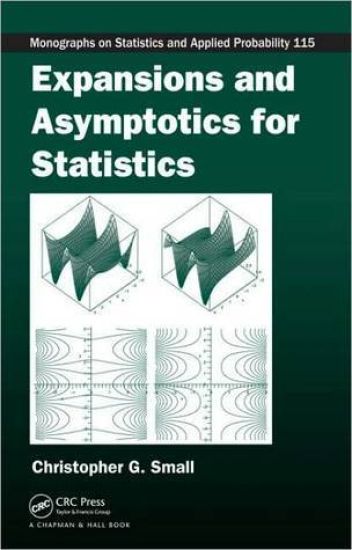
Expansions and Asymptotics for Statistics

Expansions and Asymptotics for Statistics

Christopher G. Small

Chapman Hall/CRC
2010
sidottu
Asymptotic methods provide important tools for approximating and analysing functions that arise in probability and statistics. Moreover, the conclusions of asymptotic analysis often supplement the conclusions obtained by numerical methods. Providing a broad toolkit of analytical methods, Expansions and Asymptotics for Statistics shows how asymptotics, when coupled with numerical methods, becomes a powerful way to acquire a deeper understanding of the techniques used in probability and statistics. The book first discusses the role of expansions and asymptotics in statistics, the basic properties of power series and asymptotic series, and the study of rational approximations to functions. With a focus on asymptotic normality and asymptotic efficiency of standard estimators, it covers various applications, such as the use of the delta method for bias reduction, variance stabilisation, and the construction of normalising transformations, as well as the standard theory derived from the work of R.A. Fisher, H. Cramér, L. Le Cam, and others. The book then examines the close connection between saddle-point approximation and the Laplace method. The final chapter explores series convergence and the acceleration of that convergence.