Kirjojen hintavertailu. Mukana 11 342 296 kirjaa ja 12 kauppaa.

Kirjahaku

Etsi kirjoja tekijän nimen, kirjan nimen tai ISBN:n perusteella.

13 kirjaa tekijältä Christopher R. Seitz

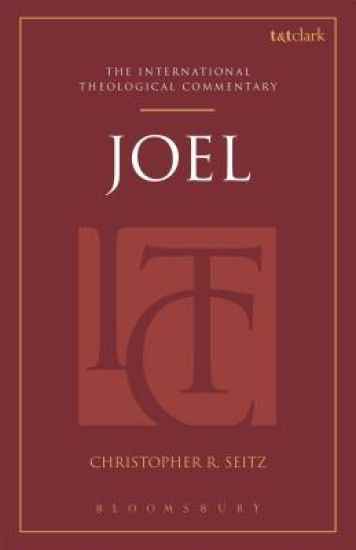
Joel (ITC)

Joel (ITC)

Christopher R. Seitz

T. T.Clark Ltd
2016
sidottu
The book of Joel is held to be one of the latest prophetic witnesses; it cites other books of the book of the Twelve prophets with a density that distinguishes it from its neighbours. The concept of the "Day of the LORD" which runs throughout the Minor Prophets as a whole reaches its zenith in Joel and its co-mingling of ecological and military metaphors advances Hosea on the former and anticipates later texts on the latter.In this volume within T&T Clark's International Theological Commentary Series Christopher Seitz starts from a foundation of historical-critical methodology to provide an account of Joel's place and purpose within the book of the Twelve prophets as a whole. Seitz examines the theology and background of Joel, and shows how Joel's theological function can provide a major hermeneutical key to the interpretation of the wider collection, and teases out the precise character of that role.
Joel (ITC)

Joel (ITC)

Christopher R. Seitz

BLOOMSBURY PUBLISHING PLC
2025
nidottu
The book of Joel is held to be one of the latest prophetic witnesses; it cites other books of the book of the Twelve prophets with a density that distinguishes it from its neighbours. The concept of the "Day of the LORD" which runs throughout the Minor Prophets as a whole reaches its zenith in Joel and its co-mingling of ecological and military metaphors advances Hosea on the former and anticipates later texts on the latter.In this volume within T&T Clark's International Theological Commentary Series Christopher Seitz starts from a foundation of historical-critical methodology to provide an account of Joel's place and purpose within the book of the Twelve prophets as a whole. Seitz examines the theology and background of Joel, and shows how Joel's theological function can provide a major hermeneutical key to the interpretation of the wider collection, and teases out the precise character of that role.
Figured Out

Figured Out

Christopher R. Seitz

Westminster/John Knox Press,U.S.
2001
nidottu
All of our attempts to find the historical backgrounds to texts have led us to believe that we have "figured out" the Bible. Steering a course between modernity's obsession with historical readings and fundamentalism's compulsion for ahistorical readings, Christopher Seitz recovers a figural/typological approach to both the Old and New Testament that shapes a theological understanding of Scripture. Figured Out examines the loss of figural assumptions and models another way forward.
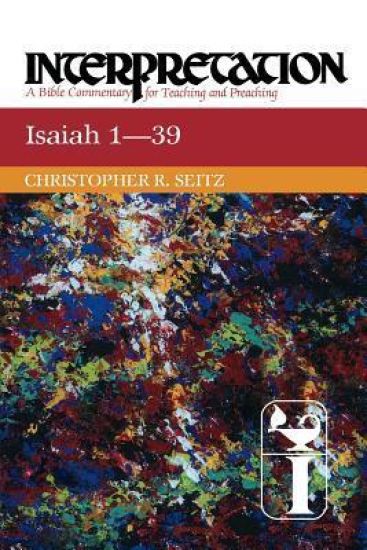
Isaiah 1-39

Isaiah 1-39

Christopher R. Seitz

Westminster/John Knox Press,U.S.
2011
nidottu
This unique commentary allows the interpretation of Isaiah 1-39 to be guided by the final form of the book. It focuses on the theological aspect of the book of Isaiah, giving special attention to the role of literary context. Christopher Seitz explores structural and organizational concerns as clues to the editorial intention of the final form of the material, which he argues is both intelligible and an intended result of the efforts of those who gave shape to the present form of the book.Interpretation: A Bible Commentary for Teaching and Preaching is a distinctive resource for those who interpret the Bible in the church. Planned and written specifically for teaching and preaching needs, this critically acclaimed biblical commentary is a major contribution to scholarship and ministry.
Isaiah 1-39

Isaiah 1-39

Christopher R. Seitz

Westminster/John Knox Press,U.S.
1993
sidottu
This unique commentary allows the interpretation of Isaiah 1-39 to be guided by the final form of the book. It focuses on the theological aspect of the book of Isaiah, giving special attention to the role of literary context. Christopher Seitz explores structural and organizational concerns as clues to the editorial intention of the final form of the material, which he argues is both intelligible and an intended result of the efforts of those who gave shape to the present form of the book.Interpretation: A Bible Commentary for Teaching and Preaching is a distinctive resource for those who interpret the Bible in the church. Planned and written specifically for teaching and preaching needs, this critically acclaimed biblical commentary is a major contribution to scholarship and ministry.
The Elder Testament

The Elder Testament

Christopher R. Seitz

Baylor University Press
2021
pokkari
The Elder Testament serves as a theological introduction to the canonical unity of the Scriptures of Israel. Christopher Seitz demonstrates that, while an emphasis on theology and canonical form often sidesteps critical methodology, the canon itself provides essential theological commentary on textual and historical reconstruction.Part One reflects on the Old Testament as literature inquiring about its implied reader. Seitz introduces the phrase "Elder Testament" to establish a wider conceptual lens for what is commonly called the "Old Testament" or the "Hebrew Bible," so that the canon might be read to its fullest capacity.Part Two provides an overview of the canon proper, from Torah to Prophets to Writings. Seitz here employs modern criticism to highlight the theological character of the Bible in its peculiar canonical shape. But he argues that the canon cannot be reduced to simply vicissitudes of history, politics, or economics. Instead, the integrated form of this Elder Testament speaks of metahistorical disclosures of the divine, correlating the theological identity of God across time and beyond.Part Three examines Proverbs 8, Genesis 1, and Psalms 2 and 110—texts that are notable for their prominence in early Christian exegesis. The Elder Testament measures the ontological pressure exerted by these texts, which led directly to the earliest expressions of Trinitarian reading in the Christian church, long before the appearance of a formally analogous Scripture, bearing the now-familiar name "New Testament."Canon to Theology to Trinity. This trilogy, as Seitz concludes, is not strictly a historical sequence. Rather, this trilogy is ontologically calibrated through time by the One God who is the selfsame subject matter of both the Elder and New Testaments. The canon makes the traditional theological work of the church possible without forcing a choice between a minimalist criticism or a detached, often moribund systematic theology. The canon achieves "the concord and harmony of the law and the prophets in the covenant delivered at the coming of the Lord" of which Clement of Alexandria so eloquently spoke.
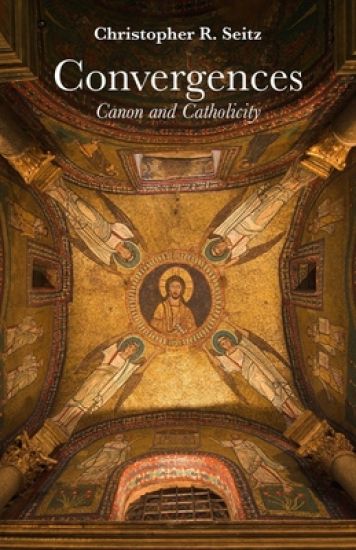
Convergences

Convergences

Christopher R. Seitz

Baylor University Press
2020
sidottu
In an essay on Biblical Theology published in 1982, Paul Beauchamp points out a ""striking convergence"" between a prominent Roman Catholic scholar of the period, Roland de Vaux, and the leading Protestant Old Testament theologian of the day, Gerhard von Rad. Both saw looming on the horizon the need for a Biblical Theology in which both Testaments were taken seriously as part of a single, comprehensive theological reflection. There was genuine excitement at the prospect of the methods of tradition-historical reading, already harnessed by von Rad toward a specifically theological goal, turning now to a Biblical Theology proper. Where did that project and the excitement go?With Convergences, Christopher Seitz returns to the period in question. In the later work of von Rad and Martin Noth, Seitz identifies the clear foreshadowing of what would become ""canonical interpretation"" reflected especially in the work of Brevard Childs. Seitz further reveals that the work of Beauchamp, largely unknown in the Anglophone world, would ultimately line up with Childs in a great many areas (typology, concern with the final form, appreciation for the history of biblical interpretation before the modern era). These scholars reached common shores by distinctive routes and via different interlocutors. Convergences displays such lines of connection and how they spill over from the academy into the interests of the church, including Roman Catholic understandings of the place of Scripture since the mid-twentieth century. Seitz studies the emergence of the lectionary conception, the ressourcement movement, and non-Catholic interest in the prior history of interpretation and figural reading. Convergences maintains that much of what was accomplished in a hopeful coalescence around the canonical form of Scripture remains relevant for biblical interpretation in our present period. Here, we find a form of ""catholicity"" that offers hope and promise for our day in spite of cultural, ecclesial, and academic distinctives.
The Heights of the Hills Are His Also

The Heights of the Hills Are His Also

Christopher R. Seitz

Baylor University Press
2024
sidottu
In the majority of canonical lists, the Psalms and the book of Job sit next to one another, perhaps due to their size. They share a theme, lament, or complaint, though in the case of Job the intensity of Job's distress and the singularity of its causation--something we know but he does not--sets that book apart. Job's laments are relentless and are made more severe in the face of the assault of those who would purport to comfort him.The Psalms and Job also both bear witness to the theme of the majesty of God in creation. Psalms of creation appear across the five books of the Psalter and have been carefully distributed. The present study will examine the character of this psalm form and how the Psalter takes us on a journey in which God's majestic control of creation forms a major compass heading.The notion of a collection of "Wisdom Literature" created a different context for reading Job, one in which it occupied a medial position between Proverbs and Ecclesiastes and participated in a movement from traditional empirical wisdom to extreme skepticism about its utility and indeed about God himself. On this view, creation is out of sorts, and testifies to pointlessness and impenetrability. This book will plot a different course, seeking to hear afresh the response of God to Job by means of his created order. By situating the divine speeches in the context of what is said about God in creation in the Psalms, a new range of distinctive notes arises, making sense of Job's own impassioned confession that his eye has seen God, with this in turn leading to his magnificent restoration.
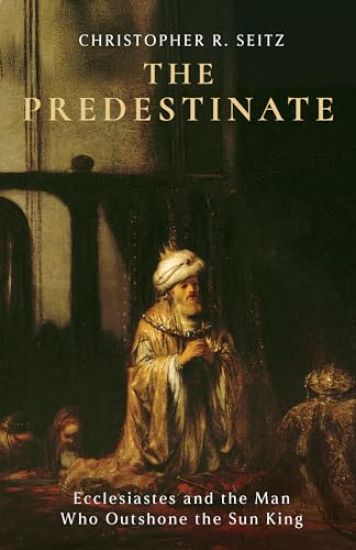
The Predestinate

The Predestinate

Christopher R. Seitz

Baylor University Press
2025
sidottu
This is an unusual book, rich with intrigue. It is, foremost, a book about Ecclesiastes—not a commentary, not another scholarly monograph, but rather a guide to understanding the angle of vision the ancient text asks us to see: that is, how to live our lives within proper limits, how to surrender ourselves to God, and finally how to learn to die. With creativity, flair, insight, and eloquence, Christopher Seitz moves effortlessly between the wisdom of Kohelet and an illustrious figure of the seventeenth century, not well known outside of France—Nicolas Fouquet, whose position as Superintendent of Finances under Louis XIV gave him wealth, fame, creative talent, friends, and influence. He was the purported author of a highly successful volume of sayings from Solomon entitled Les Conseils de la Sagesse, and the rapidity and severity of his fall is the stuff of legend. This biographical angle gives to the treatment of Ecclesiastes a fresh perspective for those who are confounded by this challenging book. Seitz guides us in evaluating how we are to view the narrator in relation to Solomon (whose name is never mentioned) by centering on the matter of authorial perspective. Fouquet's life mirrors Solomon's as that legendary king has been given voice in the book of Ecclesiastes. And as with Ecclesiastes, the contested issue of Fouquet's authorship of the book associated with him relativizes authorship as a determinative category for interpretation, which has presented a major challenge for scholarship on the biblical book. He and the Solomon referred to, taken as a source of wise counsel, endure similar circumstances and share a landscape of penitential confession and surrender to God's purposes. Their common thread is scriptural and "Solomonic." And the thing they most truly share, and which Ecclesiastes seeks to show us—as Les Conseils does in its way—are two larger-than-life individuals, broken and penitent and, just to the degree that is so, finally coming to their spiritual senses.
Colossians

Colossians

Christopher R. Seitz

Brazos Press
2021
nidottu
The Brazos Theological Commentary on the Bible advances the assumption that the Nicene creedal tradition, in all its diversity, provides the proper basis for the interpretation of the Bible as Christian scripture. The series encourages readers to extend the vital roots of the ancient Christian tradition to our day.In this addition to the acclaimed series, renowned scholar Christopher Seitz offers a theological exegesis of Colossians, bringing his expertise in canonical reading to bear on his interpretation of this Pauline letter. As with other volumes in the series, the book is ideal for those called to ministry.
Word Without End

Word Without End

Christopher R. Seitz

Baylor University Press
2005
nidottu
Word Without End advocates a canonical approach to biblical interpretation, one that does not allow the New Testament to eclipse the interpretation of the Old Testament. In so doing, Seitz directly challenges the way in which the Old Testament is currently being read and taught in theological seminaries. By attending to ""theology,"" ""exegesis,"" and ""practice"" - the three divisions of the book - Seitz models a reading of the Old Testament as Scripture that lays out a theological foundation for the life of the church.
Essays on Prophecy and Canon

Essays on Prophecy and Canon

Christopher R. Seitz

Mohr Siebeck
2021
sidottu
The present volume consists of twenty essays on the Prophetic Books, with a major focus on Isaiah as well as the Minor Prophets and Jeremiah. They span a period of roughly thirty-five years and trace a methodological shift away from the excavation of the individual prophet and setting toward an appreciation of a book or a collection in its final form, as an intentionally shaped accomplishment. An introductory chapter places the individual contributions in their original settings-in-composition and in relationship to one another. A description in this chapter of the period in which the author was trained in Germany and at Yale University enables the reader to comprehend the "rise of a new model of interpretation," now referred to as canonical reading or canonical interpretation. The essays come alongside published commentary treatments of Isaiah and Joel, as well as public lectures delivered in the 1980s through the present decade.