Kirjahaku
Etsi kirjoja tekijän nimen, kirjan nimen tai ISBN:n perusteella.
35 kirjaa tekijältä Cicero

A significant two-fold development in recent classical scholarship has been a revival of interest in, and respect for, post-Aristotelian Greek philosophy and Cicero’s contribution to our knowledge of it. Of Cicero’s major works in this field the Tusculan Disputations is perhaps the most approachable. Less technical than Academia and De Finibus, it still provides many insights into Hellenistic philosophical controversies, especially those concerning the two great schools of Stoicism and Epicureanism. At the same time it contains significant evidence of a reviving interest in Plato and Aristotle themselves. The theme of the first Tusculan is whether death is an evil. Of the many popular beliefs about the nature of the soul and its fate after death Cicero has little to say, but the philosophically based approach which he adopts is rich in material and provides the inspiration for striking passages worthy of the great orator. Latin text with facing-page English translation, introduction and commentary.
Cicero’s first major triumph was the prosecution of Caius Verres for misgovernment in Sicily. This speech was given in the second part of the trial and shows the development of Cicero’s rhetoric. This edition communicates the literary flavour of the original and discusses the historical and political background to the trial, with examination of noteworthy textual cruces and problems of interpretation. [Latin text with facing-page English translation, introduction and commentary.]
Cicero’s great polemic against Antony, a literary masterpiece, is here made available with full translation and notes. The introduction to this edition deals with the historical setting, Roman rhetoric and Cicero’s style while the notes are mainly literary, not historical. Attention is paid to Cicero’s use of the devices and techniques of rhetoric, and the variety of tones by which he sustains his attack on Antony without ever losing the reader’s interest. The notes also draw attention to the rhythms of the Latin and the clausulae. Latin text with facing-page English translation, introduction and commentary.
The Fifth Tusculan Disputation is the finest of the five books, its nearest rival being the First (also edited in this series). The middle three books, represented in this edition by the Second, are, as the author clearly intended, less elevated, though still showing Cicero’s flair for elegant and lively exposition, and providing much valuable information about the teaching of the main Hellenistic philosophical schools, especially the Stoics. They argue that the perfect human life, or complete human well-being, that of the ‘wise man’, is unaffected by physical and mental distress or extremes of emotion. Against this background the Fifth puts the positive, mainly Stoic, case that virtue, moral goodness, is alone and of itself sufficient. Latin text with facing-page English translation, introduction and commentary.
Cicero and Boethius did more than anyone else to transmit the insights of Greek philosophy to the Latin culture of Western Europe which has played so influential a part in our civilisation to this day. Cicero’s treatise On Fate (De Fato), though surviving only in a fragmentary and mutilated state, records contributions to the discussion of a central philosophical issue, that of free will and determinism, which are comparable in importance to those of twentieth-century philosophers and indeed sometimes anticipate them. Study of the treatise has been hindered by the lack of a combined Latin text and English translation based on a clear understanding of the arguments; R. W. Sharples’ text is intended to meet this need. The last book of Boethius’ Consolation of Philosophy (Philosophiae Consolationis) is linked with Cicero’s treatise by its theme, the relation of divine foreknowledge to human freedom. Latin text with facing-page English translation, introduction and commentary.
This edition, first published by Macmillan in 1943, has the straightforward utilitarian aims of all those prepared by H.E. Gould and J.L. Whiteley: a basic introduction, reliable text, suitable illustrations, and a vocabulary that gives only those meanings that are required. Last and perhaps most important of all, adequate assistance is provided in the notes, so that the student may feel capable of translating with confidence and accuracy.
This brief, user friendly edition has long remained popular, for it is pitched at just the right level for school students tackling their first continuous prose, and for other early-stage learners of Latin. Moreover, the text is selected from the Pro Cluentio - the defence speech of one of the most intriguing and lurid ancient murder trials - set in the northern Italian provincial town of Larinum - for which evidence survives, by the young forensic lawyer Cicero, destined to become Rome’s most celebrated political orator. The excitement and scandal of the original case still resonates with those who might compare the ancient reality with the modern fictions of Perry Mason or LA Law. The Introduction elucidates the background situation, the feud between the Cluentil and the villainous Oppicianus; the Notes give ample linguistic and historical assistance and there is also a full Vocabulary. This is unadapted and exciting Latin well within the grasp of those who are tackling a 'real' text for the first time.
Cicero's speech on behalf of Roscius of Ameria in Umbria represents his first public 'cause celebre' in 80 BC when he was just twenty-six. It followed closely the notorius proscriptions made under hte dictator Sulla. One of Sulla's freedman favourites, Chrysogonus, had criminally contrived to have Roscius' wealthy father's name added to the list of the proscribed after his death and after closure of the list, with the aim of depriving Roscius of his substantial inheritance. Cicero's speech, one of his most straightforward and yet powerful, brought him into immediate political danger but at the same time established him as a fearless forensic orator. Donkin's edition, first published as one of the history 'red Macmillan' series, has never been bettered for its concise, yet detailed, introduction and its annotation covering matters of language and content.
Aimed at advanced school students, this classic collection - first published in 1964 - contains forty passages, coherent in themselves, illustrating Cicero's thinking on government, religion, law and ethics. This book fills a gap, as most students are only familiar with Cicero's speeches and letters, knowing little of his philosophical works, through which many of our ideas of civilisation have come down to us. The introduction gives the essential background, including a brief outline of Greek philosophy. There are practical notes on the texts, observations on Cicero's style and a select vocabulary.
Cicero's fifth speech against Verres - a Roman magistrate prosecuted for his notorious misgovernment of Sicily - was never actually delivered but is nonetheless a carefully crafted piece which shows all the vigour of Cicero's oratory at its height. This edition includes introduction, the Latin text, a comprehensive commentary of the text and a vocabulary. The introduction, divided into seven sections, describes the history and condition of Sicily down to the time of Verres, with special attention to Roman administration and the duties of Roman governors. It dealing with all aspects - historical, legal, and oratorical - of the trial of Verres. The meticulous commentary and full vocabulary, all serve to make this an excellent edition for school and undergraduate students.
The Three Dialogues of M. T. Cicero on the Orator (LARGE PRINT EDITION)
Cicero
KESSINGER PUBLISHING, LLC
2011
sidottu
Cicero - Orations Catiline, who was running for the consulship a second time after having lost the first time around, tried to ensure his victory by resorting to outlandish, blatant bribery. Cicero, in indignation, issued a law prohibiting machinations of this kind. It was obvious to all that the law was directed specifically at Catiline. Catiline, in turn, conspired with some of his minions to murder Cicero and the key men of the Senate on the day of the election. Cicero discovered the plan and postponed the election to give the Senate time to discuss the attempted coup d' tat. The day after the election was supposed to be held, Cicero addressed the Senate on the matter and Catiline's reaction was immediate and violent. In response to Catiline's behavior, the Senate issued a senatus consultum ultimum, a kind of declaration of martial law invoked whenever the Senate and the Roman Republic were in imminent danger from treason or sedition. Ordinary law was suspended and Cicero, as consul, was invested with absolute power. When the election was finally held, Catiline lost again. Anticipating the bad news, the conspirators had already begun to assemble an army, made up mostly of Sulla's veteran soldiers. The nucleus of conspirators was also joined by senators whose profligate tastes left them perennially without funds. The plan was to initiate an insurrection in all of Italy, put Rome to the torch and to kill as many senators as they could. Through his own investigations, Cicero knew exactly what was being planned. On November 8, Cicero called for a meeting of the Senate in the Temple of Jupiter Stator near the forum, which was used for this purpose only when great danger was imminent. Catiline attended as well. It was in this context that Cicero delivered one of his most famous orations.
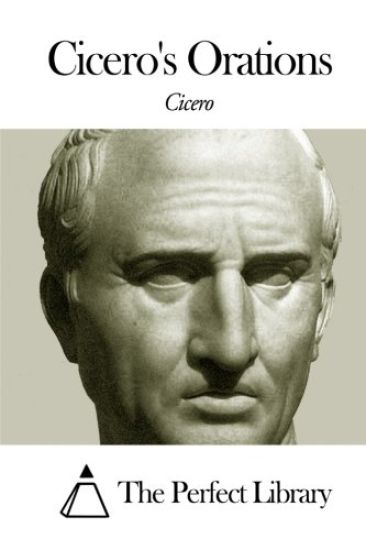
"Cicero's Orations". Cicero was a Roman philosopher, politician, lawyer, orator, political theorist, consul and constitutionalist (106-43 BC).
Cicero's Tusculan Disputations: Also, Treatises on the Nature of the Gods, and on the Commonwealth
Cicero
Createspace Independent Publishing Platform
2014
nidottu
Letters of Marcus Tullius Cicero and Letters of Gaius Plinius Caecilius Secundus: V9 Harvard Classics
Cicero
Literary Licensing, LLC
2014
nidottu