Kirjojen hintavertailu. Mukana 11 699 587 kirjaa ja 12 kauppaa.

Kirjahaku

Etsi kirjoja tekijän nimen, kirjan nimen tai ISBN:n perusteella.

3 kirjaa tekijältä Ciro Paoletti

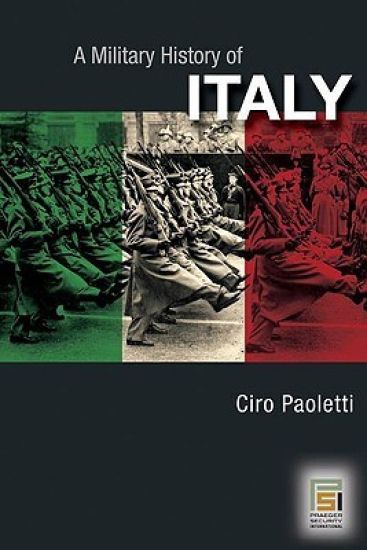
A Military History of Italy

A Military History of Italy

Ciro Paoletti

Praeger Publishers Inc
2007
sidottu
This book follows Italy's military history from the late Renaissance through the present day, arguing that its leaders have consistently looked back to the power of Imperial Rome as they sought to bolster Italy's status and influence in the world. As early as the late 15th century, Italian city-states played important roles in European conflicts. After unification in 1861, the military would become the nation's unifying force, the melting pot of the state. Italy's industrial and then colonial expansion brought it into the wars of the 20th century. The rise of fascist movement was the disastrous consequence of Italy's desire for colonial and military power, a history that the nation still confronts as it seeks to play a role in world politics. Wealthy, urban Italy has always had great political, cultural, and strategic importance for Europe. The leaders of its independent city-states intervened militarily in struggles among the European powers to its north and west but also against the expanding Muslim empires to its south and east. Italian culture supported military innovation, developing (for instance) new fortifications and naval organizations. After centuries of division, which limited Italy's power against the larger, unified European nations, the military played an important role in the nationalist unification of the entire country. Rapid industrialization followed, and along with it Italy's forays into overseas colonialism. Italy became a major power, but its turn to militant fascism during its expansionist era continues to haunt its state and military.

William III's Italian Ally

William III's Italian Ally

Ciro Paoletti

Helion Company
2019
nidottu
The Italian Front of the Nine Year has been completely neglected by Italian and other European Historians. It is often assumed that the conflict was fought solely in Flanders and the Rhineland, and by mainly North West European Armies. This was not so. William of Orange, the driving force of the Grand Alliance in the fight against the French, considered the Italian aspect of the conflict to be the greatest strategic importance. Piedmont, in north western Italy bordered France, and Italian armies were able to threaten the south of France with invasion. For the first time too, the nature of late 17th century warfare in Italy is considered and the author examines organisation, training and logistics. Military artist Bruno Mugnai enhances the book’s text with 8 specially commissioned colour plates that illustrate the uniforms and flags of this highly visual period.
Italy, Piedmont & the War of the Spanish Succession
The War of Spanish Succession is well known in English concerning Flanders and Germany, not that much concerning Spain, not at all about Italy. Italian front was so important that the French considered it as important as the German one, and committed there their best generals. William III considered it to be far more important than Spain, and, in spite of having no British army there, after King William’s death London committed to it 1/10 of her war expense. It was considered so important in Vienna that the Emperor sent there his best general. Last, it was the front where all the French hopes to submit Europe died in Turin in 1706 after the first dramatic wound they suffered in Blenheim in 1704.