Kirjojen hintavertailu. Mukana 11 244 527 kirjaa ja 12 kauppaa.

Kirjahaku

Etsi kirjoja tekijän nimen, kirjan nimen tai ISBN:n perusteella.

6 kirjaa tekijältä Clayborne Carson

The Movement 1964-1970

The Movement 1964-1970

Clayborne Carson

Greenwood Press
1993
sidottu
Publication of this complete edition of The Movement is an important contribution to popular understanding of the social movements of the 1960s. No other periodical provided such extensive coverage of the transformation of the civil rights movement into the diverse radical movements of the late 1960s.Malcolm X, Stokely Carmichael, and Huey Newton are among the many black militant leaders who are discussed in The Movement. Its insightful and sympathetic coverage, including participants' accounts, of a wide range of community organizing activities such as anti-war/anti-draft protests and Cesar Chavez's National Farm Workers Association and grape workers' strike in Delano, California. It covers national and international events, with articles on revolutionary movements in Cuba, Vietnam, and Africa. It is an excellent source of information regarding the social change activities of the late 1960s. As such, it is invaluable to students of the New Left, contemporary race relations, African-American history and Black Studies.
The Autobiography of Martin Luther King, Jr.

The Autobiography of Martin Luther King, Jr.

Clayborne Carson

Grand Central Publishing
2001
nidottu
Written by Martin Luther King, Jr. himself, this astounding autobiography brings to life a remarkable man changed the world --and still inspires the desires, hopes, and dreams of us all. Martin Luther King: the child and student who rebelled against segregation. The dedicated minister who questioned the depths of his faith and the limits of his wisdom. The loving husband and father who sought to balance his family's needs with those of a growing, nationwide movement. And to most of us today, the world-famous leader who was fired by a vision of equality for people everywhere. Relevant and insightful, The Autobiography of Martin Luther King, Jr. offers King's seldom disclosed views on some of the world's greatest and most controversial figures: John F. Kennedy, Malcolm X, Lyndon B. Johnson, Mahatma Gandhi, and Richard Nixon. It paints a moving portrait of a people, a time, and a nation in the face of powerful change. And it shows how Americans from all walks of life can make a difference if they have the courage to hope for a better future.
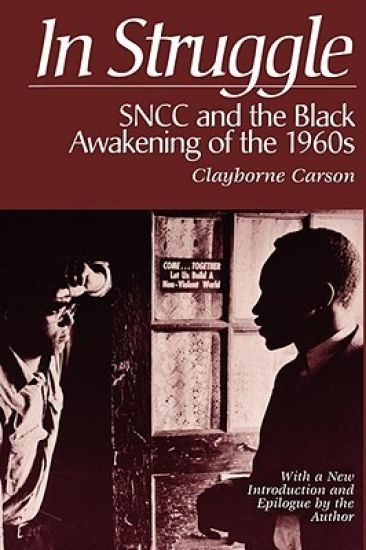
In Struggle

In Struggle

Clayborne Carson

Harvard University Press
1995
nidottu
With its radical ideology and effective tactics, the Student Nonviolent Coordinating Committee (SNCC) was the cutting edge of the civil rights movement during the 1960s. This sympathetic yet evenhanded book records for the first time the complete story of SNCC’s evolution, of its successes and its difficulties in the ongoing struggle to end white oppression.At its birth, SNCC was composed of black college students who shared an ideology of moral radicalism. This ideology, with its emphasis on nonviolence, challenged Southern segregation. SNCC students were the earliest civil rights fighters of the Second Reconstruction. They conducted sit-ins at lunch counters, spearheaded the freedom rides, and organized voter registration, which shook white complacency and awakened black political consciousness. In the process, Clayborne Carson shows, SNCC changed from a group that endorsed white middle-class values to one that questioned the basic assumptions of liberal ideology and raised the fist for black power. Indeed, SNCC’s radical and penetrating analysis of the American power structure reached beyond the black community to help spark wider social protests of the 1960s, such as the anti–Vietnam War movement.Carson’s history of SNCC goes behind the scene to determine why the group’s ideological evolution was accompanied by bitter power struggles within the organization. Using interviews, transcripts of meetings, unpublished position papers, and recently released FBI documents, he reveals how a radical group is subject to enormous, often divisive pressures as it fights the difficult battle for social change.
Bayard Rustin

Bayard Rustin

Clayborne Carson

NEW YORK UNIVERSITY PRESS
2023
sidottu
2024 Outstanding Academic Title, given by Choice Reviews Celebrates the life and legacy of Bayard Rustin, the civil rights leader behind the 1963 March on Washington for Jobs and Freedom While we can all recall images of Martin Luther King Jr. giving his "I Have a Dream" speech in front of a massive crowd at Lincoln Memorial, few of us remember the man who organized this watershed nonviolent protest in eight short weeks: Bayard Rustin. This was far from Rustin's first foray into the fight for civil rights. As a world-traveling pacifist, he brought Gandhi's protest techniques to the forefront of US civil rights demonstrations, helped build the Southern Christian Leadership Conference, led the fight for economic justice, and played a deeply influential role in the life of Dr. King by helping to mold him into an international symbol of nonviolent resistance. Rustin's legacy touches many areas of contemporary life—from civil resistance to violent uprisings, democracy to socialism, and criminal justice reform to war resistance. Despite these achievements, Rustin was often relegated to the background. He was silenced, threatened, arrested, beaten, imprisoned, and fired from important leadership positions, largely because he was an openly gay man in a fiercely homophobic era. With expansive, searching, and sometimes critical essays from a range of esteemed writers—including Rustin's own partner, Walter Naegle—this volume draws a full picture of Bayard Rustin: a gay, pacifist, socialist political radical who changed the course of US history and set a precedent for future civil rights activism, from LGBTQ+ Pride to Black Lives Matter.
Malcolm X

Malcolm X

Clayborne Carson

Allworth Press,U.S.
2012
pokkari
The FBI has made possible a reassembling of the history of Malcolm X that goes beyond any previous research. From the opening of his file in March of 1953 to his assassination in 1965, the story of Malcolm X's political life is a gripping one. Shortly after he was released from a Boston prison in 1953, the FBI watched every move Malcolm X made. Their files on him totaled more than 3,600 pages, covering every facet of his life. Viewing the file as a source of information about the ideological development and political significance of Malcolm X, historian Clayborne Carson examines Malcolm's relationship to other African-American leaders and institutions in order to define more clearly Malcolm's place in modern history. With its sobering scrutiny of the FBI and the national policing strategies of the 1950s and 1960s, Malcolm X: The FBI File is one of a kind: never before has there been so much material on the assassination of Malcolm X in one conclusive volume.
Bayard Rustin

Bayard Rustin

Clayborne Carson

NEW YORK UNIVERSITY PRESS
2025
pokkari
2024 Outstanding Academic Title, given by Choice Reviews Celebrates the life and legacy of Bayard Rustin, the civil rights leader behind the 1963 March on Washington for Jobs and Freedom While we can all recall images of Martin Luther King Jr. giving his "I Have a Dream" speech in front of a massive crowd at Lincoln Memorial, few of us remember the man who organized this watershed nonviolent protest in eight short weeks: Bayard Rustin. This was far from Rustin's first foray into the fight for civil rights. As a world-traveling pacifist, he brought Gandhi's protest techniques to the forefront of US civil rights demonstrations, helped build the Southern Christian Leadership Conference, led the fight for economic justice, and played a deeply influential role in the life of Dr. King by helping to mold him into an international symbol of nonviolent resistance. Rustin's legacy touches many areas of contemporary life - from civil resistance to violent uprisings, democracy to socialism, and criminal justice reform to war resistance. Despite these achievements, Rustin was often relegated to the background. He was silenced, threatened, arrested, beaten, imprisoned, and fired from important leadership positions, largely because he was an openly gay man in a fiercely homophobic era. With expansive, searching, and sometimes critical essays from a range of esteemed writers—including Rustin's own partner, Walter Naegle—this volume draws a full picture of Bayard Rustin: a gay, pacifist, socialist political radical who changed the course of US history and set a precedent for future civil rights activism, from LGBTQ Pride to Black Lives Matter.