Kirjojen hintavertailu. Mukana 12 016 292 kirjaa ja 12 kauppaa.

Kirjahaku

Etsi kirjoja tekijän nimen, kirjan nimen tai ISBN:n perusteella.

8 kirjaa tekijältä Clayton E. Cramer

For the Defense of Themselves and the State

For the Defense of Themselves and the State

Clayton E. Cramer

Praeger Publishers Inc
1994
sidottu
[This book] provides the kind of scholarly resource that educated citizens need to think for themselves, a rich digest of primary sources documenting--in their own words--the views, motives, and intentions of the Framers, historic commentators, legislators, and judiciary who have debated the right to keep and bear arms from the origins of our republic. Preston K. Covey, Carnegie Mellon University Beginning with its origins in the English Civil War, Clayton Cramer traces the development in the United States of the right to keep and bear arms--through the Constitutional Convention, the ratification debates that followed, its inclusion by Congress in the Bill of Rights, to the present controversy over gun control. This book provides important background, analysis, documentation, and perspective for the ongoing national debate over arms.

Concealed Weapon Laws of the Early Republic

Concealed Weapon Laws of the Early Republic

Clayton E. Cramer

Praeger Publishers Inc
1999
sidottu
Cramer's work examines the motivations and legislative history behind the nation's first laws regulating the carrying of concealed deadly weapons and establishes a previously unexplored link between these laws and efforts to suppress dueling in the southern back country. Earlier attempts to analyze these laws focused upon efforts to maintain slavery by severely restricting the rights of free blacks: if free blacks could not possess arms and lacked other basic rights, slaves would be less inclined to seek their freedom. Cramer rejects such thinking by demonstrating that the concealed weapon laws of the early republic were not racially-motivated. He further supports the work of other scholars who have lately examined the role of Scots-Irish immigrants in creating a distinctive southern back-country culture of honor violence including dueling and brawling. It was the attempt to control such violence, Cramer argues, that led to the concealed weapons laws. Thus, rather than considering gun control laws primarily as legal or constitutional history, this study starts from a cultural and historical viewpoint. Southern state legislatures sought to improve the morals of their back-country population through increasingly severe punishments for dueling. When judges and juries regularly refused to convict duelists, these legislatures created extrajudicial punishments by requiring elected and appointed officials, as well as lawyers, to swear oaths of non-participation in dueling. Young men, obsessed with honor and reluctant to perjure themselves for fear of damaging their public reputation, soon took to carrying Bowie knives and handguns with which to kill those who insulted them—a perfectly honorable action to much of the population. The state legislatures then severely regulated carrying of concealed deadly weapons in the hope of suppressing the bloody results of what had been, until then, an accepted practice.
Black Demographic Data, 1790-1860

Black Demographic Data, 1790-1860

Clayton E. Cramer

Greenwood Press
1997
sidottu
An excellent resource on the changing population distribution of antebellum Black Americans, this book covers census data by region and state. Two-thirds of the book consists of tables and graphs providing dimensional representations of black populations, both free and slave, in pre-Civil War America. The book opens with a discussion of the limitations of the census data, then goes on to provide an overview of the progress of manumission, abolition, and restrictions on black migration. The book also examines the 1840 census controversy. It will be a particularly useful resource for scholars concerned with changes in the black population.
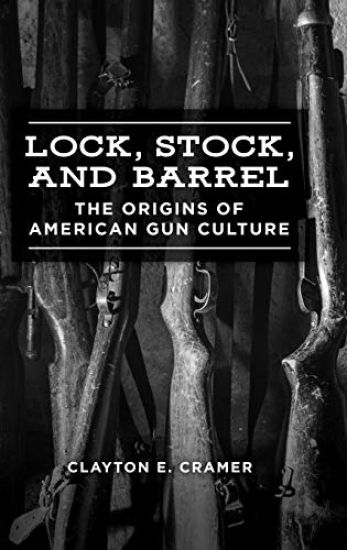
Lock, Stock, and Barrel

Lock, Stock, and Barrel

Clayton E. Cramer

Praeger Publishers Inc
2018
sidottu
This provocative book debunks the myth that American gun culture was intentionally created by gun makers and demonstrates that gun ownership and use have been a core part of American society since our colonial origins.Revisionist historians argue that American gun culture and manufacturing are relatively recent developments. They further claim that widespread gun violence was largely absent from early American history because guns of all types, and especially handguns, were rare before 1848. According to these revisionists, American gun culture was the creation of the first mass production gun manufacturers, who used clever marketing to sell guns to people who neither wanted nor needed them.However, as proven in this first scholarly history of "gun culture" in early America, gun ownership and use have in fact been central to American society from its very beginnings. Lock, Stock, and Barrel: The Origins of American Gun Culture shows that gunsmithing and gun manufacturing were important parts of the economies of the colonies and the early republic and explains how the American gun industry helped to create our modern world of precision mass production and high wages for workers.
Armed America

Armed America

Clayton E. Cramer

Thomas Nelson Publishers
2009
nidottu
"For many Americans, guns seem to be a fundamental part of the American experience?and always have been."Grand in scope, rigorous in research, and elegant in presenting the formative years of our country, Armed America traces the winding historical trail of United States citizens' passion for firearms. Author and historial Clayton E. Cramer goes back to the source, unearthing first-hand accounts from the colonial times, through the Revolutionary War period, and into the early years of the American Republic.In Armed America, Cramer depicts a budding nation dependent on its firearms not only for food and protection, but also for recreation and enjoyment. Through newspaper clippings, official documents, and personal diaries, he shows that recent grandiose theories claiming that guns were scarce in early America are shaky at best, and downright false at worst. Above all, Cramer allows readers a priceless glimpse of a country literally fighting for its identity.For those who think that our citizens' attraction to firearms is a recent phenomenon, it's time to think again. Armed America proves that the right to bear arms is as American as apple pie.