Kirjojen hintavertailu. Mukana 11 627 670 kirjaa ja 12 kauppaa.

Kirjahaku

Etsi kirjoja tekijän nimen, kirjan nimen tai ISBN:n perusteella.

12 kirjaa tekijältä Cleanth Brooks

Well Wrought Urn

Well Wrought Urn

Cleanth Brooks

HOUGHTON MIFFLIN
2022
nidottu
A classic that has been widely used by several generations, this book consists of detailed commentaries on ten famous English poems from the Elizabethan period to the present. Index.
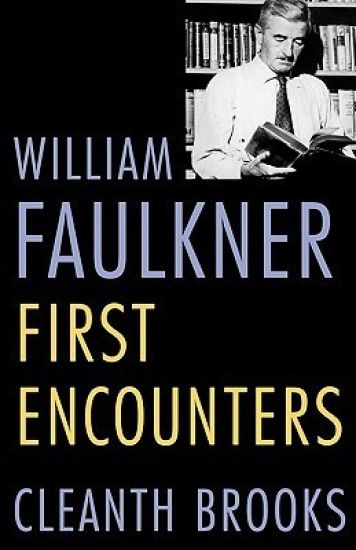
William Faulkner

William Faulkner

Cleanth Brooks

Yale University Press
1985
pokkari
In this clear-sighted and enjoyable book, Cleanth Brooks, acknowledged to be "the best critic of our best novelist," introduces the general reader to Faulkner's most important novels and stories: The Sound and the Fury; As I lay Dying; The Hamlet; Go Down, Moses; Light in August; and Absalom, Absalom! Brooks focuses on theme, character, and plot as well as on Faulkner's world—the fictional Yoknapatawpha County that provides a unique setting for Faulkner's tragicomic vision.
The Hidden God

The Hidden God

Cleanth Brooks

Yale University Press
2005
pokkari
The clarity of style for which Mr. Brooks has long been noted is displayed to advantage in this newest book of his criticism. Originally delivered as lectures at a faculty conference of people interested in theology, the critical studies have special importance for all readers who would like a fresh perspective on five distinguished literary figures whose Christian commitment has been regarded as nonexistent or nebulous. Mr. Brooks believes that whatever a writer has to say about mankind, Christianity, or culture in general is most significantly explained through his achievements as an artist, and for that reason the critic here deals with the characteristic literary work of each author, rather than with his theology or philosophy.
William Faulkner

William Faulkner

Cleanth Brooks

Louisiana State University Press
1989
nidottu
An examination of the Yoknapatawpha novels, in themselves and in their relationship with Faulkner's central accomplishment, sheds light on Faulkner's development, technique, themes, and concerns
William Faulkner

William Faulkner

Cleanth Brooks

Louisiana State University Press
1989
nidottu
In this companion volume to William Faulkner: The Yoknapatawpha Country, Cleanth Brooks takes an in-depth look at Faulkner's early poetry and prose as well as his five non-Yoknapatawpha novels - Soldiers Pay, Mosquitoes, Pylon, The Wild Palms, and A Fable. Brooks also offers relevant clarification of some of his earlier interpretations of Faulkner that have been challenged - most notably in the case of Faulkner that have been challenged - most notable in the case of Absalom, Absalom!, which he considers Faulkner's greatest novel. recognising that the creative and imaginative center of Faulkner's art is Yoknapatawpha County, Brooks examines the merits of each of the works set beyond these boundaries and explores how these writings complement Faulkner as an artist. He sheds light on the literary sources that influenced Faulkner's early work and the technical innovations and general themes Faulkner was to develop in his later writing. The notes and appendixes with which Brooks concludes Toward Yoknapatawpha and Beyond serve only to amplify this comprehensive study.
On The Prejudices, Predilections, and Firm Beliefs of William Faulkner

On The Prejudices, Predilections, and Firm Beliefs of William Faulkner

Cleanth Brooks

Louisiana State University Press
1987
nidottu
It seems appropriate, if not inevitable, that one of our best critics should be the foremost authority on one of our best novelists. Cleanth Brooks, the author of three seminal studies of William Faulkner, has been a serious student of that master craftsman's fiction for more than four decades. In this new collection, Brooks considers many of the important characteristics of Faulkner's work. He focuses more specifically than he has in the past on certain questions and in some instances offers rebuttals to what he considered unfair assessments of Faulkner. In the first essay, Brooks challenges the notion that Donald Davidson, John Crowe Ransom, Robert Penn Warren, and other members of the Fugitive-Agrarian movement at Vanderbilt University were slow to recognise Faulkner's achievements. Indeed, Brooks provides clear evidence not only that the Fugitives were early supporters of Faulkner but that Faulkner and the Fugitives shared many concerns and ideas about their region. Brooks also writes about Faulkner's personal beliefs and demonstrates how the virtues Faulkner held in highest esteem - such as courage and honor - are embodied in his fiction. In two essays, ""Faulkner and the Community"" and ""Faulkner's Two Cities,"" Brooks analyses the importance of a closely knit world - specifically the hill region of north Mississippi and the cities of Memphis and New Orleans - to Faulkner's works.Brooks considers Faulkner's serious regard for the chivalric tradition, as well as his amusement in Gavin Stevens' exemplification of it in Intruder in the Dust and Requiem for a Nun. Faulkner's treatment of women characters, especially in Light in August and The Hamlet, is discussed, as are his ideas about the American Dream.These essays are vintage Brooks. The prose is, as always, felicitous, the manner modest and winning, the thought pertinent and rigorous. Despite the thematic diversity of the essays, the emphasis is ultimately the same: reading and rereading the novels of William Faulkner is a continuing pleasure and an enduring challenge.
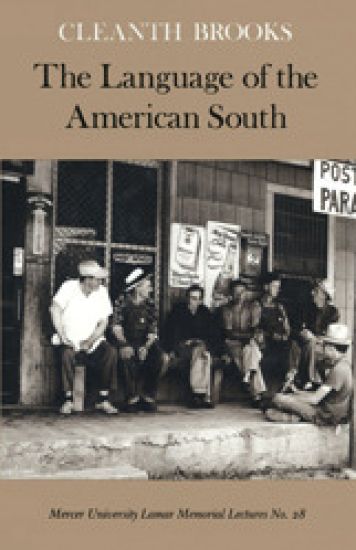
The Language of the American South

The Language of the American South

Cleanth Brooks

University of Georgia Press
2007
pokkari
In this volume Cleanth Brooks pays tribute to the language and literature of the American South. He writes of the language's unique syntax and its celebrated languorous rhythms; of the classical allusions and Addisonian locutions once favored by the gentry; and of the more earthbound eloquence, rooted in the dialect of England's southern lowlands, that is still heard in the speech of the region's plain folk.It is this rich spoken language, Brooks suggests, that has always been the life blood of southern writing. The strong tradition of storytelling in the South is reflected in the tales told by Joel Chandler Harris's Uncle Remus and in the obsessive retellings that structure William Faulkner's novels and stories. But even more crucially, the language of the South—firmly rooted in the land but with a tendency to reach for the heavens above—has shaped the literary concerns and molded the complex visions to be found in the poetry of Robert Penn Warren and John Crowe Ransom; the stories of Flannery O'Connor, Peter Taylor, and Eudora Welty; and the novels of Warren, Allen Tate, and Walker Percy.
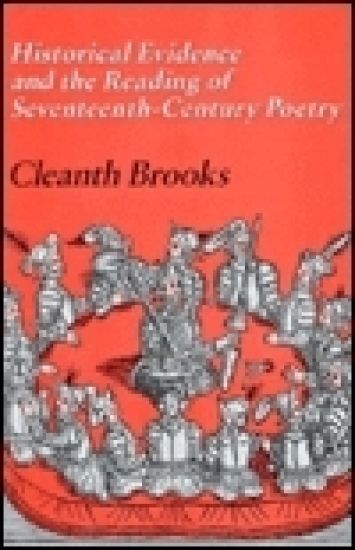
Historical Evidence and the Reading of Seventeenth-Century Poetry
Cleanth Brooks has deeply influenced the course of letters and literature in America. As coauthor (with Robert Penn Warren) of ""Understanding poetry"", he has helped bring poems to life for many thousands of students. His subsequent studies, including ""Modern poetry and the tradition"" and ""The well-wrought urn"", have been praised by students and scholars like and have established him as a critic of stature. His ""Historical evidence"" indicates how sadly he has been misrepresented as a kind of ""formalist"" who has no concern for biography land history. This series of case studies examines the degree and extent to which some dozen particular 17th century poems deal with the history of the time out of which they came. With the exception of those by Andrew Marvell, they are the work of minor poets, such as Henry Ling, Richard Corbett, James Shirley, Richard Lovelace, Aurelian Townshend, Richard Fanshawe, and Edward, Lord Herbert of Cherbury. Yet the poems were not chosen merely in the interest of advancing an idea. They are highly interesting in themselves. What Brooks has done with each of these 17th century poets is what he's spent a lifetine doing - bringing their poems to life for a 20th century reader. This book responds to the terrible ills that have befallen our approach to literature. Without waving flags or hurling abuse at a real or imagined foe, Brooks makes it clear how important a knowledge of history and culture may be to the reader of literature. Brooks provides original readings of specific poems and poets. This book should interest students of 17th century poetry in particular and among appreciators of literature in general.
A Shaping Joy

A Shaping Joy

Cleanth Brooks

TAYLOR FRANCIS LTD
2024
sidottu
In A Shaping Joy (originally published in 1971), Cleanth Brooks writes about modern literature and the criticism that has been developed to deal with it. Most of the essays concern poets and novelists of the twentieth century, but there are also discussions of nineteenth-century American writers such as Mark Twain and Edgar Allen Poe, and of traditional English poets such as Wordsworth, Milton, and Marlowe.Among the functions of literature described in the first essay are those of nourishing the imagination and keeping the language alive and the channels of communication open. The criticism contained in the essays that follow admirably exemplifies these concerns. Whether writing on the world of William Faulkner and the literature of the American South, or on subjects more familiar to the British reader—Joyce, Auden, and T.S. Eliot, for example—Professor Brooks keeps the methods of communication marvelously unblocked. It is criticism of the rarest kind—alert, imaginative and wholly invigorating.This book will be a beneficial read for students and researchers of English literature, particularly of literary criticism.
A Shaping Joy

A Shaping Joy

Cleanth Brooks

TAYLOR FRANCIS LTD
2026
nidottu
In A Shaping Joy (originally published in 1971), Cleanth Brooks writes about modern literature and the criticism that has been developed to deal with it. Most of the essays concern poets and novelists of the twentieth century, but there are also discussions of nineteenth-century American writers such as Mark Twain and Edgar Allen Poe, and of traditional English poets such as Wordsworth, Milton, and Marlowe. Among the functions of literature described in the first essay are those of nourishing the imagination and keeping the language alive and the channels of communication open. The criticism contained in the essays that follow admirably exemplifies these concerns. Whether writing on the world of William Faulkner and the literature of the American South, or on subjects more familiar to the British reader—Joyce, Auden, and T.S. Eliot, for example—Professor Brooks keeps the methods of communication marvelously unblocked. It is criticism of the rarest kind—alert, imaginative and wholly invigorating. This book will be a beneficial read for students and researchers of English literature, particularly of literary criticism.