Kirjojen hintavertailu. Mukana 11 342 296 kirjaa ja 12 kauppaa.

Kirjahaku

Etsi kirjoja tekijän nimen, kirjan nimen tai ISBN:n perusteella.

4 kirjaa tekijältä Clive Webb

Fight against Fear

Fight against Fear

Clive Webb

University of Georgia Press
2003
pokkari
In the uneasily shared history of Jews and blacks in America, the struggle for civil rights in the South may be the least understood episode. Fight against Fear is the first book to focus on Jews and African Americans in that remarkable place and time. Mindful of both communities' precarious and contradictory standings in the South, Clive Webb tells a complex story of resistance and complicity, conviction and apathy.Webb begins by ranging over the experiences of southern Jews up to the eve of the civil rights movement—from antebellum slaveowners to refugees who fled Hitler's Europe only to arrive in the Jim Crow South. He then shows how the historical burden of ambivalence between Jews and blacks weighed on such issues as school desegregation, the white massive resistance movement, and business boycotts and sit-ins.As many Jews grappled as never before with the ways they had become—and yet never could become—southerners, their empathy with African Americans translated into scattered, individual actions rather than any large-scale, organized alliance between the two groups. The reasons for this are clear, Webb says, once we get past the notion that the choices of the much larger, less conservative, and urban-centered Jewish populations of the North define those of all American Jews. To understand Jews in the South we must look at their particular circumstances: their small numbers and wide distribution, denominational rifts, and well-founded anxiety over defying racial and class customs set by the region's white Protestant majority.For better or worse, we continue to define the history of Jews and blacks in America by its flash points. By setting aside emotions and shallow perceptions, Fight against Fear takes a substantial step toward giving these two communities the more open and evenhanded consideration their shared experiences demand.
Rabble Rousers

Rabble Rousers

Clive Webb

University of Georgia Press
2010
sidottu
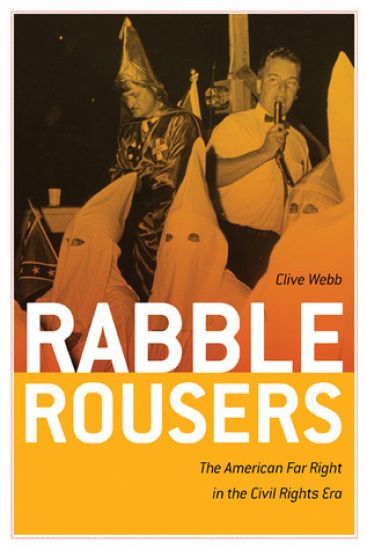
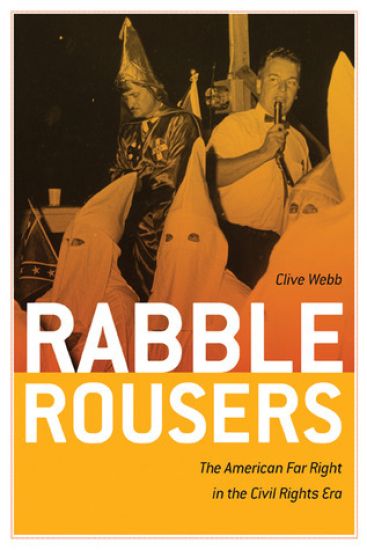
The decade following the 1954 Brown v. Board of Education decision saw white southerners mobilize in massive resistance to racial integration. Most segregationists conceded that ultimately they could only postpone the demise of Jim Crow. Some militant whites, however, believed it possible to win the civil rights struggle. Histories of the black freedom struggle, when they mention these racist zealots at all, confine them to the margin of the story.These extremist whites are caricatured as ineffectual members of the lunatic fringe. Civil rights activists, however, saw them for what they really were: calculating, dangerous opponents prepared to use terrorism in their stand against reform. To dismiss white militants is to underestimate the challenge they posed to the movement and, in turn, the magnitude of civil rights activists’ accomplishments. The extremists helped turn massive resistance into a powerful political phenomenon. While white southern elites struggled to mobilize mass opposition to racial reform, the militants led entire communities in revolt.Rabble Rousers turns traditional top-down models of massive resistance on their head by telling the story of five far-right activists—Bryant Bowles, John Kasper, Rear Admiral John Crommelin, Major General Edwin Walker, and J. B. Stoner—who led grassroots rebellions. It casts new light on such contentious issues as the role of white churches in defending segregation, the influence of anti-Semitism in southern racial politics, and the divisive impact of class on white unity. The flame of the far right burned brilliantly but briefly. In the final analysis, violent extremism weakened the cause of white southerners. Tactical and ideological tensions among massive resisters, as well as the strength and unity of civil rights activists, accelerated the destruction of Jim Crow.
Rabble Rousers

Rabble Rousers

Clive Webb

University of Georgia Press
2010
pokkari
The decade following the 1954 Brown v. Board of Education decision saw white southerners mobilize in massive resistance to racial integration. Most segregationists conceded that ultimately they could only postpone the demise of Jim Crow. Some militant whites, however, believed it possible to win the civil rights struggle. Histories of the black freedom struggle, when they mention these racist zealots at all, confine them to the margin of the story.These extremist whites are caricatured as ineffectual members of the lunatic fringe. Civil rights activists, however, saw them for what they really were: calculating, dangerous opponents prepared to use terrorism in their stand against reform. To dismiss white militants is to underestimate the challenge they posed to the movement and, in turn, the magnitude of civil rights activists’ accomplishments. The extremists helped turn massive resistance into a powerful political phenomenon. While white southern elites struggled to mobilize mass opposition to racial reform, the militants led entire communities in revolt.Rabble Rousers turns traditional top-down models of massive resistance on their head by telling the story of five far-right activists—Bryant Bowles, John Kasper, Rear Admiral John Crommelin, Major General Edwin Walker, and J. B. Stoner—who led grassroots rebellions. It casts new light on such contentious issues as the role of white churches in defending segregation, the influence of anti-Semitism in southern racial politics, and the divisive impact of class on white unity. The flame of the far right burned brilliantly but briefly. In the final analysis, violent extremism weakened the cause of white southerners. Tactical and ideological tensions among massive resisters, as well as the strength and unity of civil rights activists, accelerated the destruction of Jim Crow.