Kirjojen hintavertailu. Mukana 11 342 296 kirjaa ja 12 kauppaa.

Kirjahaku

Etsi kirjoja tekijän nimen, kirjan nimen tai ISBN:n perusteella.

4 kirjaa tekijältä Colin A. Russell

The Earth, Humanity and God

The Earth, Humanity and God

Colin A. Russell

Routledge
2019
sidottu
Originally published in 1994, The Earth, Humanity and God discusses the relationship between science and religion. The book discusses the condition of the earth (as it was at the time of publication) and the future prospects of the planet, arguing that neither the conventional "mechanistic" view nor "New Age" philosophy helps alone in evaluating our relationship with the Earth. The book examines methods of combatting the threats to the Earth exploring both a scientific and non-scientific stance, investigating the uncontrolled expansion of technology as well as empirical pre-scientific mysticism. The book also explores the resurgence in ancient ideas of "Mother Earth" as a dangerous piece of romantic irrationality and suggests, that these views pose a danger to religious/scientific examinations. The book suggests instead a hard-headed attempt to relate Biblical and scientific data, and that this in turn can yield a valuable new understanding of the problems facing the world.
The Earth, Humanity and God

The Earth, Humanity and God

Colin A. Russell

Routledge
2021
nidottu
Originally published in 1994, The Earth, Humanity and God discusses the relationship between science and religion. The book discusses the condition of the earth (as it was at the time of publication) and the future prospects of the planet, arguing that neither the conventional "mechanistic" view nor "New Age" philosophy helps alone in evaluating our relationship with the Earth. The book examines methods of combatting the threats to the Earth exploring both a scientific and non-scientific stance, investigating the uncontrolled expansion of technology as well as empirical pre-scientific mysticism. The book also explores the resurgence in ancient ideas of "Mother Earth" as a dangerous piece of romantic irrationality and suggests, that these views pose a danger to religious/scientific examinations. The book suggests instead a hard-headed attempt to relate Biblical and scientific data, and that this in turn can yield a valuable new understanding of the problems facing the world.
Edward Frankland

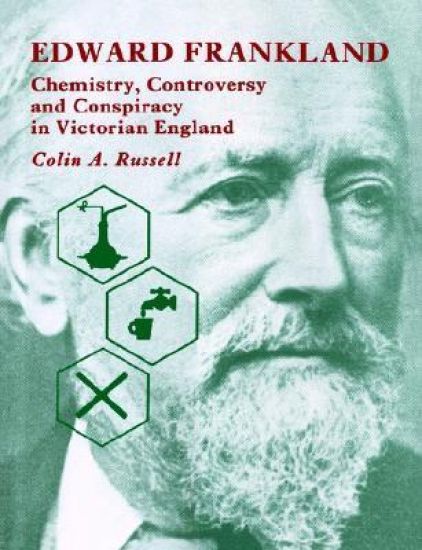
Edward Frankland

Colin A. Russell

Cambridge University Press
2003
pokkari
This is the first scientific biography of Edward Frankland, probably the most eminent chemist of nineteenth-century Britain. Frankland discovered the chemical bond and founded the science of organometallic chemistry. He was a leading reformer of chemistry teaching, and the government’s close adviser on urban water purity. From an apprenticeship in a druggist’s shop in Lancaster, he was to occupy the first chemical chair at Manchester, and become professor at what became Imperial College. He was knighted in 1897. Today an obscurity of reputation stems from the conspiracy of silence surrounding Frankland’s origins as an illegitimate child. Recently, however, Professor Russell has gained access to a vast collection of his private papers. Russell’s authoritative account discloses, amongst much else, this web of conspiracy in the scientific community, and will be of great interest to professional chemists, historians of science, and general readers concerned with the social fabric of Victorian England.
From Atoms to Molecules

From Atoms to Molecules

Colin A. Russell

Ashgate Publishing Limited
2010
sidottu
The focus of this volume by Professor Russell is the history of organic chemistry, which arose improbably out of early speculations about the construction of chemical compounds, and in particular their electrochemical nature. The rise of electrochemistry and the work of Berzelius were critical in this regard, and receive much attention in the first few chapters in this book. Aspects of the contributions of Frankland (fully explored elsewhere) and those of Kekulê and Hofmann are considered, together with the miscellaneous functions of organic synthesis and the origins of conformational analysis. Questions of chemical organisation are germane to the whole sequence of events and are briefly summarized before the whole last hundred years of organic chemistry are placed in historical perspective.