Kirjojen hintavertailu. Mukana 11 244 527 kirjaa ja 12 kauppaa.

Kirjahaku

Etsi kirjoja tekijän nimen, kirjan nimen tai ISBN:n perusteella.

16 kirjaa tekijältä Colin G. Calloway

The Shawnees and the War for America

The Shawnees and the War for America

Colin G. Calloway

Penguin USA
2008
pokkari
With the courage and resilience embodied by their legendary leader Tecumseh, the Shawnees waged a war of territorial and cultural resistance for half a century. Noted historian Colin G. Calloway details the political and legal battles and the bloody fighting on both sides for possession of the Shawnees? land, while imbuing historical figures such as warrior chief Tecumseh, Daniel Boone, and Andrew Jackson with all their ambiguity and complexity. More than defending their territory, the Shawnees went to war to preserve a way of life and their own deeply held vision of what their nation should be.
The Indian World of George Washington

The Indian World of George Washington

Colin G. Calloway

Oxford University Press Inc
2019
nidottu
George Washington's place in the foundations of the Republic remains unrivalled. His life story--from his beginnings as a surveyor and farmer, to colonial soldier in the Virginia Regiment, leader of the Patriot cause, commander of the Continental Army, and finally first president of the United States--reflects the narrative of the nation he guided into existence. There is, rightfully, no more chronicled figure. Yet American history has largely forgotten what Washington himself knew clearly: that the new Republic's fate depended less on grand rhetoric of independence and self-governance and more on land--Indian land. Colin G. Calloway's biography of the greatest founding father reveals in full the relationship between Washington and the Native leaders he dealt with intimately across the decades: Shingas, Tanaghrisson, Guyasuta, Attakullakulla, Bloody Fellow, Joseph Brant, Cornplanter, Red Jacket, and Little Turtle, among many others. Using the prism of Washington's life to bring focus to these figures and the tribes they represented--the Iroquois Confederacy, Lenape, Miami, Creek, Delaware--Calloway reveals how central their role truly was in Washington's, and therefore the nation's, foundational narrative. Calloway gives the First Americans their due, revealing the full extent and complexity of the relationships between the man who rose to become the nation's most powerful figure and those whose power and dominion declined in almost equal degree during his lifetime. His book invites us to look at America's origins in a new light. The Indian World of George Washington is a brilliant portrait of both the most revered man in American history and those whose story during the tumultuous century in which the country was formed has, until now, been only partially told.
Pen and Ink Witchcraft

Pen and Ink Witchcraft

Colin G. Calloway

Oxford University Press Inc
2014
nidottu
Indian peoples made some four hundred treaties with the United States between the American Revolution and 1871, when Congress prohibited them. They signed nine treaties with the Confederacy, as well as countless others over the centuries with Spain, France, Britain, Mexico, the Republic of Texas, Canada, and even Russia, not to mention individual colonies and states. In retrospect, the treaties seem like well-ordered steps on the path of dispossession and empire. The reality was far more complicated. In Pen and Ink Witchcraft, eminent Native American historian Colin G. Calloway narrates the history of diplomacy between North American Indians and their imperial adversaries, particularly the United States. Treaties were cultural encounters and human dramas, each with its cast of characters and conflicting agendas. Many treaties, he notes, involved not land, but trade, friendship, and the resolution of disputes. Far from all being one-sided, they were negotiated on the Indians' cultural and geographical terrain. When the Mohawks welcomed Dutch traders in the early 1600s, they sealed a treaty of friendship with a wampum belt with parallel rows of purple beads, representing the parties traveling side-by-side, as equals, on the same river. But the American republic increasingly turned treaty-making into a tool of encroachment on Indian territory. Calloway traces this process by focusing on the treaties of Fort Stanwix (1768), New Echota (1835), and Medicine Lodge (1867), in addition to such events as the Peace of Montreal in 1701 and the treaties of Fort Laramie (1851 and 1868). His analysis demonstrates that native leaders were hardly dupes. The records of negotiations, he writes, show that "Indians frequently matched their colonizing counterparts in diplomatic savvy and tried, literally, to hold their ground." Each treaty has its own story, Calloway writes, but together they tell a rich and complicated tale of moments in American history when civilizations collided.
The Victory with No Name

The Victory with No Name

Colin G. Calloway

Oxford University Press Inc
2016
nidottu
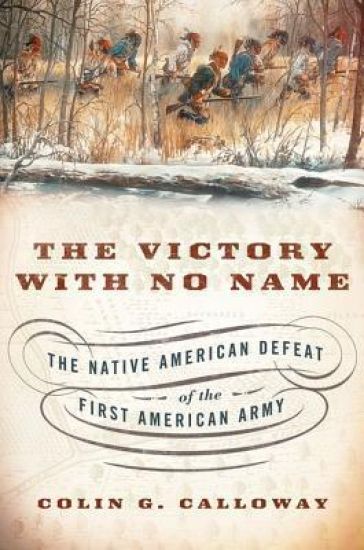
In 1791, General Arthur St. Clair led the United States army in a campaign to destroy a complex of Indian villages at the Maumee River in northwestern Ohio. Almost within reach of their objective, St. Clair's 1,400 men were attacked by about one thousand Indians. The U.S. force was decimated, suffering nearly one thousand casualties in killed and wounded, while Indian casualties numbered only a few dozen. But despite the lopsided result, it wouldn't appear to carry much significance; it involved only a few thousand people, lasted less than three hours, and the outcome, which was never in doubt, was permanently reversed a mere three years later. Neither an epic struggle nor a clash that changed the course of history, the battle doesn't even have a name. Yet, as renowned Native American historian Colin Calloway demonstrates here, St. Clair's Defeat--as it came to be known-- was hugely important for its time. It was both the biggest victory the Native Americans ever won, and, proportionately, the biggest military disaster the United States had suffered. With the British in Canada waiting in the wings for the American experiment in republicanism to fail, and some regions of the West gravitating toward alliance with Spain, the defeat threatened the very existence of the infant United States. Generating a deluge of reports, correspondence, opinions, and debates in the press, it produced the first congressional investigation in American history, while ultimately changing not only the manner in which Americans viewed, raised, organized, and paid for their armies, but the very ways in which they fought their wars. Emphasizing the extent to which the battle has been overlooked in history, Calloway illustrates how this moment of great victory by American Indians became an aberration in the national story and a blank spot in the national memory. Calloway shows that St. Clair's army proved no match for the highly motivated and well-led Native American force that shattered not only the American army but the ill-founded assumption that Indians stood no chance against European methods and models of warfare. An engaging and enlightening read for American history enthusiasts and scholars alike, The Victory with No Name brings this significant moment in American history back to light.
The Indian World of George Washington

The Indian World of George Washington

Colin G. Calloway

Oxford University Press Inc
2018
sidottu
George Washington dominates the narrative of the nation's birth, yet American history has largely forgotten what he knew: that the country's fate depended less on grand rhetorical statements of independence and self-governance than on land--Indian land. While other histories have overlooked the central importance of Indian power during the country's formative years, Colin G. Calloway here gives Native American leaders their due, revealing the relationship between the man who rose to become the most powerful figure in his country and the Native tribes whose dominion he usurped. In this sweeping new biography, Calloway uses the prism of Washington's life to bring focus to the great Native leaders of his time--Shingas, Tanaghrisson, Bloody Fellow, Joseph Brant, Red Jacket, Little Turtle--and the tribes they represented: the Iroquois Confederacy, Lenape, Miami, Creek, Delaware; in the process, he returns them to their rightful place in the story of America's founding. The Indian World of George Washington spans decades of Native American leaders' interaction with Washington, from his early days as surveyor of Indian lands, to his military career against both the French and the British, to his presidency, when he dealt with Native Americans as a head of state would with a foreign power, using every means of diplomacy and persuasion to fulfill the new republic's destiny by appropriating their land. By the end of his life, Washington knew more than anyone else in America about the frontier and its significance to the future of his country. The Indian World of George Washington offers a fresh portrait of the most revered American and the Native Americans whose story has been only partially told. Calloway's biography invites us to look again at the story of America's beginnings and see the country in a whole new light.
The Scratch of a Pen

The Scratch of a Pen

Colin G. Calloway

Oxford University Press Inc
2007
nidottu
In this superb volume in Oxford's acclaimed Pivotal Moments series, Colin Calloway reveals how the Treaty of Paris of 1763 had a profound effect on American history, setting in motion a cascade of unexpected consequences, as Indians and Europeans, settlers and frontiersmen, all struggled to adapt to new boundaries, new alignments, and new relationships. Britain now possessed a vast American empire stretching from Canada to the Florida Keys, yet the crushing costs of maintaining it would push its colonies toward rebellion. White settlers, free to pour into the West, clashed as never before with Indian tribes struggling to defend their way of life. In the Northwest, Pontiac's War brought racial conflict to its bitterest level so far. Whole ethnic groups migrated, sometimes across the continent: it was 1763 that saw many exiled settlers from Acadia in French Canada move again to Louisiana, where they would become Cajuns. Calloway unfurls this panoramic canvas with vibrant narrative skill, peopling his tale with memorable characters such as William Johnson, the Irish baronet who moved between Indian campfires and British barracks; Pontiac, the charismatic Ottawa chieftain; and James Murray, Britains first governor in Quebec, who fought to protect the religious rights of his French Catholic subjects. Most Americans know the significance of the Declaration of Independence or the Emancipation Proclamation, but not the Treaty of Paris. Yet 1763 was a year that shaped our history just as decisively as 1776 or 1862. This captivating book shows why. Winner of the Society of Colonial Wars Book Award for 2006
The Chiefs Now in This City

The Chiefs Now in This City

Colin G. Calloway

Oxford University Press Inc
2021
sidottu
During the years of the Early Republic, prominent Native leaders regularly traveled to American cities--Albany, Boston, Charleston, Philadelphia, Montreal, Quebec, New York, and New Orleans--primarily on diplomatic or trade business, but also from curiosity and adventurousness. They were frequently referred to as "the Chiefs now in this city" during their visits, which were sometimes for extended periods of time. Indian people spent a lot of time in town. Colin Calloway, National Book Award finalist and one of the foremost chroniclers of Native American history, has gathered together the accounts of these visits and from them created a new narrative of the country's formative years, redefining what has been understood as the "frontier." Calloway's book captures what Native peoples observed as they walked the streets, sat in pews, attended plays, drank in taverns, and slept in hotels and lodging houses. In the Eastern cities they experienced an urban frontier, one in which the Indigenous world met the Atlantic world. Calloway's book reveals not just what Indians saw but how they were seen. Crowds gathered to see them, sometimes to gawk; people attended the theatre to watch “the Chiefs now in this city” watch a play. Their experience enriches and redefines standard narratives of contact between the First Americans and inhabitants of the American Republic, reminding us that Indian people dealt with non-Indians in multiple ways and in multiple places. The story of the country's beginnings was not only one of violent confrontation and betrayal, but one in which the nation's identity was being forged by interaction between and among cultures and traditions.
Hard Neighbors

Hard Neighbors

Colin G. Calloway

OXFORD UNIVERSITY PRESS INC
2025
sidottu
An intricate portrayal of the early American settlers who came to be known as Scotch-Irish, who through collusion and bloody conflict acted as the tip of the spear for white colonial expansion into Indian lands, embodying what became the American pioneer spirit. Hard Neighbors highlights stories that have been subsumed by terms such as "English settlers" and "American expansion" and traces shifting relationships involving Scotch-Irish people living on the frontier, neighboring Indian peoples, and more distant governments. It follows the people who came to be known as Scotch-Irish from their genesis on a colonial borderland on one side of the Atlantic to their role in the borderlands of Indian country on the other. It traces their relations with Native Americans over time and across the continent, examines their experiences as marginalized and expendable people living between colonial powers and Indigenous peoples, and demonstrates their roles as protective and disruptive forces on the hard edge of colonialism. The Scotch-Irish fought Indian wars and shaped the frontier, and their experiences living near and fighting against Indians shaped their identity and their attitudes towards government. They influenced national attitudes and policies, and they transformed Indian people into racial others as they transformed themselves into Americans. The story this book tells is less about the Scotch-Irish as a distinct ethnic group than as a people in motion who, in collusion and conflict with colonial authorities, repeatedly inserted themselves on Native land. Instead of a tale of unified westward expansion, it recovers the experiences, encounters, and humanity of groups of people enmeshed in the violence of colonialism and reconstructs the roles of multiple peoples placed as buffers between competing powers. Expansion, and the accompanying expulsion and killing of Indian people, helped to create American unity and identity and, ultimately, made the Scotch-Irish Americans. Once marginalized as little better than Indians, they reaffirmed their reputation as Indian killers and made a place for themselves in America, as Americans.
The Victory with No Name

The Victory with No Name

Colin G. Calloway

Oxford University Press Inc
2014
sidottu
In 1791, General Arthur St. Clair led the United States army in a campaign to destroy a complex of Indian villages at the Miami River in northwestern Ohio. Almost within reach of their objective, St. Clair's 1,400 men were attacked by about one thousand Indians. The U.S. force was decimated, suffering nearly one thousand casualties in killed and wounded, while Indian casualties numbered only a few dozen. But despite the lopsided result, it wouldn't appear to carry much significance; it involved only a few thousand people, lasted less than three hours, and the outcome, which was never in doubt, was permanently reversed a mere three years later. Neither an epic struggle nor a clash that changed the course of history, the battle doesn't even have a name. Yet, as renowned Native American historian Colin Calloway demonstrates here, St. Clair's Defeat--as it came to be known-- was hugely important for its time. It was both the biggest victory the Native Americans ever won, and, proportionately, the biggest military disaster the United States had suffered. With the British in Canada waiting in the wings for the American experiment in republicanism to fail, and some regions of the West gravitating toward alliance with Spain, the defeat threatened the very existence of the infant United States. Generating a deluge of reports, correspondence, opinions, and debates in the press, it produced the first congressional investigation in American history, while ultimately changing not only the manner in which Americans viewed, raised, organized, and paid for their armies, but the very ways in which they fought their wars. Emphasizing the extent to which the battle has been overlooked in history, Calloway illustrates how this moment of great victory by American Indians became an aberration in the national story and a blank spot in the national memory. Calloway shows that St. Clair's army proved no match for the highly motivated and well-led Native American force that shattered not only the American army but the ill-founded assumption that Indians stood no chance against European methods and models of warfare. An engaging and enlightening read for American history enthusiasts and scholars alike, The Victory with No Name brings this significant moment in American history back to light.
The American Revolution in Indian Country

The American Revolution in Indian Country

Colin G. Calloway

Cambridge University Press
1995
pokkari
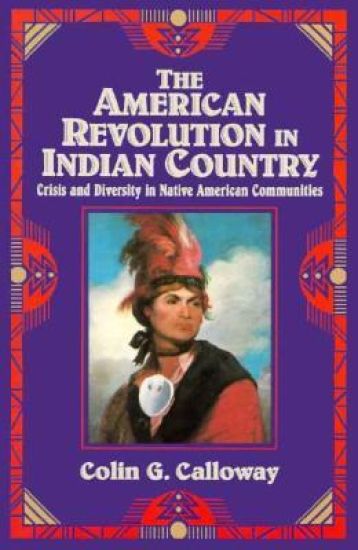
This study presents the first broad coverage of Indian experiences in the American Revolution rather than Indian participation as allies or enemies of contending parties. Colin Calloway focuses on eight Indian communities as he explores how the Revolution often translated into war among Indians and their own struggles for independence. Drawing on British, American, Canadian and Spanish records, Calloway shows how Native Americans pursued different strategies, endured a variety of experiences, but were bequeathed a common legacy as result of the Revolution.
One Vast Winter Count

One Vast Winter Count

Colin G. Calloway

University of Nebraska Press
2003
sidottu
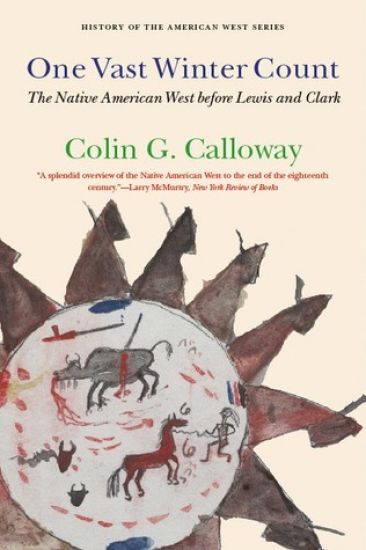
This magnificent, sweeping work traces the histories of the Native peoples of the American West from their arrival thousands of years ago to the early years of the nineteenth century. Emphasizing conflict and change, One Vast Winter Count offers a new look at the early history of the region by blending ethnohistory, colonial history, and frontier history. Drawing on a wide range of oral and archival sources from across the West, Colin G. Calloway offers an unparalleled glimpse at the lives of generations of Native peoples in a western land soon to be overrun.
One Vast Winter Count

One Vast Winter Count

Colin G. Calloway

University of Nebraska Press
2006
pokkari
A professor of history offers a sweeping new history of the Native American West from the earliest arrival of ancient peoples to the early nineteenth century, before the Lewis and Clarke expedition opened it to exploration, focusing particular attention on the period of conflict that preceded this period. Reprint.
New Directions in American Indian History

New Directions in American Indian History

Colin G. Calloway

University of Oklahoma Press
1992
nidottu
Each year more than five hundred new books appear in the field of North American Indian history. There exists, however, no means by which scholars can easily judge which are most significant, which explore new fields of inquiry and ask new questions, and which areas are the subject of especially strong inquiry or are being overlooked. New Directions in American Indian History provides some answers to these questions by bringing together a collection of bibliographic essays by historians, anthropologists, sociologists, religionists, linguists, economists, and legal scholars who are working at the cutting edge of Indian history. This volume responds to the label ""new directions"" in two ways. First, it describes what new directions have been pursued recently by historians of the Indian experience. Second, it points out some new directions that remain to be pursued. Part One, ""Recent Trends,"" contains six essays reviewing the following six areas where there has been significant interest and activity: quantitative methods in Native American history, by Melissa L. Meyer and Russell Thornton; American Indian women, by Deborah Welch; new developments in Métis history, by Dennis F.K. Madill; recent developments in southern plains Indian history, by Willard Rollings; Indians and the law, by George S. Grossman; and twentieth-century Indian history, by James Riding In. Part Two, ""Emerging Trends,"" contains essays on aspects of Indian history that remain undeveloped: language study and Plains Indian history, by Douglas R. Parks; economics and American Indian history, by Ronald L. Trosper; and religious changes in Native American societies, by Robert A. Brightman. These latter essays present a critique of current scholarship and sketch an agenda for future inquiry. Taken together, the nine essays in this book will help students at all levels to evaluate recent scholarship and tap the immense contemporary literature on American Indian history.
The Western Abenakis of Vermont, 1600-1800

The Western Abenakis of Vermont, 1600-1800

Colin G. Calloway

University of Oklahoma Press
1994
nidottu
Before European incursions began in the seventeenth century, the Western Abenaki Indians inhabited present-day Vermont and New Hampshire, particularly the Lake Champlain and Connecticut River valleys. This history of their coexistence and conflicts with whites on the northern New England frontier documents their survival as a people-recently at issue in the courts-and their wars and migrations, as far north as Quebec, during the first two centuries of white contacts.Written clearly and authoritatively, with sympathy for this long-neglected tribe, Colin G. Calloway's account of the Western Abenaki diaspora adds to the growing interest in remnant Indian groups of North America. This history of an Algonquian group on the periphery of the Iroquois Confederacy is also a major contribution to general Indian historiography and to studies of Indian white interactions, cultural persistence, and ethnic identity in North America.
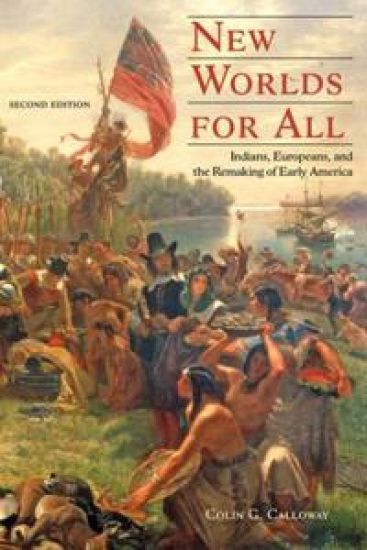
New Worlds for All

New Worlds for All

Colin G. Calloway

Johns Hopkins University Press
2013
pokkari
Although many Americans consider the establishment of the colonies as the birth of this country, in fact early America existed long before the arrival of the Europeans. From coast to coast, Native Americans had created enduring cultures, and the subsequent European invasion remade much of the land and society. In New Worlds for All, Colin G. Calloway explores the unique and vibrant new cultures that Indians and Europeans forged together in early America. The journey toward this hybrid society kept Europeans' and Indians' lives tightly entwined: living, working, worshiping, traveling, and trading together-as well as fearing, avoiding, despising, and killing one another. In some areas, settlers lived in Indian towns, eating Indian food. In the Mohawk Valley of New York, Europeans tattooed their faces; Indians drank tea. A unique American identity emerged. The second edition of New Worlds for All incorporates fifteen years of additional scholarship on Indian-European relations, such as the role of gender, Indian slavery, relationships with African Americans, and new understandings of frontier society.
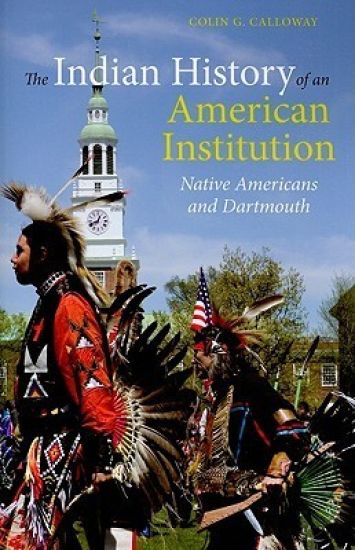
The Indian History of an American Institution

The Indian History of an American Institution

Colin G. Calloway

Dartmouth College Press
2010
nidottu
Dartmouth College began life as an Indian school, a pretense that has since been abandoned. Still, the institution has a unique, if complicated, relationship with Native Americans and their history. Beginning with Samson Occom's role as the first "development officer" of the college, Colin G. Calloway tells the entire, complex story of Dartmouth's historical and ongoing relationship with Native Americans. Calloway recounts the struggles and achievements of Indian attendees and the history of Dartmouth alumni's involvements with American Indian affairs. He also covers more recent developments, such as the mascot controversies, the emergence of an active Native American student organization, and the partial fulfillment of a promise deferred. This is a fascinating picture of an elite American institution and its troubled relationship- at times compassionate, at times conflicted-with Indians and Native American culture.