Kirjojen hintavertailu. Mukana 11 342 296 kirjaa ja 12 kauppaa.

Kirjahaku

Etsi kirjoja tekijän nimen, kirjan nimen tai ISBN:n perusteella.

6 kirjaa tekijältä Colin M. MacLachlan

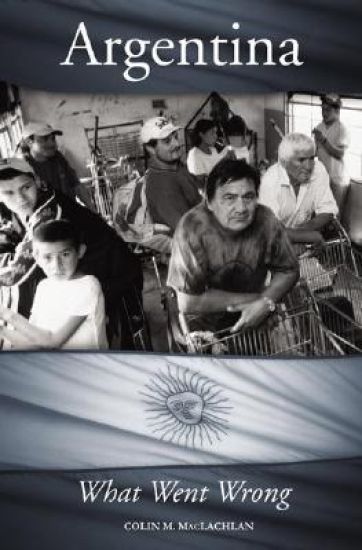
Argentina

Argentina

Colin M. MacLachlan

Praeger Publishers Inc
2006
sidottu
Why has Argentina failed so spectacularly, both economically and politically? It is a puzzle because the country seemed to have all the requirements for greatness, including a well-established middle class of professionals. Its failure raises the specter that other middle-class societies could also fail. In Argentina, MacLachlan delivers history with a plot, a sense of direction and purpose, and fascinating conclusions that reveal a much more complex picture of Argentina than one might have had in mind prior to reading this book. Argentina traces the roots of the nation from the late colonial period to the present, and examines the impact of events that molded it: the failure of political accommodation in 1912, the role of the oligarchy, the development of a middle class, gender issues, the elaboration of a distinct culture, the era of Peron, the army, and the dirty war. The conclusion suggests the reasons for the nation's difficulties. The IMF, World Bank, and international financial markets play a role, but so does a high level of political corruption and mismanagement of the economy that emerged from political and economic failure. Juan and Eva Peron tried to override politics to create an economic and social balance between urban labor and agriculture interests, but failed. The dirty war arose from that failure. Nationalism forged a culture of victimization and resentment that continues to this day. Laying aside standard explanations, MacLachlan presents a portrait of Argentina that emphasizes the role of a destructive nationalism—and a form a corruption that turns citizens into clients.
Criminal Justice in Eighteenth-Century Mexico

Criminal Justice in Eighteenth-Century Mexico

Colin M. MacLachlan

University of California Press
2021
pokkari
This title is part of UC Press's Voices Revived program, which commemorates University of California Press’s mission to seek out and cultivate the brightest minds and give them voice, reach, and impact. Drawing on a backlist dating to 1893, Voices Revived makes high-quality, peer-reviewed scholarship accessible once again using print-on-demand technology. This title was originally published in 1974.
Criminal Justice in Eighteenth-Century Mexico

Criminal Justice in Eighteenth-Century Mexico

Colin M. MacLachlan

University of California Press
2021
sidottu
This title is part of UC Press's Voices Revived program, which commemorates University of California Press’s mission to seek out and cultivate the brightest minds and give them voice, reach, and impact. Drawing on a backlist dating to 1893, Voices Revived makes high-quality, peer-reviewed scholarship accessible once again using print-on-demand technology. This title was originally published in 1974.
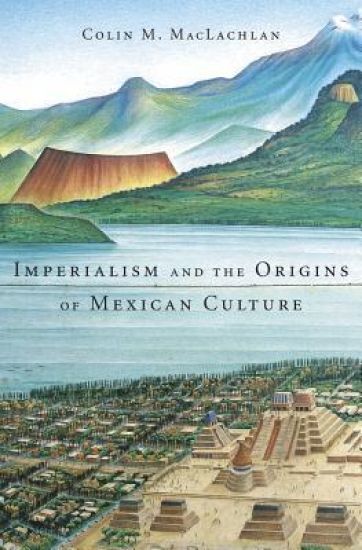
Imperialism and the Origins of Mexican Culture

Imperialism and the Origins of Mexican Culture

Colin M. MacLachlan

Harvard University Press
2015
sidottu
With an empire stretching across central Mexico, unmatched in military and cultural might, the Aztecs seemed poised on the brink of a golden age in the early sixteenth century. But the arrival of the Spanish changed everything. Imperialism and the Origins of Mexican Culture chronicles this violent clash of two empires and shows how modern Mestizo culture evolved over the centuries as a synthesis of Old and New World civilizations.Colin MacLachlan begins by tracing Spain and Mesoamerica’s parallel trajectories from tribal enclaves to complex feudal societies. When the Spanish laid siege to Tenochtitlán and destroyed it in 1521, the Aztecs could only interpret this catastrophe in cosmic terms. With their gods discredited and their population ravaged by epidemics, they succumbed quickly to Spanish control—which meant submitting to Christianity. Spain had just emerged from its centuries-long struggle against the Moors, and zealous Christianity was central to its imperial vision. But Spain’s conquistadors far outnumbered its missionaries, and the Church’s decision to exclude Indian converts from priesthood proved shortsighted. Native religious practices persisted, and a richly blended culture—part Indian, part Christian—began to emerge.The religious void left in the wake of Spain’s conquests had enduring consequences. MacLachlan’s careful analysis explains why Mexico is culturally a Mestizo country while ethnically Indian, and why modern Mexicans remain largely orphaned from their indigenous heritage—the adopted children of European history.
A History of Modern Brazil

A History of Modern Brazil

Colin M. MacLachlan

Rowman Littlefield
2003
sidottu
Over time, Brazil has evolved into a well-defined nation with a strong sense of identity. From the natural beauty of the Amazon River to the exciting resort city of Rio de Janeiro, from soccer champion Pele to classical musician Villa Lobos, Brazil is known as a distinctive, diverse country. It is recognized worldwide for its World Cup soccer team, samba music, dancing, and celebrations of Carnival. This book provides a well-rounded, brief history of Brazil that uniquely focuses on both the politics and culture of the republic. Colin MacLachlan uses a political narrative to frame the evolution of national culture and the formation of national identity. He evaluates Brazilian myths, stereotypes, and icons such as soccer and dancing as part of the historical analysis. Brazil's history is presented from its colonial roots to the present, showing how the country developed its economic and social base, then struggled to modernize and secure a respected world role. Key issues are examined: immigration, slavery and race, territorial expansion, the military, and technology and industrialization. The integration of cultural material enriches the text. It provides handy points for classroom discussion and will help students remember particular aspects Brazil's history. The book includes fascinating side-bars on various aspects of Brazilian culture, including Copacabana Beach and the rain forests. A History of Modern Brazil will inform and entertain students in courses on Brazil and modern Latin America.
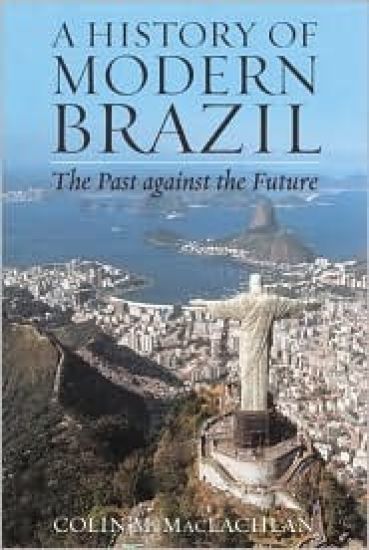
A History of Modern Brazil

A History of Modern Brazil

Colin M. MacLachlan

Rowman Littlefield
1993
nidottu
Over time, Brazil has evolved into a well-defined nation with a strong sense of identity. From the natural beauty of the Amazon River to the exciting resort city of Rio de Janeiro, from soccer champion Pele to classical musician Villa Lobos, Brazil is known as a distinctive, diverse country. It is recognized worldwide for its World Cup soccer team, samba music, dancing, and celebrations of Carnival. This book provides a well-rounded, brief history of Brazil that uniquely focuses on both the politics and culture of the republic. Colin MacLachlan uses a political narrative to frame the evolution of national culture and the formation of national identity. He evaluates Brazilian myths, stereotypes, and icons such as soccer and dancing as part of the historical analysis. Brazil's history is presented from its colonial roots to the present, showing how the country developed its economic and social base, then struggled to modernize and secure a respected world role. Key issues are examined: immigration, slavery and race, territorial expansion, the military, and technology and industrialization. The integration of cultural material enriches the text. It provides handy points for classroom discussion and will help students remember particular aspects Brazil's history. The book includes fascinating side-bars on various aspects of Brazilian culture, including Copacabana Beach and the rain forests. A History of Modern Brazil will inform and entertain students in courses on Brazil and modern Latin America.