Kirjojen hintavertailu. Mukana 11 342 296 kirjaa ja 12 kauppaa.

Kirjahaku

Etsi kirjoja tekijän nimen, kirjan nimen tai ISBN:n perusteella.

8 kirjaa tekijältä Colin MacCabe

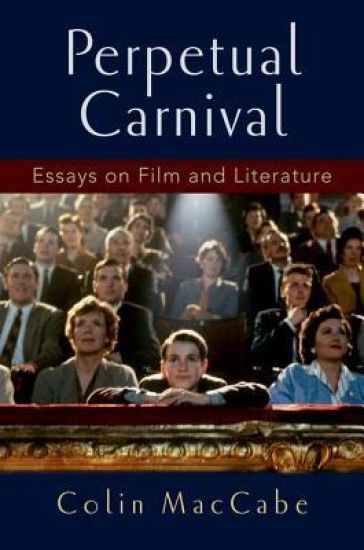
Perpetual Carnival

Perpetual Carnival

Colin MacCabe

Oxford University Press Inc
2017
sidottu
Upholding literature and film together as academically interwoven, Perpetual Carnival underscores the everlasting coexistence of realism and modernism, eschewing the popularly accepted view that the latter is itself a rejection of the former. Mining examples from both film and literature, Colin MacCabe asserts that the relationship between film and literature springs to life a wealth of beloved modernist art, from Jean-Luc Godard's Pierre le Fou to James Joyce's Ulysses, enriched by realism's enduring legacy. The intertextuality inherent in adaptation furthers this assertion in MacCabe's inclusion of Roman Polanski's Tess, a 1979 adaptation of Thomas Hardy's nineteenth-century realist novel, Tess of the d'Urbervilles. Showcasing essays enlivened by cosmopolitan interests, theoretical insight, and strong social purpose, Perpetual Carnival supports a humanities which repudiates narrow specialization and which seeks to place the discussion of film and literature firmly in the reality of current political and ideological discussion. It argues for the writers and directors, the thinkers and critics, who have most fired the contemporary imagination.
Perpetual Carnival

Perpetual Carnival

Colin MacCabe

Oxford University Press Inc
2017
nidottu
Upholding literature and film together as academically interwoven, Perpetual Carnival underscores the everlasting coexistence of realism and modernism, eschewing the popularly accepted view that the latter is itself a rejection of the former. Mining examples from both film and literature, Colin MacCabe asserts that the relationship between film and literature springs to life a wealth of beloved modernist art, from Jean-Luc Godard's Pierre le Fou to James Joyce's Ulysses, enriched by realism's enduring legacy. The intertextuality inherent in adaptation furthers this assertion in MacCabe's inclusion of Roman Polanski's Tess, a 1979 adaptation of Thomas Hardy's nineteenth-century realist novel, Tess of the d'Urbervilles. Showcasing essays enlivened by cosmopolitan interests, theoretical insight, and strong social purpose, Perpetual Carnival supports a humanities which repudiates narrow specialization and which seeks to place the discussion of film and literature firmly in the reality of current political and ideological discussion. It argues for the writers and directors, the thinkers and critics, who have most fired the contemporary imagination.
James Joyce

James Joyce

Colin MacCabe

Oxford University Press
2021
nidottu
James Joyce is one of the greatest writers in English. His first book, A Portrait of the Artist as A Young Man laid down the template for the Coming of Age novel, while his collection of short stories, Dubliners, is of perennial interest. His great modern epic, Ulysses, took the city of Dublin for its setting and all human life for its subject, and its publication in 1922 marked the beginning of the modern novel. Joyce's final work, Finnegans Wake is an endless experiment in narrative and language. But if Joyce is a great writer he is also the most difficult writer in English. Finnegans Wake is written in a freshly invented language, and Ulysses exhausts all the forms and styles of English. Even the apparently simple Dubliners has plots of endless complexity, while the structure of A Portrait of the Artist as A Young Man is exceptionally intricate. This Very Short Introduction explores the work of this most influential yet complex writer, and analyses how Joyce's difficulty grew out of his situation as an Irish writer unwilling to accept the traditions of his imperialist oppressor, and contemptuous of the cultural banality of the Gaelic revival. Joyce wanted to investigate and celebrate his own life, but this meant investigating and celebrating the drunks of Dublin's pubs and the prostitutes of Dublin's brothels. No subject was alien to him and he developed the naturalist project of recording all aspects of life with the symbolist project of finding significant correspondences in the most unlikely material. Throughout, Colin MacCabe interweaves Joyce's life and history with his books, and draws out their themes and connections. Very Short Introductions: Brilliant, Sharp, Inspiring ABOUT THE SERIES: The Very Short Introductions series from Oxford University Press contains hundreds of titles in almost every subject area. These pocket-sized books are the perfect way to get ahead in a new subject quickly. Our expert authors combine facts, analysis, perspective, new ideas, and enthusiasm to make interesting and challenging topics highly readable.
James Joyce and the Revolution of the Word

James Joyce and the Revolution of the Word

Colin MacCabe

Palgrave Macmillan
2002
sidottu
This second edition of Colin MacCabe's James Joyce and the Revolution of the Word reprints a classic critical text on Joyce and adds a wealth of new material which places the text in its political and historical context. The argument links politics and literature, sex and language, to provide an account of Joyce which places him continually in both Irish and European history.
James Joyce and the Revolution of the Word

James Joyce and the Revolution of the Word

Colin MacCabe

Palgrave Macmillan
2002
nidottu
This second edition of Colin MacCabe's James Joyce and the Revolution of the Word reprints a classic critical text on Joyce and adds a wealth of new material which places the text in its political and historical context. The argument links politics and literature, sex and language, to provide an account of Joyce which places him continually in both Irish and European history.
T.S. Eliot

T.S. Eliot

Colin MacCabe

Northcote House Publishers Ltd
2004
nidottu
T.S. Eliots's life took him from the United States to England, from philosophy to poetry and from modern scepticism to traditional Christianity. Colin MacCabe's study places Eliot's poetry in the context of these journeys and uses Eliot's life to illuminate his poetry. This poetry, although very modest in quantity, remains one of the great artistic triumphs of the English language. In his ironic accounts of adolescent desire in 'The Love Song of Alfred Prufrock' and 'Portrait of a Lady', he performs masculine self-doubt with a pathos and wit that has yet to be surpassed in poem, book or song. But these early poems can seem like mere exercises beside the astonishing achievements of 'Gerontion' and 'The Wasteland', poems which defined a generation and which broke the mould in English verse to allow a symphony of despairing voices to bear witness to the destruction in Europe. Finally, in 'Four Quartets' he forges an original form and a compelling tone to hymn both religious belief and national destiny as England faced defeat at the hands of Germany.
The Eloquence of the Vulgar: Language, Cinema and the Politics of Culture
In The Eloquence of the Vulgar, the distinguished academic Colin MacCabe reflects on cultural change from Shakespeare to Derek Jarman, on the institutional forms of knowledge, on the links between popular and elite art, and on the role of the intellectual in contemporary life. A radical argument emerges from the book's diverse concerns. Cinema and television - the new and democratic art forms of the twentieth century - demand a fundamental rethinking of our concepts of language and culture. What is at stake is the very idea of a liberal and humane education.
Performance

Performance

Colin MacCabe

Bloomsbury Publishing PLC
2020
nidottu
Directed by Donald Cammell and Nicolas Roeg, and starring James Fox, Mick Jagger and Anita Pallenberg, Performance was filmed in 1968, but not released until 1970. When its studio backers saw the director's cut, they were so shocked by the film's sexual explicitness and formal radicalism that attempts were made to destroy the negative. In his study of the film, Colin MacCabe draws on extensive interviews with surviving participants to present the definitive history of the making of Performance, as well as a new interpretation of its consummate artistry.This edition includes an afterword reflecting on the film 50 years on, and the reasons for its continuing classic status. Performance’s extraordinary power, suggests MacCabe, comes partly from its entrancing portrayal of London in the late 1960s, but primarily from its full scale assault on any notion of normality, not simply at the level of content but also of form. The remarkable ending, when the thriller and the psychodrama merge into one, means that there is no comfortable resolution to the film’s meanings. Performance is one of those rare narrative film which takes us into the complexity of sound and image without the comforting guarantee of a safe exit.