Kirjojen hintavertailu. Mukana 11 699 587 kirjaa ja 12 kauppaa.

Kirjahaku

Etsi kirjoja tekijän nimen, kirjan nimen tai ISBN:n perusteella.

3 kirjaa tekijältä Craig Berry

Pensions Imperilled

Pensions Imperilled

Craig Berry

Oxford University Press
2021
sidottu
Private pensions provision in the UK is in crisis, yet it is not the crisis often depicted in political and popular discourses. While population ageing has affected traditional pensions practice, the imperilment of UK pensions is due in fact to the peculiar way policy-makers have responded to wider social and economic change. Pensions are a mechanism for managing failed futures, yet this function is being impeded by the individualization of provision. This book offers a political economy perspective on the development of private pensions, focusing specifically on how policy elites have sought to respond to perceived crises of demographic change, under-saving, and fund deficits, and in doing so have absorbed imperatives to subject individuals to a market-led regime under the influence of neoliberal ideology. This terrain is explored through chapters on the historical and comparative context of UK pensions provision, the demise of collectivist provision, the rise of pensions individualization and the state's role as facilitator and regulator in this regard, and the financial and economic context in which pensions provision operates. By placing the UK system in a comparative context of pensions reform agendas across the world, this book offers an original understanding of the unique temporality and materiality of pensions provision as a set of mechanisms for coping with generational change and forecast failures in capitalist economies. It also presents a nuanced account of the extent to which the state acts to anchor the process of pensions rematerialization and, crucially, concludes by outlining a coherent and radical programme of progressive pensions reform.

Globalisation and Ideology in Britain

Globalisation and Ideology in Britain

Craig Berry

Manchester University Press
2011
sidottu
The 'globalisation' concept has become ubiquitous in British politics, as it has in many countries of the world. This exciting new book examines discourse on foreign economic policy to determine the impact of globalisation across the ideological landscape of British politics.The book critically interrogates the assumption that the idea of globalisation is derivative solely of neo-liberal ideology by profiling the discourse on globalisation of five political groups involved in making and contesting British foreign economic policy between 1997 and 2009: New Labour, International Financial Services London, the Liberal Democrats, Oxfam and the Socialist Workers Party. In addition to the relationship between neo-liberalism and globalisation, it also explores the core meaning of the idea of globalisation, the implications for the principle of free trade, the impact on notions of the state, nation-state and global governance, and whether globalisation means different things across the ideological spectrum.Topically, the book examines how the responses to the global financial crisis have been shaped by globalisation discourse and the value of ideology as an analytical concept able to mitigate debates on the primacy of material and ideational explanations in political economy. It will be of vital use to students and scholars of global economic change, financial crisis, the state, the impact of globalisation on national governance, and those interested in ideological change.
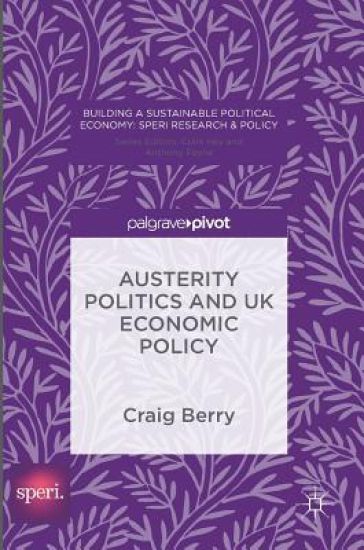
Austerity Politics and UK Economic Policy

Austerity Politics and UK Economic Policy

Craig Berry

Palgrave Macmillan
2016
sidottu
Craig Berry assesses UK economic policy in the wake of the financial crisis through the lens of the austerity agenda, focusing on monetary policy, economic rebalancing, industrial and regional policy, the labour market, welfare reform and budgetary management. He argues that austerity is geared towards a resurrection of financialisation and the UK’s pre-crisis economic model, through the transformation of individual behaviour and demonisation of the state. Cutting public spending and debt in the short term is, at most, a secondary concern for the UK policy elite. However, the underlying purpose of austerity is frequently misunderstood due to its conflation with a narrow deficit reduction agenda, not least by its Keynesian critics. Berry also demonstrates how austerity has effectively dismantled the prospect of a centre-left alternative to neoliberalism.