Kirjojen hintavertailu. Mukana 11 232 919 kirjaa ja 12 kauppaa.

Kirjahaku

Etsi kirjoja tekijän nimen, kirjan nimen tai ISBN:n perusteella.

11 kirjaa tekijältä Craig Calhoun

The Roots of Radicalism

The Roots of Radicalism

Craig Calhoun

University of Chicago Press
2012
sidottu
The story of the rise of radicalism in the early nineteenth century has often been simplified into a fable about progressive social change. The diverse social movements of the era - religious, political, regional, national, antislavery, and protemperance - are presented as mere strands in a unified tapestry of labor and democratic mobilization. Taking aim at this flawed view of radicalism as simply the extreme end of a single dimension of progress, Craig Calhoun emphasizes the coexistence of different kinds of radicalism, their tensions, and their implications. "The Roots of Radicalism" reveals the importance of radicalism's links to pre-industrial culture and attachments to place and local communities, as well as the ways in which journalists who had been pushed out of "respectable" politics connected to artisans and other workers. Calhoun shows how much public recognition mattered to radical movements and how religious, cultural, and directly political - as well as economic - concerns motivated people to join up. Reflecting two decades of research into social movement theory and the history of protest, "The Roots of Radicalism" offers compelling insights into the past that can tell us much about the present, from American right-wing populism to democratic upheavals in North Africa.
The Roots of Radicalism

The Roots of Radicalism

Craig Calhoun

University of Chicago Press
2012
nidottu
The story of the rise of radicalism in the early nineteenth century has often been simplified into a fable about progressive social change. The diverse social movements of the era - religious, political, regional, national, antislavery, and protemperance - are presented as mere strands in a unified tapestry of labor and democratic mobilization. Taking aim at this flawed view of radicalism as simply the extreme end of a single dimension of progress, Craig Calhoun emphasizes the coexistence of different kinds of radicalism, their tensions, and their implications. "The Roots of Radicalism" reveals the importance of radicalism's links to pre-industrial culture and attachments to place and local communities, as well as the ways in which journalists who had been pushed out of "respectable" politics connected to artisans and other workers. Calhoun shows how much public recognition mattered to radical movements and how religious, cultural, and directly political - as well as economic - concerns motivated people to join up. Reflecting two decades of research into social movement theory and the history of protest, "The Roots of Radicalism" offers compelling insights into the past that can tell us much about the present, from American right-wing populism to democratic upheavals in North Africa.

Cosmopolitanism and Belonging

Cosmopolitanism and Belonging

Craig Calhoun

Routledge
2026
sidottu
Reviewing recent cosmopolitan thinking and theorizing from the somewhat chastened perspective of the twenty-first century, Cosmopolitanism and Belonging questions the social bases of cosmopolitanism and the continuing importance of nationalism. With a special focus on European integration which loomed large in the cosmopolitan visions of a few years ago, Craig Calhoun addresses the ways in which cosmopolitan theories may be biased from the standpoint of European and American élites and indeed the heritage of liberal thought.This intellectually stimulating and timely book, written by one of the top social scientists today, deals with a topical area of study as cosmopolitanism has rapidly become one of the burning issues in the social sciences today.Cosmopolitanism and Belonging has a distinct focus on identity and belonging, analyzing a multidisciplinary area, so is an ideal purchase for students, academics and social scientists researching in the disciplines of sociology, politics and cultural studies.
Cosmopolitanism and Belonging

Cosmopolitanism and Belonging

Craig Calhoun

Routledge
2026
nidottu
Reviewing recent cosmopolitan thinking and theorizing from the somewhat chastened perspective of the twenty-first century, Cosmopolitanism and Belonging questions the social bases of cosmopolitanism and the continuing importance of nationalism. With a special focus on European integration which loomed large in the cosmopolitan visions of a few years ago, Craig Calhoun addresses the ways in which cosmopolitan theories may be biased from the standpoint of European and American élites and indeed the heritage of liberal thought.This intellectually stimulating and timely book, written by one of the top social scientists today, deals with a topical area of study as cosmopolitanism has rapidly become one of the burning issues in the social sciences today.Cosmopolitanism and Belonging has a distinct focus on identity and belonging, analyzing a multidisciplinary area, so is an ideal purchase for students, academics and social scientists researching in the disciplines of sociology, politics and cultural studies.
Nations Matter

Nations Matter

Craig Calhoun

Routledge
2007
sidottu
Craig Calhoun, one of the most respected social scientists in the world, re-examines nationalism in light of post-1989 enthusiasm for globalization and the new anxieties of the twenty-first century. Nations Matter argues that pursuing a purely postnational politics is premature at best and possibly dangerous. Calhoun argues that, rather than wishing nationalism away, it is important to transform it. One key is to distinguish the ideology of nationalism as fixed and inherited identity from the development of public projects that continually remake the terms of national integration. Standard concepts like 'civic' vs. 'ethnic' nationalism can get in the way unless they are critically re-examined – as an important chapter in this book does. This book is essential reading for undergraduate and postgraduate students of sociology, history, political theory and all subjects concerned with nationalism, globalization, and cosmopolitanism.
Nations Matter

Nations Matter

Craig Calhoun

Routledge
2007
nidottu
Craig Calhoun, one of the most respected social scientists in the world, re-examines nationalism in light of post-1989 enthusiasm for globalization and the new anxieties of the twenty-first century. Nations Matter argues that pursuing a purely postnational politics is premature at best and possibly dangerous. Calhoun argues that, rather than wishing nationalism away, it is important to transform it. One key is to distinguish the ideology of nationalism as fixed and inherited identity from the development of public projects that continually remake the terms of national integration. Standard concepts like 'civic' vs. 'ethnic' nationalism can get in the way unless they are critically re-examined – as an important chapter in this book does. This book is essential reading for undergraduate and postgraduate students of sociology, history, political theory and all subjects concerned with nationalism, globalization, and cosmopolitanism.
Neither Gods nor Emperors

Neither Gods nor Emperors

Craig Calhoun

University of California Press
1997
pokkari
"We want neither gods nor emperors", went the words from the Chinese version of The Internationale. Students sang the old socialist song as they gathered in Beijing's Tiananmen Square in the Spring of 1989. Craig Calhoun, a sociologist who witnessed the monumental event, offers a vivid, carefully crafted analysis of the student movement, its complex leadership, its eventual suppression, and its continuing legacy.
Hannah Arendt and the Meaning of Politics

Hannah Arendt and the Meaning of Politics

Craig Calhoun

University of Minnesota Press
1997
nidottu
Eminent contributors consider what Hannah Arendt means in today’s public debates.Is politics really nothing more than power relations, competing interests and claims for recognition, conflicting assertions of “simple” truths? No thinker has argued more passionately against this narrow view than Hannah Arendt, and no one has more to say to those who bring questions of meaning, identity, value, and transcendence to our impoverished public life. This volume brings leading figures in philosophy, political theory, intellectual history, and literary theory into a dialogue about Arendt’s work and its significance for today’s fractious identity politics, public ethics, and civic life.For each essay-on the fate of politics in a postmodern, post-Marxist era; on the connection of nonfoundationalist ethics and epistemology to democracy; on the conditions conducive to a vital public sphere; on the recalcitrant problems of violence and evil-the volume includes extended responses, and a concluding essay by Martin Jay responding to all the others. Ranging from feminism to aesthetics to the discourse of democracy, the essays explore how an encounter with Arendt reconfigures, disrupts, and revitalizes what passes for public debate in our day. Together they forcefully demonstrate the power of Arendt’s work as a splendid provocation and a living resource.Contributors: Richard Bernstein, New School; Anthony Cascardi, U of California, Berkeley; Susan Bickford, U of North Carolina; Kim Curtis, Duke U; Lisa Disch, U of Minnesota; Nancy Fraser, New School; Martin Jay; U of California, Berkeley, Steven Leonard, U of North Carolina; Kirstie McClure, Johns Hopkins U; Dana Villa, Amherst College; and Eli Zaretsky, U of Missouri.
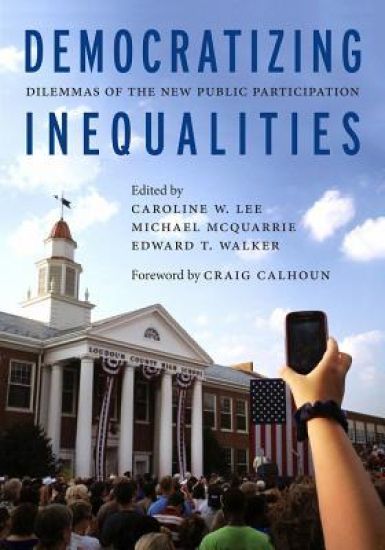
Democratizing Inequalities

Democratizing Inequalities

Craig Calhoun

New York University Press
2015
pokkari
Opportunities to “have your say,” “get involved,” and “join the conversation” are everywhere in public life. From crowdsourcing and town hall meetings to government experiments with social media, participatory politics increasingly seem like a revolutionary antidote to the decline of civic engagement and the thinning of the contemporary public sphere. Many argue that, with new technologies, flexible organizational cultures, and a supportive policymaking context, we now hold the keys to large-scale democratic revitalization. Democratizing Inequalities shows that the equation may not be so simple. Modern societies face a variety of structural problems that limit potentials for true democratization, as well as vast inequalities in political action and voice that are not easily resolved by participatory solutions. Popular participation may even reinforce elite power in unexpected ways. Resisting an oversimplified account of participation as empowerment, this collection of essays brings together a diverse range of leading scholars to reveal surprising insights into how dilemmas of the new public participation play out in politics and organizations. Through investigations including fights over the authenticity of business-sponsored public participation, the surge of the Tea Party, the role of corporations in electoral campaigns, and participatory budgeting practices in Brazil, Democratizing Inequalities seeks to refresh our understanding of public participation and trace the reshaping of authority in today’s political environment.
Critical Social Theory

Critical Social Theory

Craig Calhoun

Blackwell Publishers
1995
nidottu
In this outstanding reinterpretation - and extension - of the Critical Theory tradition, Craig Calhoun surveys the origins, fortunes and prospects of this most influential of theoretical approaches. Moving with ease from the early Frankfurt School to Habermas, to contemporary debates over postmodernism, feminism and nationalism, Calhoun breathes new life into Critical Social Theory, showing how it can learn from the past and contribute to the future.
Nationalism

Nationalism

Craig Calhoun

University of Minnesota Press
1998
nidottu
Drawing on examples from Eritrea, Yugoslavia and China to France and Germany, this book clarifies the way in which national boundaries and identities became central to the modern era, how they relate to the development of state power, and how a host of different social movements and government policies try to make use of them. At the same time, the author also challenges attempts to "debunk" nationalism that fail to grasp why it maintains its power and centrality in modern life.