Kirjojen hintavertailu. Mukana 11 627 220 kirjaa ja 12 kauppaa.

Kirjahaku

Etsi kirjoja tekijän nimen, kirjan nimen tai ISBN:n perusteella.

11 kirjaa tekijältä Craig Dworkin

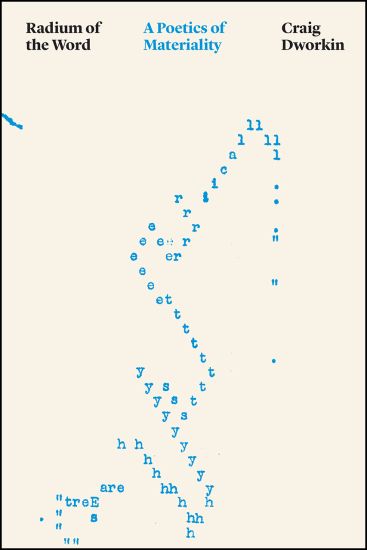
Radium of the Word

Radium of the Word

Craig Dworkin

University of Chicago Press
2020
sidottu
With fresh insight and contemporary relevance, Radium of the Word argues that a study of the form of language yields meanings otherwise inaccessible through ordinary reading strategies. Attending to the forms of words rather than to their denotations, Craig Dworkin traces hidden networks across the surface of texts, examining how typography, and even individual letters and marks of punctuation, can reveal patterns that are significant without being symbolic—fully meaningful without communicating any preordained message.Radium of the Word takes its title from Mina Loy’s poem for Gertrude Stein, which hails her as the Madame “Curie / of the laboratory / of vocabulary.” In this spirit, Dworkin considers prose as a dynamic literary form, characterized by experimentation. Dworkin draws on examples from writers as diverse as Lyn Hejinian, William Faulkner, and Joseph Roth. He takes up the status of the proper name in Modernism, with examples from Stein, Loy, and Guillaume Apollinaire, and he offers in-depth analyses of individual authors from the counter-canon of the avant-garde, including P. Inman, Russell Atkins, N. H. Pritchard, and Andy Warhol. The result is an inspiring intervention in contemporary poetics.
Radium of the Word

Radium of the Word

Craig Dworkin

University of Chicago Press
2020
nidottu
With fresh insight and contemporary relevance, Radium of the Word argues that a study of the form of language yields meanings otherwise inaccessible through ordinary reading strategies. Attending to the forms of words rather than to their denotations, Craig Dworkin traces hidden networks across the surface of texts, examining how typography, and even individual letters and marks of punctuation, can reveal patterns that are significant without being symbolic—fully meaningful without communicating any preordained message.Radium of the Word takes its title from Mina Loy’s poem for Gertrude Stein, which hails her as the Madame “Curie / of the laboratory / of vocabulary.” In this spirit, Dworkin considers prose as a dynamic literary form, characterized by experimentation. Dworkin draws on examples from writers as diverse as Lyn Hejinian, William Faulkner, and Joseph Roth. He takes up the status of the proper name in Modernism, with examples from Stein, Loy, and Guillaume Apollinaire, and he offers in-depth analyses of individual authors from the counter-canon of the avant-garde, including P. Inman, Russell Atkins, N. H. Pritchard, and Andy Warhol. The result is an inspiring intervention in contemporary poetics.

The Sound of Thinking

The Sound of Thinking

Craig Dworkin

THE UNIVERSITY OF CHICAGO PRESS
2026
sidottu
A lively compendium of musical practices and compositions that upend notions of creativity and expressivity while diversifying our sense of the musical canon. An artist draws two octaves of pitches randomly from a hat, just enough to set each syllable of the dictionary definition of imprimer (to score, to print). Trawling the internet for cute videos of cats “playing” piano, an artist splices together a complete, note-perfect performance of Arnold Schoenberg’s Opus 11. Half a century after the release of Miles Davis’s album Kind of Blue, a jazz quintet spends months of focused practice to reproduce the original exactly. These performances share a common denominator: absolute fidelity to the outcome of a system. From Marcel Duchamp to Yoko Ono, Steve Reich to Sun Ra, The Sound of Thinking brings together a diverse array of musical or sonic works that are algorithmic, automatic, permutational, procedural, or otherwise structured in contrast to the creative expressivity typically associated with artistic production. In twenty-six short essays, each keyed to a term that begins with a different letter of the alphabet, Dworkin discusses work composed or performed according to a predetermined rule, transforming artistic creation into a system running its course. The pieces detailed here, drawn from more than a century of musical experimentation, offer a fresh perspective on the history of innovative music by decoupling music from expression and by shunting creativity from the level of organizing sounds to the level of devising a system that can do the organizing. Not only does this book spotlight the critical role of music in twentieth-century conceptual art, but it also identifies previously overlooked links among diverse artists and movements.
The Sound of Thinking

The Sound of Thinking

Craig Dworkin

THE UNIVERSITY OF CHICAGO PRESS
2026
nidottu
A lively compendium of musical practices and compositions that upend notions of creativity and expressivity while diversifying our sense of the musical canon. An artist draws two octaves of pitches randomly from a hat, just enough to set each syllable of the dictionary definition of imprimer (to score, to print). Trawling the internet for cute videos of cats “playing” piano, an artist splices together a complete, note-perfect performance of Arnold Schoenberg’s Opus 11. Half a century after the release of Miles Davis’s album Kind of Blue, a jazz quintet spends months of focused practice to reproduce the original exactly. These performances share a common denominator: absolute fidelity to the outcome of a system. From Marcel Duchamp to Yoko Ono, Steve Reich to Sun Ra, The Sound of Thinking brings together a diverse array of musical or sonic works that are algorithmic, automatic, permutational, procedural, or otherwise structured in contrast to the creative expressivity typically associated with artistic production. In twenty-six short essays, each keyed to a term that begins with a different letter of the alphabet, Dworkin discusses work composed or performed according to a predetermined rule, transforming artistic creation into a system running its course. The pieces detailed here, drawn from more than a century of musical experimentation, offer a fresh perspective on the history of innovative music by decoupling music from expression and by shunting creativity from the level of organizing sounds to the level of devising a system that can do the organizing. Not only does this book spotlight the critical role of music in twentieth-century conceptual art, but it also identifies previously overlooked links among diverse artists and movements.
No Medium

No Medium

Craig Dworkin

MIT Press
2015
pokkari
Close readings of ostensibly "blank" works-from unprinted pages to silent music-that point to a new understanding of media.In No Medium, Craig Dworkin looks at works that are blank, erased, clear, or silent, writing critically and substantively about works for which there would seem to be not only nothing to see but nothing to say. Examined closely, these ostensibly contentless works of art, literature, and music point to a new understanding of media and the limits of the artistic object.Dworkin considers works predicated on blank sheets of paper, from a fictional collection of poems in Jean Cocteau's Orphee to the actual publication of a ream of typing paper as a book of poetry; he compares Robert Rauschenberg's Erased De Kooning Drawing to the artist Nick Thurston's erased copy of Maurice Blanchot's The Space of Literature (in which only Thurston's marginalia were visible); and he scrutinizes the sexual politics of photographic representation and the implications of obscured or obliterated subjects of photographs. Reexamining the famous case of John Cage's 4'33", Dworkin links Cage's composition to Rauschenberg's White Paintings, Ken Friedman's Zen for Record (and Nam June Paik's Zen for Film), and other works, offering also a "guide to further listening" that surveys more than 100 scores and recordings of "silent" music.Dworkin argues that we should understand media not as blank, base things but as social events, and that there is no medium, understood in isolation, but only and always a plurality of media: interpretive activities taking place in socially inscribed space.
Reading the Illegible

Reading the Illegible

Craig Dworkin

Northwestern University Press
2003
sidottu
This is a critical approach to reading texts rendered variously illegible - through erasures, excisions, overprintings and rearrangements - by major 20th-century artists and writers.
Reading the Illegible

Reading the Illegible

Craig Dworkin

Northwestern University Press
2003
nidottu
A poet takes another's text, excises this, prints over that, cancels, erases, rearranges, defaces--and generally renders the original unreadable, at least in its original terms. What twentieth-century writers and artists have meant by such appropriations and violations, and how the "illegible" results are to be read, is the subject Craig Dworkin takes up in this ambitious work.In his scrutiny of selected works, and with reference to a rich variety of textual materials--from popular and scientific texts to visual art, political and cultural theories, and experimental films--Dworkin proposes a new way of apprehending the radical formalism of so-called unreadable texts. Dworkin unveils what he describes as "the politics of the poem"--what is signified by its form, enacted by its structures, and implicit in the philosophy of language; how it positions its reader; and other questions relating to the poem as material object. In doing so, he exposes the mechanics and function of truly radical formalism as a practice that move beyond aesthetic considerations into the realms of politics and ideology. Reading the Illegible asks us to reconsider poetry as a physical act, and helps us to see how the range of a text's linguistic and political maneuvers depends to a great extent on the material conditions of reading and writing as well as the mechanics of reproduction.
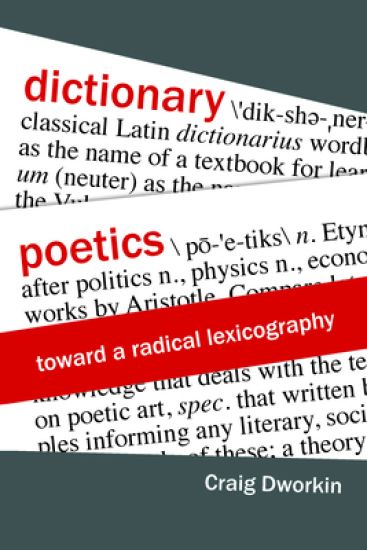
Dictionary Poetics

Dictionary Poetics

Craig Dworkin

Fordham University Press
2020
pokkari
The new ways of writing pioneered by the literary avant-garde invite new ways of reading commensurate with their modes of composition. Dictionary Poetics examines one of those modes: book-length poems, from Louis Zukofsky to Harryette Mullen, all structured by particular editions of specific dictionaries. By reading these poems in tandem with their source texts, Dworkin puts paid to the notion that even the most abstract and fragmentary avant-garde literature is nonsensical, meaningless, or impenetrable. When read from the right perspective, passages that at first appear to be discontinuous, irrational, or hopelessly cryptic suddenly appear logically consistent, rationally structured, and thematically coherent. Following a methodology of "critical description," Dictionary Poetics maps the material surfaces of poems, tracing the networks of signifiers that undergird the more familiar representational schemes with which conventional readings have been traditionally concerned. In the process, this book demonstrates that new ways of reading can yield significant interpretive payoffs, open otherwise unavailable critical insights into the formal and semantic structures of a composition, and transform our understanding of literary texts at their most fundamental levels.
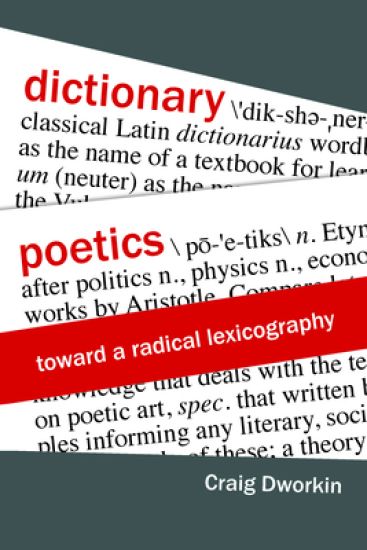
Dictionary Poetics

Dictionary Poetics

Craig Dworkin

FORDHAM UNIVERSITY PRESS
2020
sidottu
The new ways of writing pioneered by the literary avant-garde invite new ways of reading commensurate with their modes of composition. Dictionary Poetics examines one of those modes: book-length poems, from Louis Zukofsky to Harryette Mullen, all structured by particular editions of specific dictionaries. By reading these poems in tandem with their source texts, Dworkin puts paid to the notion that even the most abstract and fragmentary avant-garde literature is nonsensical, meaningless, or impenetrable. When read from the right perspective, passages that at first appear to be discontinuous, irrational, or hopelessly cryptic suddenly appear logically consistent, rationally structured, and thematically coherent. Following a methodology of “critical description,” Dictionary Poetics maps the material surfaces of poems, tracing the networks of signifiers that undergird the more familiar representational schemes with which conventional readings have been traditionally concerned. In the process, this book demonstrates that new ways of reading can yield significant interpretive payoffs, open otherwise unavailable critical insights into the formal and semantic structures of a composition, and transform our understanding of literary texts at their most fundamental levels.
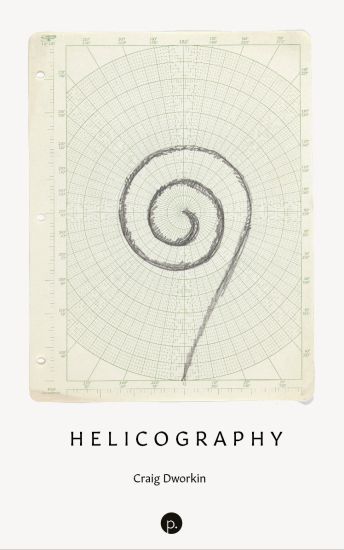
Helicography

Helicography

Craig Dworkin

Punctum Books
2021
pokkari
Part art history essay, part experimental fiction, part theoretical manifesto on the politics of equivalence, Helicography examines questions of scale in relation to Robert Smithson's iconic 1970 artwork Spiral Jetty. In an essay and film made to accompany the earthwork, Smithson invites us to imagine the stone helix of his structure at various orders of magnitude, from microscopic molecules to entire galaxies.Taking up this invitation with an unrelenting and literal enthusiasm, Helicography pursues the implications of such transformations all the way to the limits of logic. If other spirals, from the natural to the man-made, were expanded or condensed to the size of Spiral Jetty, what are the consequences of their physical metamorphoses? What other equivalences follow in turn, and where do their surprising historical, cultural, and mechanical connections lead? This book considers a number of forms in order to find out: the fluid vortices of whirlpools, hurricanes, and galaxies; the delicate shells of snails and the threatening pose of rattlesnakes; prehistoric ferns and the turns of the inner ear; the monstrous jaws of ancient sharks; a baroque finial scroll on a bass viol; a 19th-century watch spring; phonograph discs and spooled film; the largest open-pit mine on the planet.The result is a narrative laboratory for the "science of imaginary solutions" proposed by Alfred Jarry (whose King Ubu also plays a central role in the story told here), a work of fictocriticism blurring form and content, and the story of a single instant in time lost in the deserts of the intermountain west. Craig Dworkin is the author of four scholarly monographs - Reading the Illegible (Northwestern University Press), No Medium (MIT Press), Dictionary Poetics: Toward a Radical Lexicography (Fordham University Press), and Radium of the Word: a Poetics of Materiality (Chicago University Press) - as well as a half-dozen edited collections and a dozen books of experimental writing, including, most recently, The Pine-Woods Notebook (Kenning Editions). He teaches literary history and theory at the University of Utah.
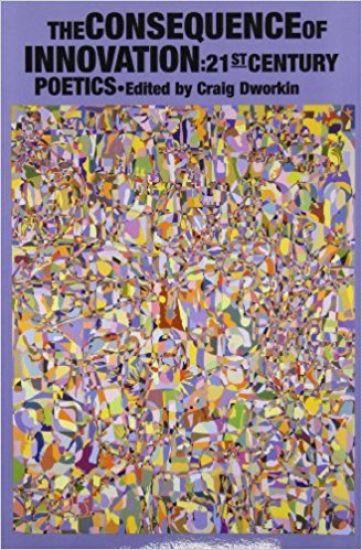
The Consequence of Innovation

The Consequence of Innovation

Craig Dworkin

Roof Books,U.S.
2008
nidottu
In The Consequence of Innovation, Dworkin has edited a collection of amazing new essays on poetics, summarizing the variety of poetries that have arisen in innovative writing during the first decade of the 21st century. Filling the gap that has arisen in publishing writing on new poetry, there are essays on computer programs as poems by Brian Kim Stefans, flarf poetics by Gary Sullivan and Michael Gottlieb, uncreative poetry by Kenneth Goldsmith, and ecological poetry by James Sherry. There are essays on playwright Fiona Templeton and a groundbreaking piece by Sianne Ngai centered on Gertrude Stein. There is also an important group of general essays on the poetry marketplace by Steve Evans, Charles Bernstein, and Marjorie Perloff. If you buy one book this year, buy this one.