Kirjojen hintavertailu. Mukana 11 244 527 kirjaa ja 12 kauppaa.

Kirjahaku

Etsi kirjoja tekijän nimen, kirjan nimen tai ISBN:n perusteella.

10 kirjaa tekijältä Craig Smorynski

History of Mathematics

History of Mathematics

Craig Smorynski

Springer-Verlag New York Inc.
2007
sidottu
1 An Initial Assignment I haven’t taught the history of mathematics that often, but I do rather like the course. The chief drawbacks to teaching it are that i. it is a lot more work than teaching a regular mathematics course, and ii. in American colleges at least, the students taking the course are not mathematics majors but e- cation majors— and and in the past I had found education majors to be somewhat weak and unmotivated. The last time I taught the course, however, themajorityofthestudentsweregraduateeducationstudentsworkingtoward their master’s degrees. I decided to challenge them right from the start: 1 Assignment. In An Outline of Set Theory, James Henle wrote about mat- matics: Every now and then it must pause to organize and re?ect on what it is and where it comes from. This happened in the sixth century B. C. when Euclid thought he had derived most of the mathematical results known at the time from ?ve postulates. Do a little research to ?nd as many errors as possible in the second sentence and write a short essay on them. Theresponsesfarexceededmyexpectations. Tobesure,someoftheund- graduates found the assignment unclear: I did not say how many errors they 2 were supposed to ?nd. But many of the students put their hearts and souls 1 MyapologiestoProf. Henle,atwhoseexpenseIpreviouslyhadalittlefunonthis matter. I used it again not because of any animosity I hold for him, but because I was familiar with it and, dealing with Euclid, it seemed appropriate for the start of my course.
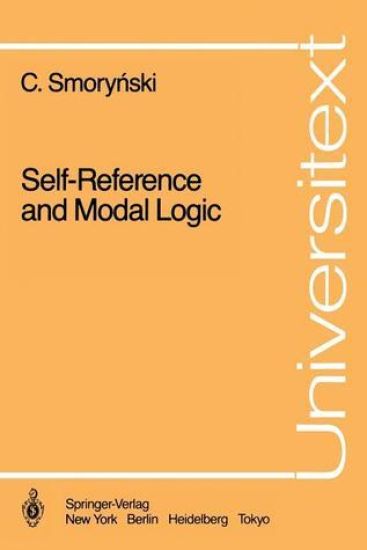
Self-Reference and Modal Logic

Self-Reference and Modal Logic

Craig Smorynski

Springer-Verlag New York Inc.
1985
nidottu
It is Sunday, the 7th of September 1930. The place is Konigsberg and the occasion is a small conference on the foundations of mathematics. Arend Heyting, the foremost disciple of L. E. J. Brouwer, has spoken on intuitionism; Rudolf Carnap of the Vienna Circle has expounded on logicism; Johann (formerly Janos and in a few years to be Johnny) von Neumann has explained Hilbert's proof theory-- the so-called formalism; and Hans Hahn has just propounded his own empiricist views of mathematics. The floor is open for general discussion, in the midst of which Heyting announces his satisfaction with the meeting. For him, the relationship between formalism and intuitionism has been clarified: There need be no war between the intuitionist and the formalist. Once the formalist has successfully completed Hilbert's programme and shown "finitely" that the "idealised" mathematics objected to by Brouwer proves no new "meaningful" statements, even the intuitionist will fondly embrace the infinite. To this euphoric revelation, a shy young man cautions~ "According to the formalist conception one adjoins to the meaningful statements of mathematics transfinite (pseudo-')statements which in themselves have no meaning but only serve to make the system a well-rounded one just as in geometry one achieves a well­ rounded system by the introduction of points at infinity.
History of Mathematics

History of Mathematics

Craig Smorynski

Springer-Verlag New York Inc.
2010
nidottu
1 An Initial Assignment I haven’t taught the history of mathematics that often, but I do rather like the course. The chief drawbacks to teaching it are that i. it is a lot more work than teaching a regular mathematics course, and ii. in American colleges at least, the students taking the course are not mathematics majors but e- cation majors— and and in the past I had found education majors to be somewhat weak and unmotivated. The last time I taught the course, however, themajorityofthestudentsweregraduateeducationstudentsworkingtoward their master’s degrees. I decided to challenge them right from the start: 1 Assignment. In An Outline of Set Theory, James Henle wrote about mat- matics: Every now and then it must pause to organize and re?ect on what it is and where it comes from. This happened in the sixth century B. C. when Euclid thought he had derived most of the mathematical results known at the time from ?ve postulates. Do a little research to ?nd as many errors as possible in the second sentence and write a short essay on them. Theresponsesfarexceededmyexpectations. Tobesure,someoftheund- graduates found the assignment unclear: I did not say how many errors they 2 were supposed to ?nd. But many of the students put their hearts and souls 1 MyapologiestoProf. Henle,atwhoseexpenseIpreviouslyhadalittlefunonthis matter. I used it again not because of any animosity I hold for him, but because I was familiar with it and, dealing with Euclid, it seemed appropriate for the start of my course.
Mathematical Problems

Mathematical Problems

Craig Smorynski

Springer Nature Switzerland AG
2020
nidottu
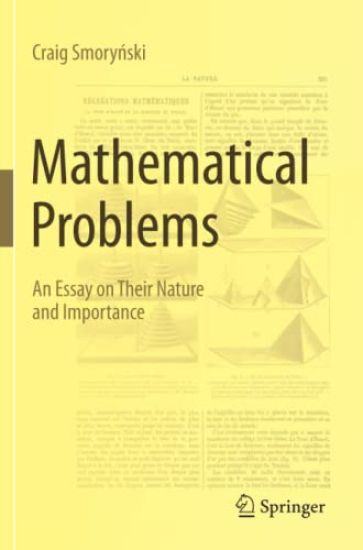
The life and soul of any science are its problems. This is particularly true of mathematics, which, not referring to any physical reality, consists only of its problems, their solutions, and, most excitingly, the challenges they pose. Mathematical problems come in many flavours, from simple puzzles to major open problems. The problems stimulate, the stories of their successful solutions inspire, and their applications are wide.The literature abounds with books dedicated to mathematical problems — collections of problems, hints on how to solve them, and even histories of the paths to the solutions of some famous ones. The present book, aimed at the proverbial “bright high-school student”, takes a different, more philosophical approach, first dividing mathematical problems into three broad classes — puzzles, exercises, and open problems — and discussing their various roles in one’s mathematical education. Various chapters are devoted to discussing examples of each type of problem, along with their solutions and some of the developments arising from them. For the truly dedicated reader, more involved material is offered in an appendix.Mathematics does not exist in a vacuum, whence the author peppers the material with frequent extra-mathematical cultural references. The mathematics itself is elementary, for the most part pre-calculus. The few references to the calculus use the integral notation which the reader need not truly be familiar with, opting to read the integral sign as strange notation for area or as operationally defined by the appropriate buttons on his or her graphing calculator. Nothing further is required.Advance praise for Mathematical Problems "There are many books on mathematical problems, but Smorynski’s compelling book offers something unique. Firstly, it includes a fruitful classification and analysis of the nature of mathematical problems. Secondly, and perhaps most importantly, it leads the reader from clear and often amusing accounts of traditional problems to the serious mathematics that grew out of some of them." - John Baldwin, University of Illinois at Chicago"Smorynski manages to discuss the famous puzzles from the past and the new items in various modern theories with the same elegance and personality. He presents and solves puzzles and traditional topics with a laudable sense of humor. Readers of all ages and training will find the book a rich treasure chest." - Dirk van Dalen, Universiteit Utrecht
MVT: A Most Valuable Theorem

MVT: A Most Valuable Theorem

Craig Smorynski

Springer International Publishing AG
2017
nidottu
This book is about the rise and supposed fall of the mean value theorem. It discusses the evolution of the theorem and the concepts behind it, how the theorem relates to other fundamental results in calculus, and modern re-evaluations of its role in the standard calculus course. The mean value theorem is one of the central results of calculus. It was called “the fundamental theorem of the differential calculus” because of its power to provide simple and rigorous proofs of basic results encountered in a first-year course in calculus. In mathematical terms, the book is a thorough treatment of this theorem and some related results in the field; in historical terms, it is not a history of calculus or mathematics, but a case study in both. MVT: A Most Valuable Theorem is aimed at those who teach calculus, especially those setting out to do so for the first time. It is also accessible to anyone who has finished the first semester of the standard course in the subject and will be of interest to undergraduate mathematics majors as well as graduate students. Unlike other books, the present monograph treats the mathematical and historical aspects in equal measure, providing detailed and rigorous proofs of the mathematical results and even including original source material presenting the flavour of the history.
Logical Number Theory I

Logical Number Theory I

Craig Smorynski

Springer-Verlag Berlin and Heidelberg GmbH Co. K
1991
nidottu
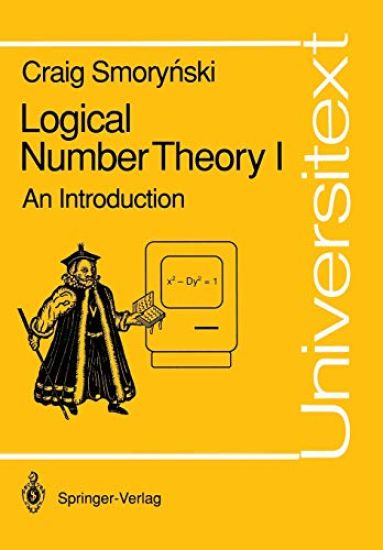
Number theory as studied by the logician is the subject matter of the book. This first volume can stand on its own as a somewhat unorthodox introduction to mathematical logic for undergraduates, dealing with the usual introductory material: recursion theory, first-order logic, completeness, incompleteness, and undecidability. In addition, its second chapter contains the most complete logical discussion of Diophantine Decision Problems available anywhere, taking the reader right up to the frontiers of research (yet remaining accessible to the undergraduate). The first and third chapters also offer greater depth and breadth in logico-arithmetical matters than can be found in existing logic texts. Each chapter contains numerous exercises, historical and other comments aimed at developing the student's perspective on the subject, and a partially annotated bibliography.