Kirjojen hintavertailu. Mukana 11 529 224 kirjaa ja 12 kauppaa.

Kirjahaku

Etsi kirjoja tekijän nimen, kirjan nimen tai ISBN:n perusteella.

3 kirjaa tekijältä Craufurd D. Goodwin

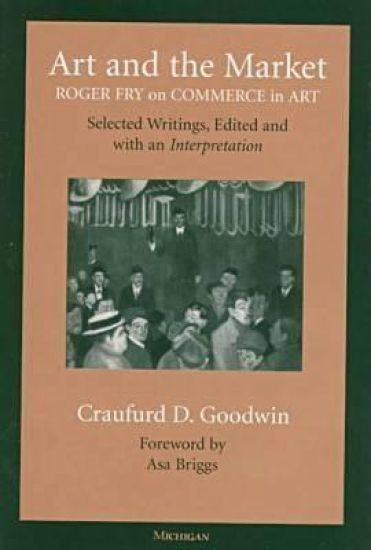
Art and the Market

Art and the Market

Craufurd D. Goodwin

The University of Michigan Press
1998
sidottu
Roger Fry, a core member of the Bloomsbury Group, was involved with all aspects of the art market as artist, critic, curator, historian, journalist, advisor to collectors, and gallery operator. He is especially remembered as the person who introduced postimpressionist art to Britain. Reprinted in this volume are seventeen of Fry's works on commerce in art. Although he had no formal training in economics, Fry addressed the art market as a modern economist might do. It is therefore fitting that his writings receive here an original interpretation from the perspective of a modern economist, Craufurd D. Goodwin. Goodwin explores why Fry's work is both a landmark in the history of cross-disciplinary thought and a source of fresh insights into a wide range of current policy questions. The new writings included contain Fry's most important contributions to theory, history, and debates over policy as he explored the determinants of the supply of art, the demand for art, and the art market institutions that facilitate exchange. His ideas and speculations are as stimulating and provocative today as when they were written."A fascinating selection of essays by one of the twentieth century's most thoughtful and stimulating critics. Goodwin's introduction sets the stage beautifully, providing useful links to Veblen and Keynes." --D. E. Moggridge, University of Toronto"Art and the Market uncovers new connections between aesthetics and art in the Bloomsbury Group. . . . Goodwin adds significantly to the understanding of cultural economics in the work of Fry himself as well as J. M. Keynes and even Leonard and Virginia Woolf." --S. P. Rosenbaum, University of Toronto"All those interested in the arts and economics, and their connections, will be delighted by this collection, as will be students of Bloomsbury." --Peter Stansky, Stanford UniversityCraufurd D. Goodwin is James B. Duke Professor of Economics, Duke University.
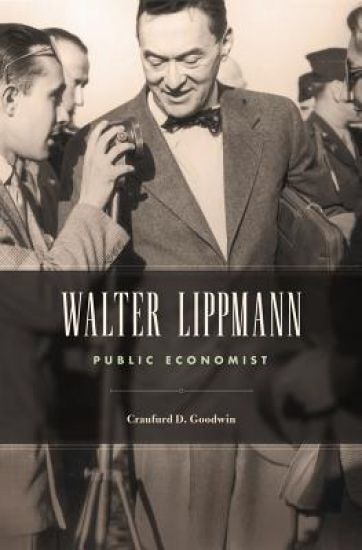
Walter Lippmann

Walter Lippmann

Craufurd D. Goodwin

Harvard University Press
2014
sidottu
Walter Lippmann was the most distinguished American journalist and public philosopher of the twentieth century. But he was also something more: a public economist who helped millions of ordinary citizens make sense of the most devastating economic depression in history. Craufurd Goodwin offers a new perspective from which to view this celebrated but only partly understood icon of American letters.From 1931 to 1946 Lippmann pursued a far-ranging correspondence with leading economic thinkers: John Maynard Keynes, Lionel Robbins, Friedrich Hayek, Henry Simons, Adolf Berle, Frank Taussig, and others. Sifting through their divergent views, Lippmann formed his own ideas about economic policy during the Great Depression and shared them with a vast readership in his syndicated column, Today and Tomorrow. Unemployment, monetary and fiscal policy, and the merits and drawbacks of free markets were just a few of the issues he helped explain to the public, at a time when professional economists who were also skilled at translating abstract concepts for a lay audience had yet to come on the scene.After World War II Lippmann focused on foreign affairs but revisited economic policy when he saw threats to liberal democracy. In addition to pointing out the significance of the Marshall Plan and the World Bank, he addressed the emerging challenge of inflation and what he called “the riddle of the Sphinx”: whether price stability and full employment could be achieved in an economy with strong unions.
Economics and National Security

Economics and National Security

Craufurd D. Goodwin

Duke University Press
1991
sidottu
This is an examination of the interaction between economics and national security, which explores why the area of security studies has long been neglected by economists, even though defence and wartime expenditures regularly consume large portions of government income. The contributors demonstrate that the history of the relationship between economics and national security is far richer than previously thought. As a point of departure, the authors begin with the broad question of economists' neglect of national security and proceed to develop a series of hypotheses about why economists disengaged from this important collection of policy-relevant topics. The essays examine a number of traditions in economics (classicism, neo-classicism, Marxism) as well as the ideas of individual thinkers (Pareto, Pigou, Veblen, Hitler, Rostow).