Kirjojen hintavertailu. Mukana 11 627 383 kirjaa ja 12 kauppaa.

Kirjahaku

Etsi kirjoja tekijän nimen, kirjan nimen tai ISBN:n perusteella.

5 kirjaa tekijältä Cristanne Miller

Cultures of Modernism

Cultures of Modernism

Cristanne Miller

The University of Michigan Press
2007
nidottu
Cultures of Modernism explores how the structure and location of literary communities significantly influence who writes, what they write about, and their openness to formal experimentation. These influences particularly affect women writers. Author Cristanne Miller notes striking patterns of similarity in the concerns and lives of women living in geographically distant centers of modernist production. She looks at three significant poets---the American Marianne Moore, the British expatriate Mina Loy, and the German Else Lasker-Schüler---in the context of cultural, national, and local elements to argue that location significantly affected their performances of subjectivity, gender, race, and religion. The first book of its kind, Cultures of Modernism breaks new ground while it contributes to the ongoing reconception of the modernist period."A fascinating, provocative, and genuinely original study of a 'different' modernism in poetry---namely, the Modernism of women poets."---Marjorie Perloff, Stanford University"An important and ambitious work that makes major contributions to the fields of gender studies and modernist studies, and to the study of modernist poetry."---Robin Schulze, Pennsylvania State University"Offers a welcome corrective to the unreflective critical tendency . . . to make broad claims about the historical experiences and cultural conundrums of 'women,' and particularly 'women writers.' Miller offers tour-de-force comparative readings . . . threading together the world-historical with the personal, poetics with the political, and wielding the instruments of scansion as deftly as a surgeon."---Modernism/modernity, The Official Journal of the Modernist Studies AssociationCristanne Miller is Edward H. Butler Professor of English and Chair of the English Department at the University of Buffalo, State University of New York.
Emily Dickinson

Emily Dickinson

Cristanne Miller

Harvard University Press
1989
nidottu
In this inventive work on Emily Dickinson’s poetry, Cristanne Miller traces the roots of Dickinson’s unusual, compressed, ungrammatical, and richly ambiguous style, finding them in sources as different as the New Testament and the daily patterns of women’s speech. Dickinson writes as she does both because she is steeped in the great patriarchal texts of her culture, from the Bible and hymns to Herbert’s poetry and Emerson’s prose, and because she is conscious of writing as a woman in an age and culture that assume great and serious poets are male.Miller observes that Dickinson’s language deviates from normal construction along definable and consistent lines; consequently it lends itself to the categorical analysis of an interpretive “grammar” such as the one she has constructed in this book. In order to facilitate the reading of Dickinson’s poems and to reveal the values and assumptions behind the poet’s manipulations of language, Miller examines in this grammar how specific elements of the poet’s style tend to function in various contexts. Because many, especially modernist, poets use some of the same techniques, the grammar throws light on the poetic syntax of other writers as well.In the course of her analysis, Miller draws not only on traditional historical and linguistic sources but also on current sociolinguistic studies of gender and speech and on feminist descriptions of women’s writing. Dickinson’s language, she concludes, could almost have been designed as a model for twentieth-century theories of what a women’s language might be. As a critical examination of the relationship between linguistic style and literary identity in America’s greatest woman poet, Emily Dickinson: A Poet’s Grammar provides a significant addition to feminist literary studies.
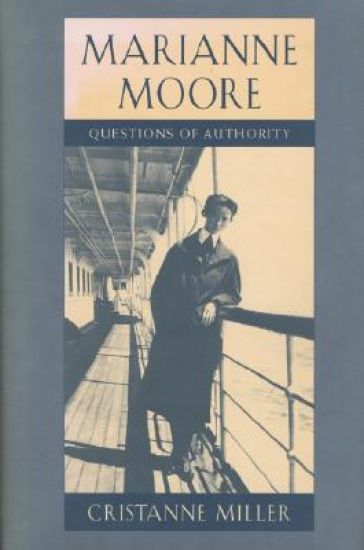
Marianne Moore

Marianne Moore

Cristanne Miller

Harvard University Press
1995
sidottu
Not confessional or autobiographical, not openly political or gender-conscious: all that Marianne Moore’s poetry is not has masked what it actually is. Cristanne Miller’s aim is to lift this mask and reveal the radically oppositional, aesthetic, and political nature of the poet’s work. A new Moore emerges from Miller’s persuasive book—one whose political engagement and artistic experiments, though not cut to the fashion of her time, point the way to an ambitious new poetic.Miller locates Moore within the historical, literary, and family environments that shaped her life and work, particularly her sense and deployment of poetic authority. She shows how feminist notions of gender prevalent during Moore’s youth are reflected in her early poetry, and tracks a shift in later poems when Moore becomes more openly didactic, more personal, and more willing to experiment with language typically regarded as feminine. Distinguishing the lack of explicit focus on gender from a lack of gender-consciousness, Miller identifies Moore as distinctly feminist in her own conception of her work, and as significantly expanding the possibilities for indirect political discourse in the lyric poem. Miller’s readings also reveal Moore’s frequent and pointed critiques of culturally determined power relationships, those involving race and nationality as well as gender.Making new use of unpublished correspondence and employing close interpretive readings of important poems, Miller revises and expands our understanding of Marianne Moore. And her work links Moore—in her radically innovative reactions to dominant constructions of authority—with a surprisingly wide range of late twentieth-century women poets.
Reading in Time

Reading in Time

Cristanne Miller

University of Massachusetts Press
2012
nidottu
This book provides new information about Emily Dickinson as a writer and new ways of situating this poet in relation to nineteenth-century literary culture, examining how we read her poetry and how she was reading the poetry of her own day. Cristanne Miller argues both that Dickinson’s poetry is formally far closer to the verse of her day than generally imagined and that Dickinson wrote, circulated, and retained poems differently before and after 1865. Many current conceptions of Dickinson are based on her late poetic practice. Such conceptions, Miller contends, are inaccurate for the time when she wrote the great majority of her poems. Before 1865, Dickinson at least ambivalently considered publication, circulated relatively few poems, and saved almost everything she wrote in organised booklets. After this date, she wrote far fewer poems, circulated many poems without retaining them, and took less interest in formally preserving her work. Yet, Miller argues, even when circulating relatively few poems, Dickinson was vitally engaged with the literary and political culture of her day and, in effect, wrote to her contemporaries. Unlike previous accounts placing Dickinson in her era, Reading in Time demonstrates the extent to which formal properties of her poems borrow from the short-lined verse she read in schoolbooks, periodicals, and single-authored volumes. Miller presents Dickinson’s writing in relation to contemporary experiments with the lyric, the ballad, and free verse, explores her responses to American Orientalism, presents the dramatic lyric as one of her preferred modes for responding to the Civil War, and gives us new ways to understand the patterns of her composition and practice of poetry.