Kirjojen hintavertailu. Mukana 11 717 486 kirjaa ja 12 kauppaa.

Kirjahaku

Etsi kirjoja tekijän nimen, kirjan nimen tai ISBN:n perusteella.

5 kirjaa tekijältä Csaba Nikolenyi

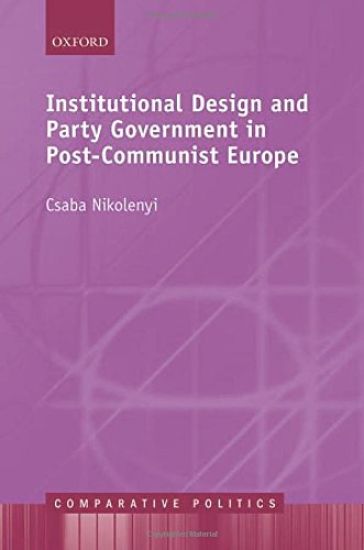
Institutional Design and Party Government in Post-Communist Europe
This books examines the institutional foundations of coalition government in the ten post-communist democracies of Eastern and Central Europe for the 1990-2010 period: Bulgaria, the Czech Republic, Estonia, Hungary, Latvia, Lithuania, Poland, Romania, Slovakia, and Slovenia. Its central argument is that differences in the arrangement of political institutions systematically explain variations in patterns of multi-party government across these states. The book starts with the premise that electoral systems and constitutional provisions about the powers, the structure, and the relationship between parliament and the presidency determine the degree to which political power is dispersed or concentrated in the political system. On the basis of these institutional features, three groups of states are distinguished with regard to their degree of power concentration; the substantive chapters of the book demonstrate how these institutional combinations and differences shape three specific facets of party government which capture the main stages of the lifecycle of coalitions governments: the formation of electoral coalitions, government formation and government duration. Specifically, three comparative chapters assess the impact of institutional power concentration on the size of electoral coalitions; the likelihood that political parties form a minority government; and the number of days that a government lasts in office. The main finding of the book is that power concentration matters: political parties in those democracies where institutions are designed to concentrate political power tend to form large electoral coalitions, they tend to form majority rather than undersized governments, and they build more durable cabinets. In addition, the book contains a detailed case study of government formation in Hungary and a previously unstudied comparison of indirect presidential elections in four states: the Czech Republic, Estonia, Hungary and Latvia. Comparative Politics is a series for students, teachers, and researchers of political science that deals with contemporary government and politics. Global in scope, books in the series are characterised by a stress on comparative analysis and strong methodological rigour. The series is published in association with the European Consortium for Political Research. For more information visit: www.ecprnet.eu.
Minority Governments in India

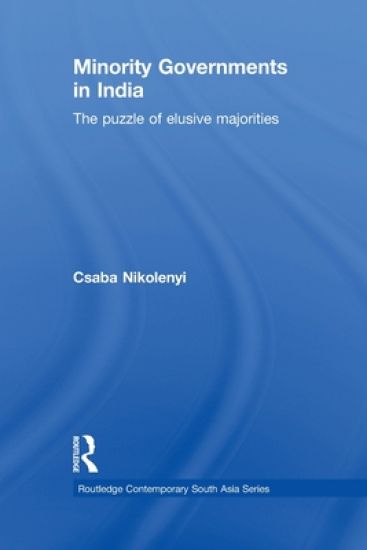
Minority Governments in India

Csaba Nikolenyi

Routledge
2012
nidottu
India's national parliamentary elections typically result in the election of majority parliaments and the formation of a single-party majority government. However, India’s national party system has changed beyond recognition since the parliamentary elections of 1989. The Congress Party has lost its dominant party status; the number of political parties that contest elections, win seats in parliament and gain cabinet portfolios have increased; minority governments and cabinet instability have become regular features of parliamentary politics. This book addresses each of these aspects of party system transformation in India by applying the analytical techniques of rational and social choice theory. Challenging conventional wisdom, the book argues that the number of parties in India has increased as a result of the unexpected consequences of the constitutional amendment of 1985 that was conceived to curtail party defections. Although the Congress Party no longer dominates the new multi-party system, it still retains a pivotal role in deciding which coalitions may form viable and stable minority government. The Indian case study is theoretically driven and it is readily comparable with other parliamentary federations where minority governments are often formed, such as Canada, and the book finds that these processes are also present in the sub-national party systems of the states, however, with greater variation.
Minority Governments in India

Minority Governments in India

Csaba Nikolenyi

Routledge
2009
sidottu
India's national parliamentary elections typically result in the election of majority parliaments and the formation of a single-party majority government. However, India’s national party system has changed beyond recognition since the parliamentary elections of 1989. The Congress Party has lost its dominant party status; the number of political parties that contest elections, win seats in parliament and gain cabinet portfolios have increased; minority governments and cabinet instability have become regular features of parliamentary politics. This book addresses each of these aspects of party system transformation in India by applying the analytical techniques of rational and social choice theory. Challenging conventional wisdom, the book argues that the number of parties in India has increased as a result of the unexpected consequences of the constitutional amendment of 1985 that was conceived to curtail party defections. Although the Congress Party no longer dominates the new multi-party system, it still retains a pivotal role in deciding which coalitions may form viable and stable minority government. The Indian case study is theoretically driven and it is readily comparable with other parliamentary federations where minority governments are often formed, such as Canada, and the book finds that these processes are also present in the sub-national party systems of the states, however, with greater variation.
Party Switching in Israel

Party Switching in Israel

Csaba Nikolenyi

STATE UNIVERSITY OF NEW YORK PRESS
2023
pokkari
Analyzes the history of legislative party switching and its regulation in the Israeli Knesset.This is the first book about the politics of party switching, or floor crossing, better known as "kalanterism" in Israeli politics. The Israeli parliament adopted legislation in 1991 that imposed penalties on parliamentary defectors. However, as the book documents, the effect of this legislation was extremely puzzling: the frequency of party switches has increased over time, and most switches have taken the form of party splits making Israeli legislative parties increasingly less cohesive and united. Building on evidence from parliamentary debates, committee records and contemporary journalistic accounts, author Csaba Nikolenyi shows that notwithstanding these unexpected consequences, the Israeli anti-defection legislation proved to be an important tool that governments could use to divide their opposition and shore up their often fragile parliamentary base of support.
Party Switching in Israel

Party Switching in Israel

Csaba Nikolenyi

STATE UNIVERSITY OF NEW YORK PRESS
2023
sidottu
Analyzes the history of legislative party switching and its regulation in the Israeli Knesset.This is the first book about the politics of party switching, or floor crossing, better known as "kalanterism" in Israeli politics. The Israeli parliament adopted legislation in 1991 that imposed penalties on parliamentary defectors. However, as the book documents, the effect of this legislation was extremely puzzling: the frequency of party switches has increased over time, and most switches have taken the form of party splits making Israeli legislative parties increasingly less cohesive and united. Building on evidence from parliamentary debates, committee records and contemporary journalistic accounts, author Csaba Nikolenyi shows that notwithstanding these unexpected consequences, the Israeli anti-defection legislation proved to be an important tool that governments could use to divide their opposition and shore up their often fragile parliamentary base of support.