The Adventures of Mr. Verdant Green is a novel by Cuthbert M. Bede, a pseudonym of Edward Bradley (1827-1889). It covers the exploits of Mr Verdant Green a first year undergraduate at Oxford University. Different editions have varying titles, including Mr Verdant Green: Adventures of an Oxford Freshman. The same characters reappear in a sequel entitled Little Mr Bouncer and his friend Verdant Green. Background: The work was first published in three separate parts, in soft covers, by James Blackwood, during the 1850s (1853, 1854 and 1857). Notices in early copies of the book indicate that they were first intended for sale at railway stations, for reading whilst travelling. Bradley himself had attended University College, Durham (whence his pseudonym), graduating BA in 1848, but then went to Oxford for a year or so, studying to enter the church. Though Bradley's Verdant Green has become something of a cult book about Oxford, he had previously produced a series of pen and ink drawings entitled 'Ye freshmonne his adventures at University College, Durham'. He altered the setting on the advice of Mark Lemon at Punch. Drawings of 'Durham Student Life' survive in College Life published in Oxford, Cambridge and Durham in 1850. These drawings were much admired by masters like George Cruikshank and John Leech. Hippolyte Taine in his Notes sur l'Angleterre (1872) drew on Bradley's 'Oxford' book for his description of English university life. It seems not to be widely known that no fewer than nine chapters of Part III are devoted to Verdant Green's visit to Northumberland. On the way he passes through Darlington. 'After mentioning Durham Cathedral and Lord Durham's monument on Penshaw Hill, Verdant Green and his party then pass over Robert Stephenson's (recently completed) High Level Bridge at Newcastle. The location of 'Honeywood Hall' is not traced but the guests visit Warkworth, Alnwick, and Chillingham Castle to see the wild cattle. There is also a trip to Bamburgh and the Longstones light to talk to Grace Darling's father. Verdant eventually gets married here. Bradley clearly knew the area well and paints an attractive picture of the wild landscape and the pleasures of riding, al fresco meals and neighbourly contact, the warmer for being more difficult than in crowded Midland counties. Much amusement is had with local dialect and customs, but it is not condescending and the laugh is usually on Verdant Green.............. Edward Bradley (25 March 1827 - 12 December 1889) was an English clergyman and novelist. He was born in Kidderminster and educated at Durham University from which he took his pen name Cuthbert M. Bede, B.A. His most popular book was The Adventures of Mr. Verdant Green, on the experiences of an Oxford undergraduate. There was a sequel, Little Mr Bouncer and his friend Verdant Green. Tales of College Life (often bound with it), introduces the character of Mr Affable Canary. The celebrated illustrations to the Verdant Green books were the work of the author. Life: He was the second son of Thomas Bradley, surgeon of Kidderminster, who came of a somewhat ancient Worcestershire and clerical family. He was born on 25 March 1827. A brother, Thomas Waldron Bradley, was author of two novels, Grantley Grange (1874) and Nelly Hamilton (1875), while an uncle, William Bradley of Leamington, wrote Sketches of the Poor by a retired Guardian. After education at the Kidderminster grammar school, Bradley went up in 1845 to University College, Durham, where he was a Thorp and foundation scholar. He graduated B.A. in 1848, and took his licentiateship of theology in 1849. Not being of age to take orders, he appears to have stayed a year at Oxford, pursuing various studies, though he never matriculated, and while there he formed a lifelong friendship with John George Wood.............
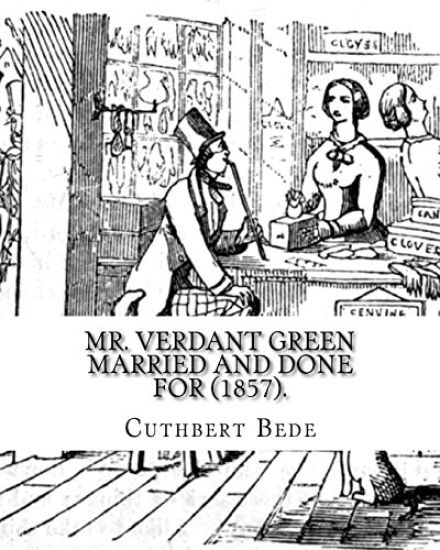
Part III of The Adventures of Mr. Verdant Green. Arguably a cult college classic; not the least of it's charms being the excellent illustrations by the author-a contributor to Punch (magazine), among others, and highly regarded as an illustrator by such contemporaries as George Cruikshank.... Edward Bradley (25 March 1827 - 12 December 1889) was an English clergyman and novelist. He was born in Kidderminster and educated at Durham University from which he took his pen name Cuthbert M. Bede, B.A. His most popular book was The Adventures of Mr. Verdant Green, on the experiences of an Oxford undergraduate. There was a sequel, Little Mr Bouncer and his friend Verdant Green. Tales of College Life (often bound with it), introduces the character of Mr Affable Canary. The celebrated illustrations to the Verdant Green books were the work of the author. Life: He was the second son of Thomas Bradley, surgeon of Kidderminster, who came of a somewhat ancient Worcestershire and clerical family. He was born on 25 March 1827. A brother, Thomas Waldron Bradley, was author of two novels, Grantley Grange (1874) and Nelly Hamilton (1875), while an uncle, William Bradley of Leamington, wrote Sketches of the Poor by a retired Guardian. After education at the Kidderminster grammar school, Bradley went up in 1845 to University College, Durham, where he was a Thorp and foundation scholar. He graduated B.A. in 1848, and took his licentiateship of theology in 1849. Not being of age to take orders, he appears to have stayed a year at Oxford, pursuing various studies, though he never matriculated, and while there he formed a lifelong friendship with John George Wood. For a year or so he worked in the clergy schools at Kidderminster. In 1850, he was ordained by the bishop of Ely (Turton) to the curacy of Glatton-with-Holme, Huntingdonshire. He remained there over four years, during which he described for the Illustrated London News the extensive work of draining Whittlesey Mere, then being carried out by William Wells of Holmewood. In 1857, Bradley was appointed vicar of Bobbington in Staffordshire. From 1859 to 1871, he was rector of Denton-with-Caldecote, Huntingdonshire. In 1871, he became rector of Stretton, Rutland, where he carried through a much-needed restoration of the church, at a cost of nearly 2,000. To raise the funds he gave lectures in the midland towns, and was much in demand as an authority upon Modern Humourists, Wit and Humour, and Light Literature. Bradley was a friend and associate of George Cruikshank, Frank Smedley, Mark Lemon, and Albert Smith (for whose serials, The Month, The Man in the Moon, and The Town and Country Miscellany, he began to write about 1850). He generally wrote for the press under the pseudonym of Cuthbert Bede, the names of the two patron saints of Durham. His one marked literary success was obtained in 1853, when he produced The Adventures of Mr. Verdant Green, an Oxford Freshman. With numerous illustrations designed and drawn on the wood by the author. Bradley had the greatest difficulty in finding a publisher, but part i. was eventually issued by Nathaniel Cooke of the Strand as one of his shilling Books for the Rail in October 1853. Part ii. appeared in 1854, and part iii. in 1856. The three parts were then bound in one volume, of which one hundred thousand copies had been sold by 1870; subsequently the book was issued in a sixpenny form, and the sale was more than doubled. The total amount that Bradley received for his work was 350. The three original parts are now scarce, and fetched over five guineas in 1890.................
Experience the uproarious world of Oxford University in Cuthbert Bede's classic "The Adventures of Mr. Verdant Green, Vols. 1 to 3." First published in the 19th century, this humorous fiction offers a delightful glimpse into student life and college life at one of the world's most prestigious universities. Follow the misadventures and coming-of-age experiences of a young man navigating the social scene and academic pressures of Oxford. Bede's charming storytelling and witty observations create a timeless portrayal of university life. This edition brings together the first three volumes of the "Mr. Verdant Green" series, allowing readers to fully immerse themselves in the vibrant atmosphere and memorable characters of this beloved work of humorous fiction. A delightful read for anyone interested in historical fiction, student life, and the enduring power of a good laugh. This meticulously prepared edition preserves the original charm and wit of Cuthbert Bede's beloved classic.This work has been selected by scholars as being culturally important, and is part of the knowledge base of civilization as we know it.This work is in the public domain in the United States of America, and possibly other nations. Within the United States, you may freely copy and distribute this work, as no entity (individual or corporate) has a copyright on the body of the work.Scholars believe, and we concur, that this work is important enough to be preserved, reproduced, and made generally available to the public. We appreciate your support of the preservation process, and thank you for being an important part of keeping this knowledge alive and relevant.
Experience the uproarious world of Oxford University in Cuthbert Bede's classic "The Adventures of Mr. Verdant Green, Vols. 1 to 3." First published in the 19th century, this humorous fiction offers a delightful glimpse into student life and college life at one of the world's most prestigious universities. Follow the misadventures and coming-of-age experiences of a young man navigating the social scene and academic pressures of Oxford. Bede's charming storytelling and witty observations create a timeless portrayal of university life. This edition brings together the first three volumes of the "Mr. Verdant Green" series, allowing readers to fully immerse themselves in the vibrant atmosphere and memorable characters of this beloved work of humorous fiction. A delightful read for anyone interested in historical fiction, student life, and the enduring power of a good laugh. This meticulously prepared edition preserves the original charm and wit of Cuthbert Bede's beloved classic.This work has been selected by scholars as being culturally important, and is part of the knowledge base of civilization as we know it.This work is in the public domain in the United States of America, and possibly other nations. Within the United States, you may freely copy and distribute this work, as no entity (individual or corporate) has a copyright on the body of the work.Scholars believe, and we concur, that this work is important enough to be preserved, reproduced, and made generally available to the public. We appreciate your support of the preservation process, and thank you for being an important part of keeping this knowledge alive and relevant.

![The Adventures of Mr. Verdant Green, by Cuthbert Bede, B.A. [Pseud.] With Nearly Two Hundred Humorous Illus. by the Author.](/covers/9781425534271.jpg)