Kirjojen hintavertailu. Mukana 12 093 934 kirjaa ja 12 kauppaa.

Kirjahaku

Etsi kirjoja tekijän nimen, kirjan nimen tai ISBN:n perusteella.

10 kirjaa tekijältä Cynthia Cruz

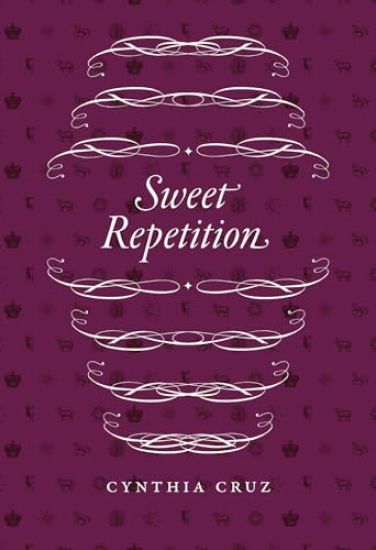
Sweet Repetition

Sweet Repetition

Cynthia Cruz

THE UNIVERSITY OF CHICAGO PRESS
2025
nidottu
Poetry that centers its movement on repetition—orbiting, unwinding, and returning. Integrating Lacanian and Freudian psychoanalysis, continental philosophy, and the works of other poets, this collection explores narrative through abstraction and considers how repetition holds both the power to constrain and to generate. Freud explains how what we repress—what we know but don’t want to acknowledge—reappears in our actions through repetition. Through slips of the tongue or selective memory, we engage with what our unconscious knows, finding knowledge through unknowing. The psychoanalytic session is centered on bringing forth repressed knowledge through acts of unknowing—speaking without thinking—which brings one closer to recognizing an obscured desire. The poetry of Sweet Repetition works in ways akin to the psychoanalytic act. These pulsing poems follow the definitions of the word revolution—to revolve, change direction, unroll, unwind, happen again, repeat, orbit around. Images and words reappear in the motion of Cynthia Cruz’s poems, inviting us into their revolutionary, political, and cumulative effects.
Disquieting

Disquieting

Cynthia Cruz

Book*hug
2019
pokkari
How do our bodies speak for us when words don?t suffice? How can we make ourselves understood when what we have to say is inarticulable?In Disquieting, Cynthia Cruz tarries with others who have provided examples of how to ?turn away,? or reject the ideologies of contemporary Neoliberal culture. These essays inhabit connections between silence, refusal, anorexia, mental illness, and Neoliberalism. Cruz also explores the experience of being working-class and poor in contemporary culture, and how those who are silenced often turn to forms of disquietude that value open-endedness, complexity, and difficulty.Disquieting: Essays on Silence draws on philosophy, theory, art, film, and literature to offer alternative ways of being in this world and possibilities for building a new one.
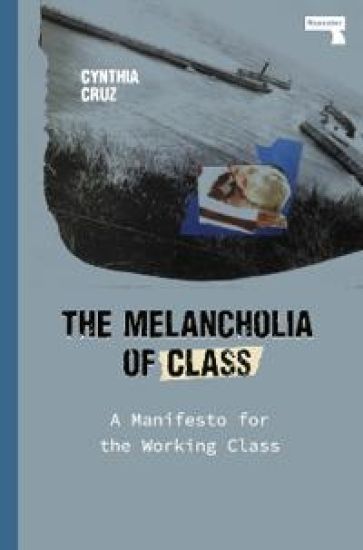
The Melancholia of Class

The Melancholia of Class

Cynthia Cruz

Repeater Books
2021
nidottu
To be working-class in a middle-class world is to be a ghost. Excluded, marginalised, and subjected to violence, the working class is also deemed by those in power to not exist. We are left with a choice between assimilation into middle-class values and culture, leaving our working-class origins behind, or total annihilation. In The Melancholia of Class, Cynthia Cruz analyses how this choice between assimilation or annihilation has played out in the lives of working-class musicians, artists, writers, and filmmakers — including Amy Winehouse, Ian Curtis, Jason Molina, Barbara Loden, and many more — and the resultant Freudian melancholia that ensues when the working-class subject leaves their origins to “become someone,” only to find that they lose themselves in the process. Part memoir, part cultural theory, and part polemic, The Melancholia of Class shows us how we can resist assimilation, uplifting and carrying our working-class origins and communities with us, as we break the barriers of the middle-class world. There are so many of us, all of us waiting. If we came together, who knows what we could do.
Becoming Nothing: The Death Drive and the Working Class
A striking cultural and philosophical study of working-class artists and the resilience of radical survival. Becoming Nothing is an exploration of the concept of negative freedom and the working class. Originating from German idealism, negative freedom the ability to say no to everything outside of one's self. This can take the form of withdrawing from capitalist society, but can also include addiction, self-harm and crime. Although often self-destructive, even at times resulting in death, these forms of negative freedom can also provide a temporary escape from capitalist reality. Analysing the work of working-class writers, musicians and film-makers -- including the Fall, Jean Genet, Marguerite Duras, Don DeLillo, Lynne Ramsay and David Wojnarowicz -- Becoming Nothing shows how these artists' engagement with negative freedom can provide the working-class subject with a means of cleaving themselves from a society they don't feel at home in, while at the same time creating an alternative space, a home, within which to survive, and perhaps even dream.
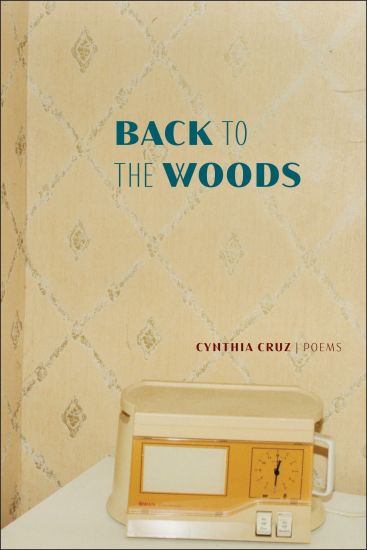
Back to the Woods

Back to the Woods

Cynthia Cruz

Four Way Books
2023
nidottu
National Book Critics Circle Award Winner Cynthia Cruz reevaluates the paradox of the death drive in her eighth collection of poetry, Back to the Woods. Could it be that in ceaselessly snuffing ourselves out we are, in fact, trying to survive? In "Shine," Cruz's speaker attests that "if she] had a home, it would be // a still in a film / where the sound / got jammed." This book inhabits the silence of the empty orchestra pit, facing "dread, and its many / instruments of sorrow." The quiet asks, "Did you love this world / and did this world / not love you?" We return to the site of our suffering, we perform the symphony of all our old injuries, to master what has broken us. To make possible the future, we retreat into the past. "I don't know / the ending. // I don't know anything," our speaker insists, but she follows the wind's off-kilter song of "winter / in the pines" and "the dissonance / of siskins." Cruz heeds the urgency of our wandering, the mandate that we must get back to the woods, not simply for the forest to devour us -- she recognizes in the oblivion "flooding out / from its spiral branches" an impossible promise. At the tree line, we might vanish to begin again.
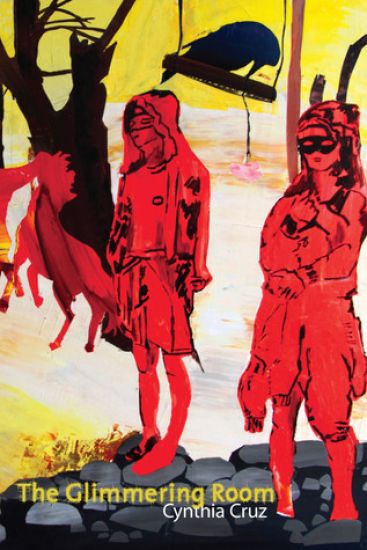
The Glimmering Room

The Glimmering Room

Cynthia Cruz

Four Way Books
2012
nidottu
Fierce and fearless, The Glimmering Room beckons readers down into the young speaker's dark underworld, and because we are seduced by Cruz's startling imagery and language rich with "Death's outrageous music," we follow willingly. Peopled with "ambassadors from the Netherworld"--the orphaned and abused, the lost and addicted--Cruz leads us through this "traveling minstrel show / Called girlhood--" which is at once tragic and magical.
Dregs

Dregs

Cynthia Cruz

Four Way Books
2018
nidottu
Like a series of slides from a film reel, the poems of Dregs reveal the ruin, remnants or dregs left over from the wars and economic and human inequalities of our world today. Praise for The Glimmering Room: ..".an exquisite fever dream of drugs, anorexia and unwanted sex (in both senses of the word) populated by young women and men...who have lost all sense of where the edge is...." --Dana Jennings, New York Times
Guidebooks for the Dead

Guidebooks for the Dead

Cynthia Cruz

Four Way Books
2020
nidottu
In Guidebooks for the Dead, Cynthia Cruz returns to a familiar literary landscape in which a cast of extraordinary women struggle to create amidst violence, addiction and poverty. For Marguerite Duras, evoked here in a collage of poems, the process of renaming herself is a "Quiet death," a renewal she envisions as vital to her evolution. In "Duras (The Flock)," she is "high priestess" to an imagined assemblage of women writers for whom the word is sustenance and weapon, "tiny pills or bullets, each one packed with memory, packed with a multitude of meaning." Joining them is the book's speaker, an "I" who steps forward to declare her rightful place among "these ladies with smeared lipstick and torn hosiery. . . this parade of wrong voices." Guidebooks for the Dead is both homage to these women and a manifesto for how to survive in a world that seeks to silence those who resist.
Steady Diet of Nothing

Steady Diet of Nothing

Cynthia Cruz

Four Way Books
2023
nidottu
In this stunning novel, Cynthia Cruz administers an IV drip of capitalist entropy that keeps us rapt: Steady Diet of Nothing compels readers to consume it in one headlong sitting. Charting the dissolution of an adolescent runaway community, the book follows a teenage girl, Candy, after her arrival at the Blue House -- an abandoned home inhabited by other children seeking shelter from the world. Here, she falls in love with Toby, a boy from elsewhere whose companionship interrupts the perpetual alienation of the status quo. "He didn't explain, but I knew," Candy says. "I knew as soon as he'd started talking, that we'd come from the same place." Beyond their den's walls, the market reigns, and the societal structure of infinite calculation and infinite exchange has rendered contemporary life meaningless. As Toby and Candy separately descend into drug addiction and prostitution, they find their efforts to defy the American economic superstructure futile, and Candy, again, is alone. "I'm going to die in here, I say, to no one." The transcription of a mute prayer, Steady Diet of Nothing is a stark, vital work that requires our attention. "I'm awake or else I'm dreaming," Candy narrates. "There's a knock on the door. The phone rings forever but I can't put the receiver down." It keeps the line open as long as it can.