Kirjojen hintavertailu. Mukana 11 244 527 kirjaa ja 12 kauppaa.

Kirjahaku

Etsi kirjoja tekijän nimen, kirjan nimen tai ISBN:n perusteella.

7 kirjaa tekijältä D. W. Hamlyn

Metaphysics

Metaphysics

D. W. Hamlyn

Cambridge University Press
1984
pokkari
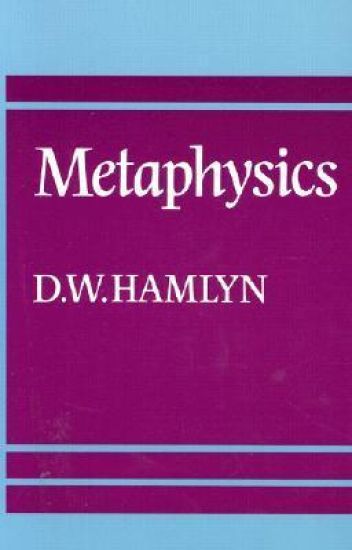
This book provides an introduction to metaphysics. At the outset Professor Hamlyn distinguishes two conceptions of metaphysics running through the history of the subject. One, which goes back to Aristotle, is concerned with ontology, and with what has to exist for beings such as we are; the other separates appearance and reality and attempts to establish what really exists. Professor Hamlyn’s account of metaphysics conforms with the first tradition. This is not, however, primarily a historical exposition. The discussion concentrates on central metaphysical concepts and problems, including the principles of ontology, substance, particulars and universals, monism and pluralism, space and time, minds, selves and personal identity. Throughout, Professor Hamlyn’s thoroughly informed and argued consideration of the topics presents both a persuasive view of the subject and an excellent grounding in it.
Perception, Learning and the Self

Perception, Learning and the Self

D. W. Hamlyn

TAYLOR FRANCIS LTD
2022
sidottu
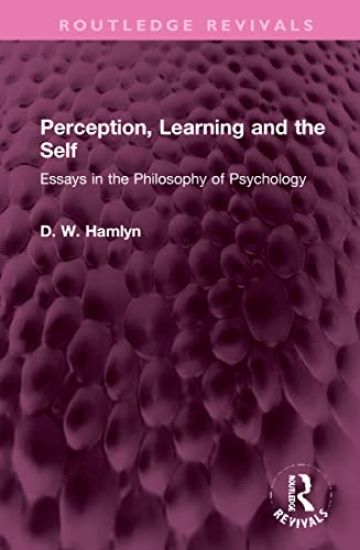
First published in 1983, Perception, Learning and the Self is a collection of essays demonstrating the incompleteness of the information-processing model in cognitive psychology and the connection between epistemic factors and social conditions in the making of the self. It is suggested that any framework employed to view cognition must be an essentially social one, in which knowers are seen as selves who are agents with feelings and attitudes. Professor Hamlyn argues that, by failing to acknowledge this social element, the information-processing model presents an overly simplistic view of the systems that underlie cognition, and thus is liable to distort what is at stake. Professor Hamlyn considers the contributions of a number of major psychologists to this area of study, including James Gibson, Jean Piaget and Sigmund Freud. This book will be of interest to students of philosophy and psychology.
Perception, Learning and the Self

Perception, Learning and the Self

D. W. Hamlyn

TAYLOR FRANCIS LTD
2024
nidottu
First published in 1983, Perception, Learning and the Self is a collection of essays demonstrating the incompleteness of the information-processing model in cognitive psychology and the connection between epistemic factors and social conditions in the making of the self. It is suggested that any framework employed to view cognition must be an essentially social one, in which knowers are seen as selves who are agents with feelings and attitudes. Professor Hamlyn argues that, by failing to acknowledge this social element, the information-processing model presents an overly simplistic view of the systems that underlie cognition, and thus is liable to distort what is at stake. Professor Hamlyn considers the contributions of a number of major psychologists to this area of study, including James Gibson, Jean Piaget and Sigmund Freud. This book will be of interest to students of philosophy and psychology.
Sensation and Perception

Sensation and Perception

D. W. Hamlyn

TAYLOR FRANCIS LTD
2022
sidottu
First published in 1961, Sensation and Perception aims to cast light upon the nature of perception itself. This, the author believes, can be achieved only through an understanding of the concepts of sensation and perception. A survey of the principal attempts to arrive at such an understanding brings out the fact that perception has most often been assimilated to sensation or judgment. The author believes that both of these views are wrong but that an attention to the history of thought can provide an explanation of the temptation to accept them. A final chapter gives the author’s own views on the nature of sensation and perception. As such it would be of interest both to philosophers and to those psychologists who are concerned with the nature of perception.
Sensation and Perception

Sensation and Perception

D. W. Hamlyn

TAYLOR FRANCIS LTD
2024
nidottu
First published in 1961, Sensation and Perception aims to cast light upon the nature of perception itself. This, the author believes, can be achieved only through an understanding of the concepts of sensation and perception. A survey of the principal attempts to arrive at such an understanding brings out the fact that perception has most often been assimilated to sensation or judgment. The author believes that both of these views are wrong but that an attention to the history of thought can provide an explanation of the temptation to accept them. A final chapter gives the author’s own views on the nature of sensation and perception. As such it would be of interest both to philosophers and to those psychologists who are concerned with the nature of perception.
The Psychology of Perception

The Psychology of Perception

D. W. Hamlyn

Routledge
2017
sidottu
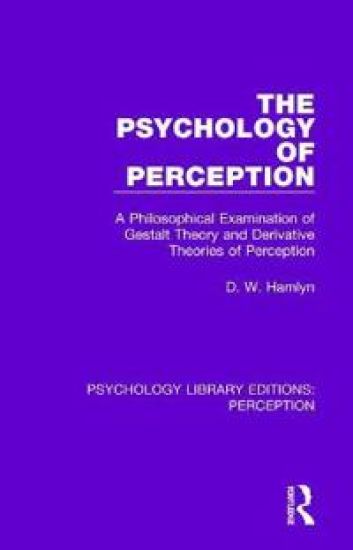
Originally published in 1957, the primary aim of this study was to shed light upon the logical character of the psychology of perception. D.W. Hamlyn begins by delimiting the field of psychological inquiry into perception, then gives a detailed account of the types of explanation appropriate in the field. He maintains that these explanations have certain important peculiarities which distinguish them from other scientific inquiries. In view of the central importance of Gestalt Theory in this field an account is given of its origins, and its main features are critically discussed. The work should still be of considerable interest to both philosophers and psychologists, as well as to all those interested in the relations between the two subjects.
The Psychology of Perception

The Psychology of Perception

D. W. Hamlyn

Routledge
2019
nidottu
Originally published in 1957, the primary aim of this study was to shed light upon the logical character of the psychology of perception. D.W. Hamlyn begins by delimiting the field of psychological inquiry into perception, then gives a detailed account of the types of explanation appropriate in the field. He maintains that these explanations have certain important peculiarities which distinguish them from other scientific inquiries. In view of the central importance of Gestalt Theory in this field an account is given of its origins, and its main features are critically discussed. The work should still be of considerable interest to both philosophers and psychologists, as well as to all those interested in the relations between the two subjects.