Kirjojen hintavertailu. Mukana 11 244 527 kirjaa ja 12 kauppaa.

Kirjahaku

Etsi kirjoja tekijän nimen, kirjan nimen tai ISBN:n perusteella.

3 kirjaa tekijältä D. W. Harding

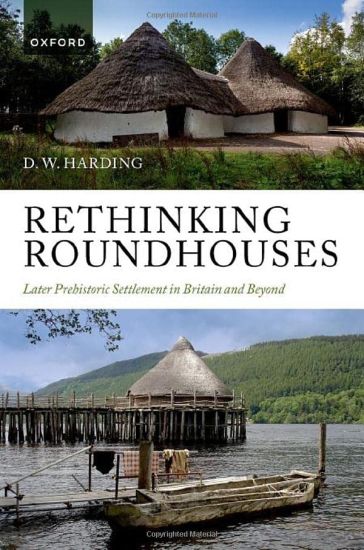
Rethinking Roundhouses

Rethinking Roundhouses

D. W. Harding

Oxford University Press
2023
sidottu
Excavated plans of roundhouses may compound multiple episodes of activity, design, construction, occupation, repair, and closure, reflecting successive stages of a building's biography. What does not survive archaeologically, through use of materials or methods that leave no tangible trace, may be as important for reconstruction as what does survive, and can only be inferred from context or comparative evidence. The great diversity in structural components suggests a greater diversity of superstructure than was implied by the classic Wessex roundhouses, including split-level roofs and penannular ridge roofs. Among the stone-built houses of the Atlantic north and west there likewise appears to have been a range of regional and chronological variants in the radial roundhouse series, and probably within the monumental Atlantic roundhouses too. Important though recognition of structural variants may be, morphological classification should not be allowed to override the social use of space for which the buildings were designed, whether their structural footprint was round or rectangular. Atlantic roundhouses reveal an important division between central space and peripheral space, and a similar division may be inferred for lowland timber roundhouses, where the surviving evidence is more ephemeral. Some larger houses were evidently byre-houses or barn houses, some with upper or mezzanine floor levels, in which livestock might be brought in or agricultural produce stored. Such 'great houses' doubtless served community needs beyond those of the resident extended family. The massively-increased scale of development-led excavations of recent years has resulted in an increased database that enables evaluation of individual sites in a wider landscape environment than was previously possible. Circumstances of recovery and recording in commercially-driven excavations, however, are not always compatible with research objectives, and the undoubted improvements in standards of environmental investigation are sometimes offset by shortcomings in the publication of basic structural or stratigraphic detail.
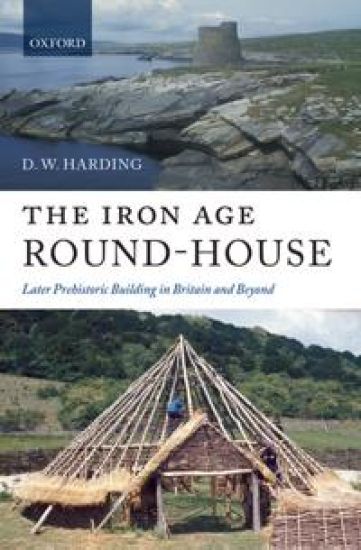
The Iron Age Round-House

The Iron Age Round-House

D. W. Harding

Oxford University Press
2009
sidottu
In contrast to Continental Europe, where the Iron Age is abundantly represented by funerary remains as well as by hill-forts and major centres, the British Iron Age is mainly represented by its settlement sites, and especially by houses of circular ground-plan, apparently in marked contrast to the Central and Northern European tradition of rectangular houses. In lowland Britain the evidence for timber round-houses comprises the footprint of post-holes or foundation trenches; in the Atlantic north and west, the remains of monumental stone-built houses survive as upstanding ruins, testimony to the building skills of Iron Age engineers and masons. D. W. Harding's fully illustrated study explores not just the architectural aspects of round-houses, but more importantly their role in the social, economic and ritual structure of their communities, and their significance as symbols of Iron Age society in the face of Romanization.
Words into Rhythm

Words into Rhythm

D. W. Harding

Cambridge University Press
2010
pokkari
Critics take for granted the importance of rhythm in poetry and prose, above all its capacity for suggesting states of mind, especially emotional states. But they are seldom clear what range of effects rhythm can reasonably be credited with, nor even, at times, what exactly the term refers to. Professor Harding here views these and allied problems from a psychological standpoint. Rhythm as a means of suggesting states of mind is discussed in the light of its being not merely something the reader listens to, but something he does, a system of movement. Throughout the book, the realities of spoken language take precedence of prosodic fictions, and emphasis is placed on the poet's organization of speech rhythms within a line of verse, metrical or free. Poetry and prose from the fifteenth to the twentieth century provide passages for illustration and analysis.